
Generative AI has crossed the experimentation phase for most large organizations. The real question is no longer whether AI works, but whether it works safely, accurately, and at enterprise scale. Public large language models are powerful, but they do not understand your policies, your contracts, your data models, or your institutional knowledge. That gap is exactly where enterprise RAG solutions step in.
Retrieval-Augmented Generation, or RAG, is quickly becoming the foundation for trustworthy GenAI copilots inside enterprises. It allows organizations to combine the reasoning power of large language models with their own structured and unstructured data, without exposing sensitive information or hallucinating answers. When implemented correctly, RAG changes GenAI from a novelty into a reliable business system.
This blog explores how enterprise RAG solutions enable GenAI copilots built on company knowledge, why they outperform generic chatbots, and how they fit into a broader AI roadmap for enterprises. We will also examine how RAG-powered copilots unlock value across customer experience, operations, revenue, and HR, all while relying on modern AI and data solutions for businesses.
Public GenAI models do not know your data. They cannot see your internal documentation, transaction history, CRM records, or operational metrics unless you explicitly upload them. Even then, governance becomes a concern. Data leakage, compliance violations, and lack of auditability stop pilots from reaching production.
Hallucinations are another major issue. When a model does not know an answer, it guesses. In consumer use cases, that is annoying. In enterprise environments, it is dangerous. A wrong policy interpretation, an inaccurate financial explanation, or an incorrect HR guideline can have real consequences. This is why many AI initiatives stall after proof-of-concept. Enterprises need AI systems that reason with their data, not around it.
First, they retrieve relevant enterprise data in real time. This can include documents, databases, dashboards, logs, and APIs. Second, they augment the prompt sent to the language model with this retrieved context. The model no longer answers in isolation. It answers with evidence.
Third, they generate responses grounded in verified data sources, with traceability back to the original content. In practical terms, RAG allows a GenAI copilot to say, “Based on your Q3 revenue dashboard and the latest sales pipeline data…” instead of producing a generic answer. This architecture transforms GenAI from a creative assistant into an enterprise-grade decision support system.
What unites these copilots is their dependency on accurate, up-to-date company knowledge. Enterprise RAG solutions provide that foundation. Without RAG, copilots rely on static training data. With RAG, they operate on living systems.
Once data pipelines are modernized and unified, enterprises can introduce advanced analytics and machine learning. Predictive analytics solutions help forecast demand, detect churn, and optimize resources.
RAG fits naturally at the next stage. It acts as the bridge between analytical systems and human decision-makers. Instead of dashboards that require interpretation, insights become conversational, contextual, and actionable. This progression ensures that GenAI investments build on solid ground rather than sitting on top of fragmented data.
According to Gartner, organizations that enable real-time analytics can improve operational decision-making speed by 50%. When RAG systems tap into real-time pipelines, GenAI copilots deliver insights that match the pace of the business. This capability is especially important for customer-facing and operational use cases, where timing directly impacts outcomes.
They access customer profiles, interaction history, product documentation, and policies in real time. An agent does not just see a suggested reply. They see a response grounded in the customer’s contract, recent tickets, and current service status.
McKinsey reports that AI-driven CX improvements can increase customer satisfaction scores by 20% while reducing handling time. RAG plays a key role by ensuring answers are accurate and personalized. Customers notice the difference. Responses feel informed, not automated.
The RAG system retrieves model outputs, assumptions, and historical trends. The GenAI layer explains them in natural language. This conversational access democratizes analytics. Insights are no longer limited to data science teams. Decision-makers across the organization can engage directly with forecasts and scenarios. The result is faster alignment and more confident decisions.
Instead of triggering alerts alone, a copilot can explain root causes, recommend actions, and reference past incidents. For example, when a system anomaly appears, the copilot retrieves similar historical events, resolution steps, and current system metrics. It then generates a contextual summary for engineers.
IBM reports that AI-driven automation can reduce operational costs by 30%. RAG increases this impact by reducing time spent searching for information.
AI for revenue optimization becomes more actionable when insights reference real data, not abstract models. RAG ensures that recommendations tie back to current metrics, contracts, and market conditions. According to Salesforce, organizations using AI for revenue intelligence see revenue growth rates up to 15% higher than peers. Enterprise RAG solutions help turn intelligence into daily decision support.
An HR leader might ask, “Which departments are most at risk of attrition this year?” The copilot retrieves predictive models, engagement scores, and historical turnover data. It then explains the reasoning behind the risk assessment. Deloitte research shows that organizations using advanced people analytics are 2x more likely to improve talent outcomes. RAG helps make those analytics accessible and understandable.
They enable standardized schemas, metadata management, and secure access layers. Modernized data platforms also support real-time ingestion and scalable retrieval, both essential for RAG performance. Without this foundation, GenAI copilots struggle to deliver consistent value.
Access controls ensure users only see authorized information. Sensitive data stays within enterprise boundaries. Models do not train on proprietary content unless explicitly configured. This approach aligns with regulatory requirements and internal risk policies, enabling wider GenAI deployment.
According to PwC, organizations that scale AI effectively see productivity improvements of up to 40%. RAG contributes by reducing friction between data and decisions. The strongest signal of success is trust. When employees rely on copilots daily, value compounds.
Enterprise RAG solutions ensure that GenAI understands the business context it operates in. They enable copilots that reason with company knowledge, not generic internet data. As enterprises mature their AI roadmap for enterprises, RAG becomes the connective tissue between data platforms, analytics, and human decision-makers. This is where AI and data solutions for businesses move from experimentation to competitive advantage.
The right partner helps align enterprise RAG solutions with business goals. They modernize data foundations, design secure retrieval layers, and deploy GenAI copilots tailored to real workflows. When done right, AI and data solutions for businesses unlock faster decisions, better experiences, and measurable outcomes across the enterprise. If your organization is ready to move beyond pilots and build GenAI copilots grounded in trusted data, now is the time to act. Discover more.
Retrieval-Augmented Generation, or RAG, is quickly becoming the foundation for trustworthy GenAI copilots inside enterprises. It allows organizations to combine the reasoning power of large language models with their own structured and unstructured data, without exposing sensitive information or hallucinating answers. When implemented correctly, RAG changes GenAI from a novelty into a reliable business system.
This blog explores how enterprise RAG solutions enable GenAI copilots built on company knowledge, why they outperform generic chatbots, and how they fit into a broader AI roadmap for enterprises. We will also examine how RAG-powered copilots unlock value across customer experience, operations, revenue, and HR, all while relying on modern AI and data solutions for businesses.
Why Generic GenAI Fails Inside Enterprises
Most enterprises start their GenAI journey with public tools. The early excitement is understandable. Teams get instant summaries, draft emails faster, and brainstorm ideas in seconds. But cracks appear quickly.Public GenAI models do not know your data. They cannot see your internal documentation, transaction history, CRM records, or operational metrics unless you explicitly upload them. Even then, governance becomes a concern. Data leakage, compliance violations, and lack of auditability stop pilots from reaching production.
Hallucinations are another major issue. When a model does not know an answer, it guesses. In consumer use cases, that is annoying. In enterprise environments, it is dangerous. A wrong policy interpretation, an inaccurate financial explanation, or an incorrect HR guideline can have real consequences. This is why many AI initiatives stall after proof-of-concept. Enterprises need AI systems that reason with their data, not around it.
Understanding Enterprise RAG Solutions in Simple Terms
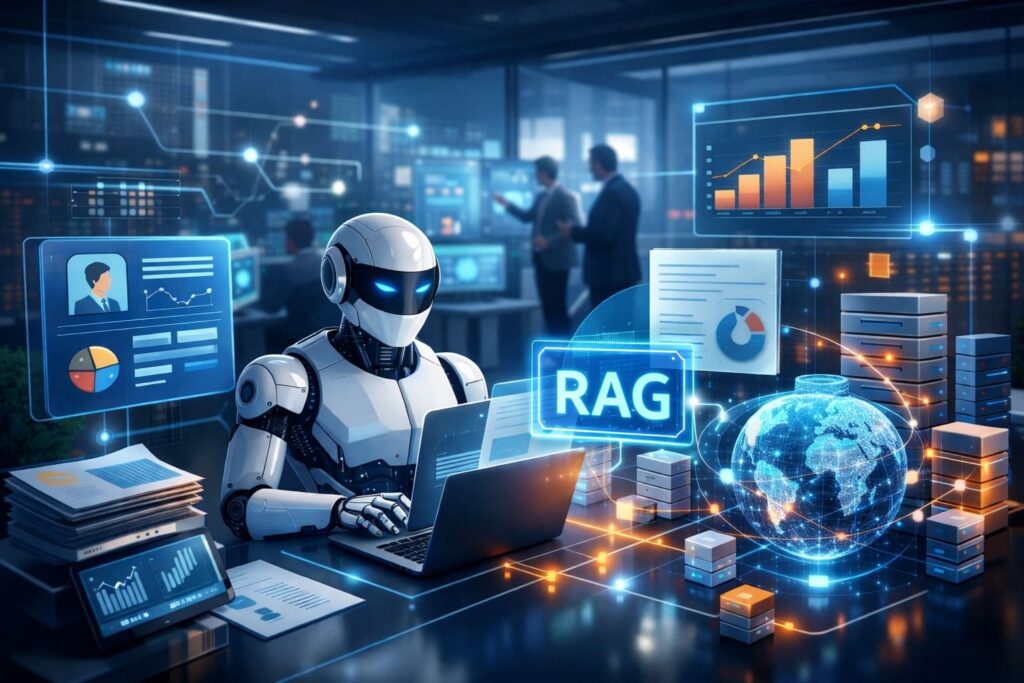
Enterprise RAG solutions combine three critical capabilities into one architecture.First, they retrieve relevant enterprise data in real time. This can include documents, databases, dashboards, logs, and APIs. Second, they augment the prompt sent to the language model with this retrieved context. The model no longer answers in isolation. It answers with evidence.
Third, they generate responses grounded in verified data sources, with traceability back to the original content. In practical terms, RAG allows a GenAI copilot to say, “Based on your Q3 revenue dashboard and the latest sales pipeline data…” instead of producing a generic answer. This architecture transforms GenAI from a creative assistant into an enterprise-grade decision support system.
RAG as the Backbone of GenAI Copilots for Enterprises
GenAI copilots for enterprises are not chatbots. They are embedded assistants designed to support specific roles, workflows, and decisions. A finance copilot helps analysts interpret variance reports. A CX copilot assists agents during live customer interactions. An operations copilot monitors anomalies across systems. An HR copilot supports workforce planning and policy queries.What unites these copilots is their dependency on accurate, up-to-date company knowledge. Enterprise RAG solutions provide that foundation. Without RAG, copilots rely on static training data. With RAG, they operate on living systems.
The Strategic Role of RAG in an AI Roadmap for Enterprises
An effective AI roadmap for enterprises rarely starts with GenAI. It usually begins with data foundations. Data quality, accessibility, and governance come first. This is where data modernization services play a critical role. Legacy warehouses, siloed applications, and batch-based reporting limit AI potential.Once data pipelines are modernized and unified, enterprises can introduce advanced analytics and machine learning. Predictive analytics solutions help forecast demand, detect churn, and optimize resources.
RAG fits naturally at the next stage. It acts as the bridge between analytical systems and human decision-makers. Instead of dashboards that require interpretation, insights become conversational, contextual, and actionable. This progression ensures that GenAI investments build on solid ground rather than sitting on top of fragmented data.
Why Real-Time Data Pipelines Matter for RAG
Enterprise RAG solutions are only as good as the data they retrieve. In fast-moving environments, stale data undermines trust. Real-time data pipelines ensure that copilots reflect the current state of the business. Inventory levels, customer interactions, operational alerts, and financial metrics should update continuously.According to Gartner, organizations that enable real-time analytics can improve operational decision-making speed by 50%. When RAG systems tap into real-time pipelines, GenAI copilots deliver insights that match the pace of the business. This capability is especially important for customer-facing and operational use cases, where timing directly impacts outcomes.
Enhancing AI for Customer Experience (CX) with RAG
Customer experience is one of the earliest and most successful GenAI adoption areas. But not all CX copilots are equal. Traditional AI for customer experience (CX) focuses on intent detection and scripted responses. RAG-powered copilots go further.They access customer profiles, interaction history, product documentation, and policies in real time. An agent does not just see a suggested reply. They see a response grounded in the customer’s contract, recent tickets, and current service status.
McKinsey reports that AI-driven CX improvements can increase customer satisfaction scores by 20% while reducing handling time. RAG plays a key role by ensuring answers are accurate and personalized. Customers notice the difference. Responses feel informed, not automated.
Driving Predictive Analytics into Conversational Interfaces
Predictive analytics solutions have existed for years. What is changing is how insights are consumed. Instead of analysts pulling forecasts from dashboards, executives can ask a copilot, “What happens if demand drops by 10% next quarter?”The RAG system retrieves model outputs, assumptions, and historical trends. The GenAI layer explains them in natural language. This conversational access democratizes analytics. Insights are no longer limited to data science teams. Decision-makers across the organization can engage directly with forecasts and scenarios. The result is faster alignment and more confident decisions.
AI Automation for Operations Through RAG
Operations teams deal with complexity. Logs, alerts, tickets, and performance metrics flood their systems daily. AI automation for operations becomes significantly more effective when combined with RAG.Instead of triggering alerts alone, a copilot can explain root causes, recommend actions, and reference past incidents. For example, when a system anomaly appears, the copilot retrieves similar historical events, resolution steps, and current system metrics. It then generates a contextual summary for engineers.
IBM reports that AI-driven automation can reduce operational costs by 30%. RAG increases this impact by reducing time spent searching for information.
AI for Revenue Optimization with Enterprise Knowledge
Revenue optimization depends on understanding patterns across sales, marketing, pricing, and customer behavior. RAG-powered GenAI copilots connect these domains. Sales leaders can ask about pipeline risks. Marketing teams can explore campaign performance drivers. Finance teams can assess pricing elasticity.AI for revenue optimization becomes more actionable when insights reference real data, not abstract models. RAG ensures that recommendations tie back to current metrics, contracts, and market conditions. According to Salesforce, organizations using AI for revenue intelligence see revenue growth rates up to 15% higher than peers. Enterprise RAG solutions help turn intelligence into daily decision support.
Transforming HR with AI for HR Analytics
HR functions are increasingly data-driven. Workforce planning, attrition analysis, and skills forecasting rely on multiple data sources. AI for HR analytics becomes more effective when GenAI copilots can retrieve policies, historical trends, survey results, and performance metrics in one place.An HR leader might ask, “Which departments are most at risk of attrition this year?” The copilot retrieves predictive models, engagement scores, and historical turnover data. It then explains the reasoning behind the risk assessment. Deloitte research shows that organizations using advanced people analytics are 2x more likely to improve talent outcomes. RAG helps make those analytics accessible and understandable.
Data Modernization Services as a Prerequisite for RAG
Enterprise RAG solutions cannot succeed on fragmented data landscapes. Legacy systems often store critical knowledge in incompatible formats. Data modernization services address this challenge by unifying data across cloud, on-prem, and hybrid environments.They enable standardized schemas, metadata management, and secure access layers. Modernized data platforms also support real-time ingestion and scalable retrieval, both essential for RAG performance. Without this foundation, GenAI copilots struggle to deliver consistent value.
Governance, Security, and Trust in Enterprise RAG Solutions
Trust is the defining factor for enterprise AI adoption. Leaders need to know where answers come from and how data is used. Enterprise RAG solutions support governance by design. Retrieved content can be logged, audited, and traced.Access controls ensure users only see authorized information. Sensitive data stays within enterprise boundaries. Models do not train on proprietary content unless explicitly configured. This approach aligns with regulatory requirements and internal risk policies, enabling wider GenAI deployment.
Measuring the Business Impact of RAG-Powered Copilots
Successful AI initiatives measure outcomes, not activity. Key metrics include decision cycle time, error reduction, operational efficiency, and user adoption. In customer-facing scenarios, metrics extend to satisfaction, retention, and resolution rates.According to PwC, organizations that scale AI effectively see productivity improvements of up to 40%. RAG contributes by reducing friction between data and decisions. The strongest signal of success is trust. When employees rely on copilots daily, value compounds.
The Future of Enterprise GenAI is Grounded, Not Generic
The next wave of GenAI adoption will not be defined by bigger models alone. It will be defined by relevance, accuracy, and integration.Enterprise RAG solutions ensure that GenAI understands the business context it operates in. They enable copilots that reason with company knowledge, not generic internet data. As enterprises mature their AI roadmap for enterprises, RAG becomes the connective tissue between data platforms, analytics, and human decision-makers. This is where AI and data solutions for businesses move from experimentation to competitive advantage.
Choosing the Right Partner for Enterprise RAG and GenAI
Building RAG systems requires expertise across data engineering, AI architecture, security, and domain knowledge. It is not a plug-and-play exercise.The right partner helps align enterprise RAG solutions with business goals. They modernize data foundations, design secure retrieval layers, and deploy GenAI copilots tailored to real workflows. When done right, AI and data solutions for businesses unlock faster decisions, better experiences, and measurable outcomes across the enterprise. If your organization is ready to move beyond pilots and build GenAI copilots grounded in trusted data, now is the time to act. Discover more.