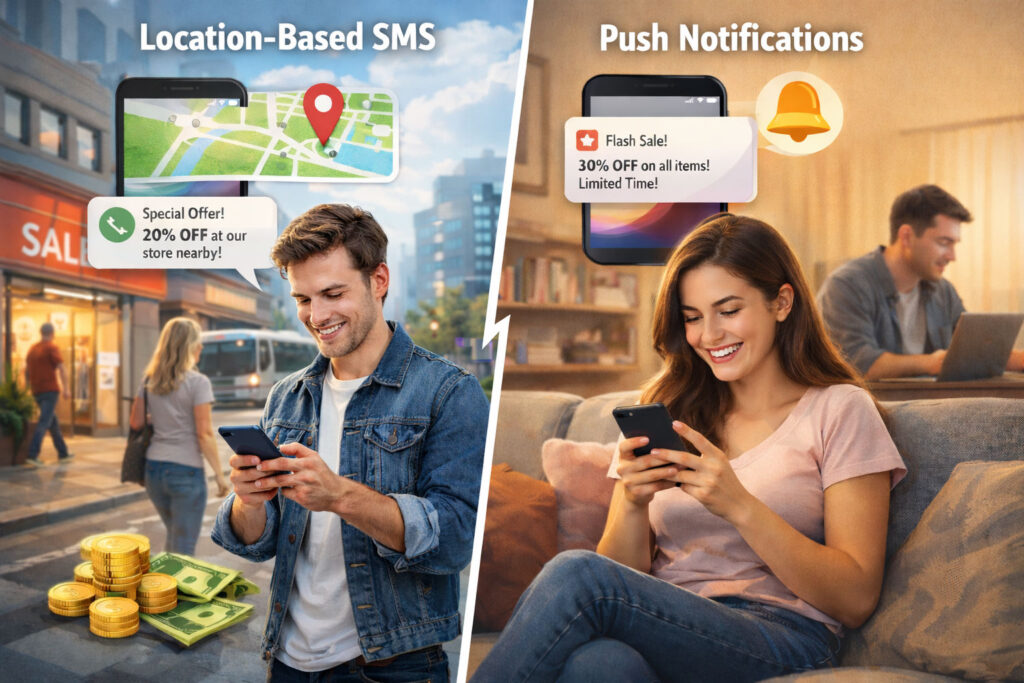
In today’s hyper-competitive mobile-first world, location based SMS marketing has emerged as one of the most practical ways for brands and telcos to reach customers at the exact moment they are most likely to convert. While push notifications are often seen as the default for mobile engagement, their effectiveness depends heavily on app installs, permissions, and user behavior. This raises an important question for marketers and operators alike: when it comes to conversion impact and cost efficiency, how does location-based SMS compare to push notifications?
This article explores both channels in depth, with a specific focus on conversion rates, delivery reliability, cost structures, and real-world applicability for telcos, enterprises, and advertisers.
Understanding the Two Channels at a Glance
Before comparing performance and cost, it is important to understand how each channel works in real scenarios.
What Is Location-Based SMS?
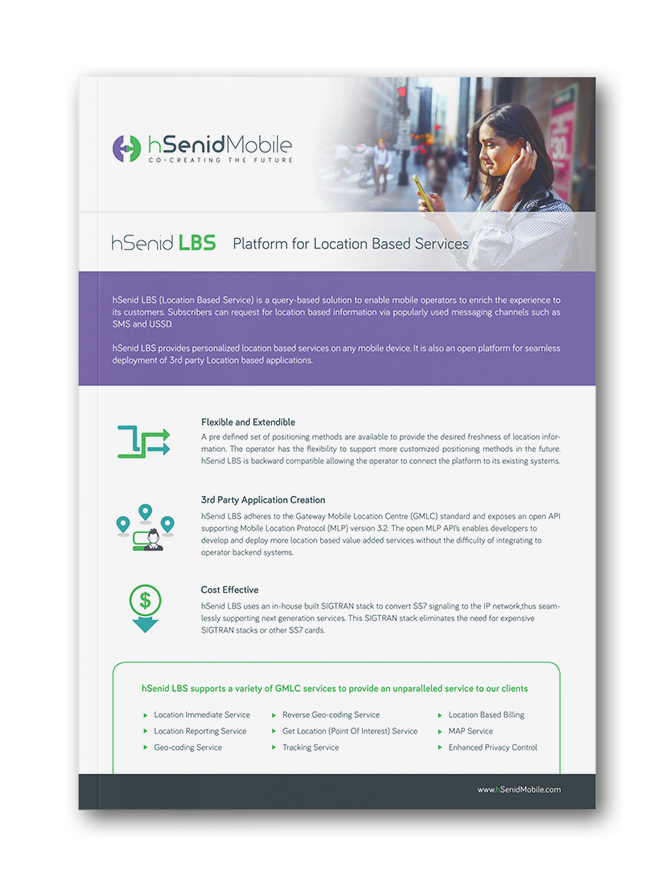
Location-based SMS delivers messages to users based on their real-time or recent geographical location. This includes techniques such as geo-fencing, geo-targeting, and proximity-based triggers. Using network-level positioning methods such as ATI, PSI, or customized positioning techniques, telcos can identify subscribers within defined boundaries and send contextual messages instantly
This approach does not require smartphones, apps, or internet access, making it especially powerful in emerging markets and low-bandwidth environments.
What Are Push Notifications?
Push notifications are messages sent through mobile applications to users who have installed an app and granted notification permissions. These messages rely on data connectivity and user opt-in at the app level. While they offer rich media and deep-linking capabilities, they are limited to users already engaged with an app ecosystem.
Conversion Rates: Where Location Context Makes the Difference
Conversion Performance of Location-Based SMS
One of the strongest advantages of location based SMS marketing is immediacy. Messages are triggered when users are physically near a store, venue, or service area. This relevance significantly increases open and action rates.
SMS enjoys open rates of over 90 percent globally, with most messages read within minutes. When combined with location context, conversion rates increase even further, especially for:
- Retail flash promotions
- Food and beverage offers
- Event-based alerts
- Emergency and service notifications
- Transport and travel updates
Because delivery happens at the network level, location based alerts for telcos reach virtually all subscribers, regardless of device type.
Conversion Performance of Push Notifications
Push notifications typically show lower open rates, often ranging between 5 and 15 percent depending on the industry. While personalization and rich content can improve engagement, conversion is limited by several factors:
- App uninstall rates
- Notification fatigue
- OS-level throttling
- Inactive users
Push notifications perform best when targeting loyal, app-engaged users, but struggle to drive conversions from passive or dormant audiences.
Verdict: Location-driven SMS consistently outperforms push notifications when targeting broad subscriber bases or time-sensitive actions.
Cost Comparison: Messaging Economics Explained
Cost Structure of Location-Based SMS Campaigns
At first glance, SMS may appear more expensive than push notifications because it involves per-message costs. However, the true cost must be measured against reach and conversion.
With the right location based SMS service provider, campaigns eliminate:
- App development costs
- User acquisition spend
- Dependency on data connectivity
- Device compatibility issues
Modern platforms use optimized signaling and in-house SIGTRAN stacks to reduce infrastructure and operational costs, making large-scale deployment more economical for operators and enterprises
.
Cost Structure of Push Notifications
Push notifications are often considered “free” because there is no per-message fee. However, hidden costs include:
- App development and maintenance
- User acquisition campaigns
- Ongoing engagement efforts
- Data usage dependency
- Lower effective reach
When factoring in cost per conversion rather than cost per message, push notifications can become significantly more expensive for location-driven use cases.
Verdict: SMS has a higher upfront delivery cost but delivers a lower cost per conversion for location-based advertising mobile campaigns.
Reach and Accessibility: The Silent Advantage of SMS
Push notifications require smartphones, apps, and permissions. Location-based SMS does not.
This distinction is critical for telcos and enterprises operating in regions with:
- Mixed device penetration
- Feature phone users
- Limited mobile data availability
- Privacy-conscious audiences
Because SMS operates directly through the mobile network, it ensures universal accessibility. This is why proximity SMS marketing remains highly effective for mass-market campaigns, public alerts, and service notifications.
Precision Targeting: Geo-Fencing vs App Segmentation
Geo Targeted SMS Campaigns
Geo-fencing allows marketers to define virtual boundaries around locations such as malls, stadiums, airports, or city zones. When subscribers enter or exit these zones, messages are triggered automatically.
Advanced platforms support multiple positioning methods and offer high accuracy with strong privacy controls, ensuring compliance while maintaining targeting precision
This capability makes SMS ideal for:
- Hyper-local promotions
- Time-sensitive offers
- City-wide service announcements
- Emergency alerts
Push Notification Targeting
Push notifications rely on app-level location permissions and background processes. If location access is disabled or restricted by the operating system, targeting accuracy drops significantly.
Push works well for personalized journeys inside an app, but struggles with real-world physical movement triggers.
Reliability and Delivery Assurance
SMS delivery is deterministic. Once sent, it is delivered or retried at the network level.
Push notifications, on the other hand, are subject to:
- OS delivery rules
- Device battery optimization
- Background app restrictions
- Network connectivity
For mission-critical use cases such as safety alerts, billing notifications, or regulatory messaging, telcos prefer SMS-based delivery due to its guaranteed reach.
Industry Use Cases Where SMS Outperforms Push
According to real-world implementations highlighted in operator-grade LBS platforms, SMS-driven location services excel in multiple industries
- Retail: Store-entry promotions and flash discounts
- QSR: Lunch-hour proximity offers
- Transport: Nearest taxi, ATM, or service alerts
- Tourism: Location-based information services
- Public Sector: City-wide notifications and emergency messaging
Push notifications remain useful for in-app journeys, but cannot replace SMS for broad, location-triggered reach.
Choosing the Right Approach: SMS, Push, or Both?
Rather than viewing this as an either-or decision, many brands adopt a hybrid approach:
- Use push notifications for loyal app users and rich engagement
- Use SMS for mass reach, acquisition, and location-triggered actions
For telcos and enterprises evaluating platforms, selecting the best SMS geofencing provider is critical. Look for solutions that offer:
- Network-level location accuracy
- Multiple positioning methods
- Open APIs for third-party integration
- Cost-efficient signaling infrastructure
- Strong privacy and consent controls
Final Thoughts: Which Channel Delivers Better ROI
When comparing location-based SMS and push notifications, the difference lies not in technology sophistication, but in real-world effectiveness. Push notifications are powerful inside an app ecosystem, but limited in reach. SMS, especially when combined with advanced LBS platforms, delivers unmatched accessibility, immediacy, and conversion performance.
For brands and telcos focused on scale, reliability, and measurable ROI, location based SMS marketing continues to prove its value across industries and markets.