In many parts of Africa, South Asia, and Southeast Asia, financial inclusion is still shaped by infrastructure realities rather than innovation hype. While mobile apps dominate conversations in developed markets, emerging economies continue to rely on simpler, more resilient technologies. This is where a USSD gateway provider plays a critical role in enabling scalable, inclusive financial services that work on any device, any network, and at national scale.
The Reality of Financial Access in Emerging Markets
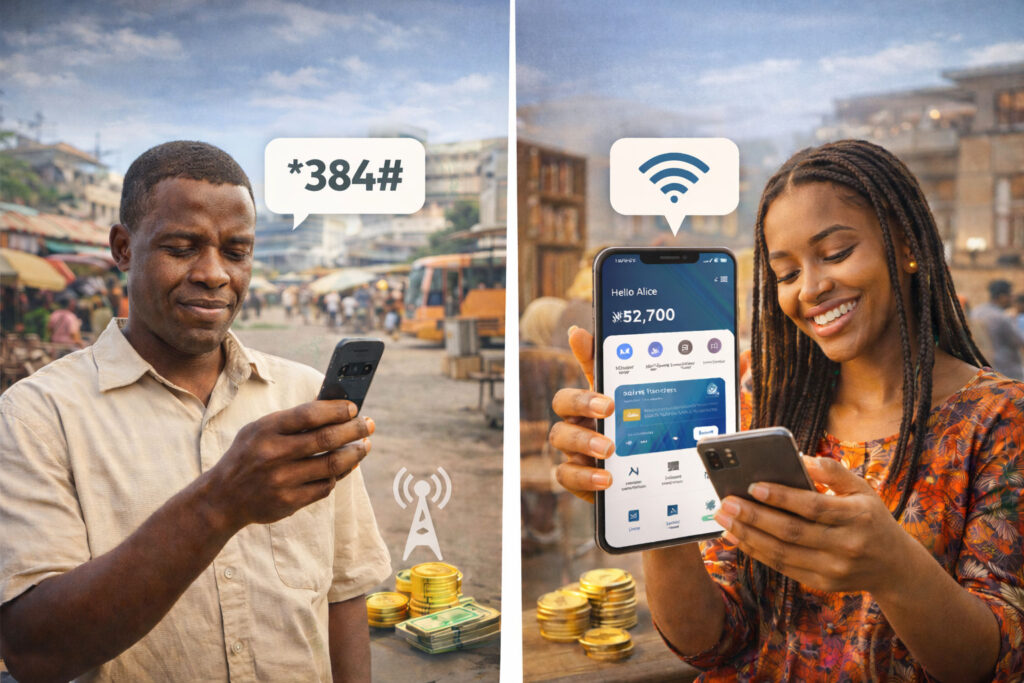
According to the World Bank, over 1.4 billion adults globally remain unbanked, with a majority concentrated in developing regions. GSMA reports that nearly 45% of mobile subscribers in Sub-Saharan Africa still use basic or feature phones, not smartphones. Even among smartphone users, unreliable mobile data, high data costs, and inconsistent electricity make app-based financial services difficult to access consistently.
This context is crucial when evaluating whether USSD or mobile apps scale better for financial services such as mobile money, micro-loans, bill payments, and balance inquiries.
How Mobile Apps Perform in Ideal Conditions
Mobile apps are powerful when conditions allow. They offer rich user interfaces, biometric authentication, offline caching, and deep personalization. In urban environments with high smartphone penetration and affordable data, apps can deliver excellent customer experiences.
However, scaling mobile apps across emerging markets introduces several challenges:
- High data dependency: Many financial apps require persistent data connectivity.
- Device fragmentation: Apps behave differently across low-end Android devices.
- Update friction: Users often run outdated app versions.
- Digital literacy barriers: App navigation assumes familiarity with smartphones.
For fintechs trying to reach rural populations or low-income users, these constraints significantly slow adoption and increase operational costs.
Why USSD Continues to Dominate at Scale
USSD (Unstructured Supplementary Service Data) is not a legacy workaround; it is a purpose-built channel for mass-scale interaction. Unlike apps, USSD works on any GSM phone, does not require mobile data, and operates in real time.
In Kenya alone, over 90% of mobile money transactions were historically initiated via USSD, especially during the early growth of M-Pesa. Even today, USSD remains the fallback channel during data outages or for users on low-cost devices.
This makes a USSD gateway provider a foundational component for financial services that aim to scale beyond early adopters and reach national populations.
USSD vs. Mobile Apps: A Scalability Comparison
1. Reach and Accessibility
- USSD: Works on 2G, 3G, 4G, and 5G networks. No app install. No data.
- Mobile Apps: Require smartphones, app stores, storage space, and data bundles.
From a pure reach perspective, USSD consistently outperforms apps in emerging markets.
2. Cost to User
GSMA Intelligence estimates that 1GB of mobile data can cost up to 5–8% of monthly income in some African countries. USSD sessions, on the other hand, are either free or billed at minimal rates.
This affordability is a major reason why mobile money providers continue to prioritize USSD channels.
3. Speed to Market
Launching a mobile app requires frontend development, QA across devices, store approvals, and ongoing updates. A USSD menu platform allows financial services to launch or modify workflows without downtime, significantly reducing time to market
.
4. Operational Scale
Modern USSD platforms can handle massive transaction volumes. The uploaded USSD Suite document highlights platforms capable of handling over 45 million transactions per day and up to 15,000 TPS, which is critical for national-scale mobile money services
.
Why USSD Is the Backbone of Mobile Money
Mobile money ecosystems depend on reliability, not visual sophistication. A USSD gateway for mobile money enables:
- Balance checks
- P2P transfers
- Merchant payments
- Loan disbursements
- Airtime top-ups
Because USSD sessions are real-time and session-based, transactions complete faster and with fewer failure points than app-based flows in low-connectivity environments.
This is why nearly every major USSD service provider in Africa continues to invest heavily in USSD infrastructure, even as mobile apps grow in parallel.
The Role of APIs and Shortcodes in Scaling Fintech
Modern USSD is not static or hardcoded. With a robust USSD API provider, fintechs can integrate USSD directly into their backend systems, CRM platforms, and payment engines.
Key enablers include:
- USSD shortcode provider capabilities for brand recognition
- REST APIs for rapid fintech integration
- External app provisioning with TPS and session controls
This API-driven approach allows fintechs to iterate quickly without redeploying core infrastructure.
Session Management: The Unsung Hero of USSD Scalability
One of the biggest misconceptions about USSD is that it offers a poor user experience. In reality, advanced USSD session management enables:
- Session resumption after timeouts
- Intelligent navigation shortcuts
- Pagination for long menus
- Context-aware menu flows
The uploaded document highlights session resuming capabilities that guide users back to their last interaction point, significantly reducing transaction drop-offs
.
This is particularly valuable for financial services where incomplete sessions can result in failed transactions or customer distrust.
Monetization and Charging Flexibility
Financial services often require complex charging logic. USSD platforms now support:
- Per-request charging
- Session-based billing
- Integration with operator billing systems
This makes USSD billing integration far more flexible than many app-based payment flows, especially in prepaid-dominant markets.
For fintechs and banks, this translates into predictable revenue models and lower dependency on third-party payment gateways.
Dynamic Menus and Localization at Scale
Emerging markets are linguistically and culturally diverse. A strong USSD menu platform supports:
- Multi-language menus
- Dynamic content based on balance, tariff, or user profile
- AI-assisted menu navigation
These capabilities allow financial institutions to personalize services at scale without increasing complexity.
So, What Scales Better?
The answer is not “USSD or mobile apps.” It is USSD first, apps second.
For fintechs, banks, and mobile money operators focused on mass adoption:
- USSD delivers immediate national reach
- Mobile apps enhance experience for digitally mature users
This hybrid approach is why the best USSD provider for fintech strategies continue to coexist with app ecosystems rather than compete with them.
Final Verdict
When scalability is measured by reach, reliability, cost-efficiency, and transaction volume, USSD consistently outperforms mobile apps in emerging markets. Mobile apps add value, but USSD remains the foundation.
Choosing the right USSD gateway provider is not a technical decision alone; it is a market-access strategy. Financial services that prioritize inclusion, resilience, and scale will continue to rely on USSD as their primary growth engine, even in a 5G-enabled future.
To explore how enterprise-grade USSD platforms power secure, high-volume financial services with real-time interactions and operator-level reliability, discover more about hSenid USSD Gateway.