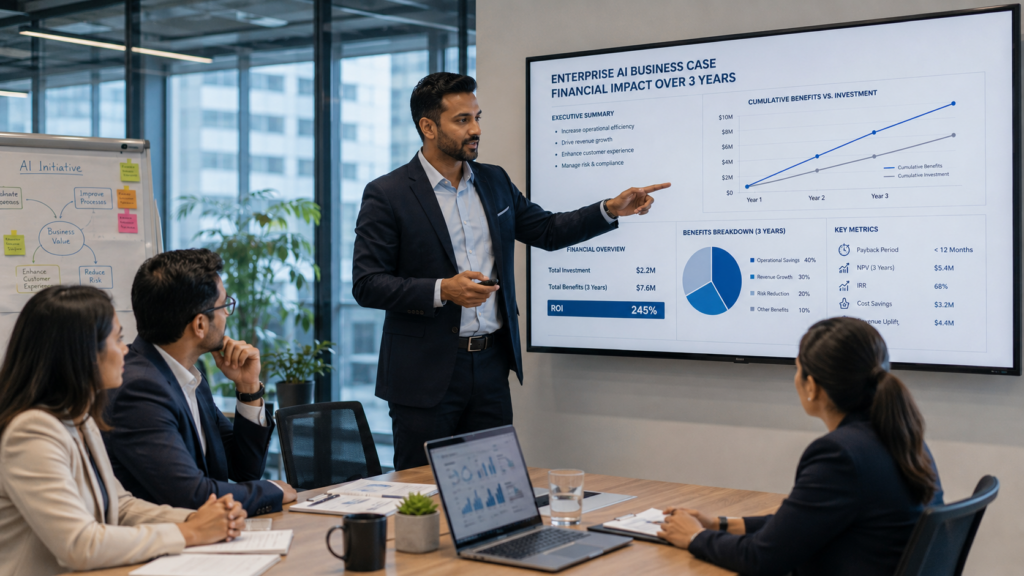
Enterprise AI may excite technology teams, but CFOs usually evaluate it through a different lens. They want to know what the organisation is spending, what measurable value the investment will create, how quickly that value can be demonstrated, and what financial risks come with scaling.
That means an AI proposal built around model capabilities alone is unlikely to be enough.
A convincing business case needs to connect AI directly to an expensive or inefficient workflow. It should show the current cost, estimate the realistic improvement, account for implementation and operating expenses, and define how success will be measured.
For organisations considering Sovereign AI, the strongest business case is usually not “we need an enterprise AI platform.” It is “we can improve this specific business process, prove the financial impact, and create a controlled foundation for future AI adoption.
Start With a Business Problem, Not an AI Platform
A CFO is unlikely to approve investment because a new AI model has better reasoning capabilities or a larger context window.
Start with something the business already understands.
Perhaps employees spend thousands of hours reviewing documents every year. Maybe recruitment teams need weeks to process applications. Compliance teams could be repeatedly searching large policy repositories. Analysts might spend days collecting information before they can begin higher-value research.
These are measurable problems.
Before proposing automation, document the current state:
Number of transactions per month
Average processing time
Number of employees involved
Fully loaded employee cost
Rework or error rates
Current technology costs
Average process completion time
Once these numbers are visible, the AI investment becomes easier to evaluate financially.
Calculate the Cost of the Existing Workflow
One of the strongest parts of an enterprise AI business case is often the simplest: what does the process cost today?
Imagine 15 employees spend an average of three hours per day reviewing applications. That represents 45 hours of staff time every working day.
Multiply that across a year and the organisation may discover that a seemingly ordinary manual workflow consumes thousands of skilled working hours.
AI does not need to eliminate the entire workload to create value.
If automation handles document extraction, classification, comparison, and routine checks while employees focus on exceptions, even a moderate reduction in manual effort can release significant capacity.
This gives the CFO a baseline against which future savings can be measured.
Translate Time Savings Into Financial Value
“AI will improve productivity” is difficult to approve.
“AI can recover 6,000 staff hours annually from this process” is much stronger.
Convert potential productivity improvements into measurable business outcomes.
Recovered employee capacity might allow the company to process more applications without increasing headcount. Faster customer onboarding could improve revenue recognition. Automated knowledge retrieval may allow specialists to handle more complex work.
The business case should separate hard savings from capacity gains.
Hard savings may include reduced external service costs, eliminated software subscriptions, infrastructure consolidation, or avoided hiring.
Capacity gains represent employee time redirected toward more valuable work.
Both matter, but CFOs should be able to see the difference.
Include the Full Cost of AI
AI has operating costs, and ignoring them weakens the proposal.
The business case should consider model consumption, infrastructure, implementation, integration, support, monitoring, security, and governance.
LLM cost management becomes increasingly important as AI moves from small experiments into high-volume production workflows.
Not every request needs the most advanced model.
AI model routing can allow an organisation to use different models based on complexity, cost, data sensitivity, and policy. Routine classification could run through an efficient model while complex analysis uses a more capable option.
This can make AI economics considerably more predictable.
A Sovereign AI architecture can also reduce dependence on one provider by allowing organisations to connect OpenAI, Gemini, Claude, Llama, DeepSeek, or local models without rebuilding the entire workflow.
Show the CFO How Risk Is Controlled
Financial approval is not only about upside.
CFOs also care about downside.
An unmanaged AI environment can introduce data exposure, uncontrolled subscriptions, duplicate technology spending, compliance issues, and unpredictable model costs.
Enterprise AI governance should therefore be part of the financial argument.
An AI Governance Gateway can provide central policies around approved models, access, data handling, usage, and workflow actions.
AI usage monitoring can give management visibility into which teams are consuming AI resources and how spending is distributed.
This also supports Shadow AI prevention by reducing uncontrolled adoption across departments.
For CFOs, governance is not simply a technology issue. It protects the return on the investment.
Include Data Security in the Business Case
Sensitive information can significantly change how an AI workflow must be deployed.
Customer records, financial information, employee data, intellectual property, and regulated documents may require stricter controls.
AI data sovereignty allows organisations to determine where information is processed and which models are allowed to receive it.
For example, highly sensitive workloads could use an on-premise or private model while lower-risk requests use an approved external provider.
AI data privacy controls can also mask sensitive information before external processing.
Strong Enterprise LLM security adds permissions, logging, workflow restrictions, and controls around what connected AI agents can access or execute.
Including these requirements early prevents unexpected security costs from appearing after the business case has already been approved.
Make ROI Measurable Within a Defined Period
A proposal becomes easier to approve when the CFO does not have to wait years to find out whether it worked.
Choose one workflow and define specific success criteria.
For document automation, measure manual processing time.
For internal knowledge automation, measure search time and employee hours recovered.
For recruitment, measure the time between application closure and an actionable shortlist.
For research automation, compare the time spent collecting information before and after implementation.
Forward Deployed Engineers can help identify these high-value workflows and connect AI directly to the systems employees already use.
A focused 90-day engagement can create something much more useful than another open-ended transformation programme: evidence.
Do Not Build the Case Around Headcount Reduction Alone
AI business cases often become unnecessarily narrow when every benefit is converted into potential job reductions.
The larger opportunity can be increasing organisational capacity.
A bank that processes twice as many applications without doubling its operations team creates value.
A compliance department that handles growing workloads without continuously adding staff creates value.
A research team that spends less time collecting information and more time analysing it creates value.
These improvements may generate stronger long-term returns than immediate headcount reduction.
They also make the AI initiative easier to connect to business growth.
Build a Case That Can Expand
Your first AI investment should solve one problem, but it should also create reusable capabilities.
The governance layer, system connectors, security controls, model routing, and monitoring created for one workflow can support the next deployment.
That is where Sovereign AI can strengthen the financial argument.
Instead of funding isolated AI applications repeatedly, the organisation builds a controlled platform that supports multiple use cases over time.
The first project proves value.
The second reuses the foundation.
Each additional workflow can improve the economics of the overall investment.
Give the CFO Evidence, Not AI Hype
The strongest enterprise AI business case is not built around promises of transformation.
It is built around numbers.
Show the cost of the current workflow. Identify where automation can reduce effort. Include realistic implementation and model costs. Explain how data and governance risks will be controlled. Define success metrics before deployment begins.
Then start small enough to prove the assumptions.
That approach turns Sovereign AI from a technology proposal into an investment case with measurable operational value, controlled risk, and a clear path toward broader enterprise adoption.