Enterprise AI is evolving too quickly for organisations to build long-term strategies around a single model provider.
A model that performs best today may be overtaken within months. Pricing can change. Data residency requirements can tighten. New local models can become viable. Business units may also need different capabilities for different workflows.
For CTOs, this creates a clear architectural challenge. How do you build enterprise AI systems that can evolve without forcing teams to rebuild workflows every time the model landscape changes?
A model-agnostic architecture offers one answer.
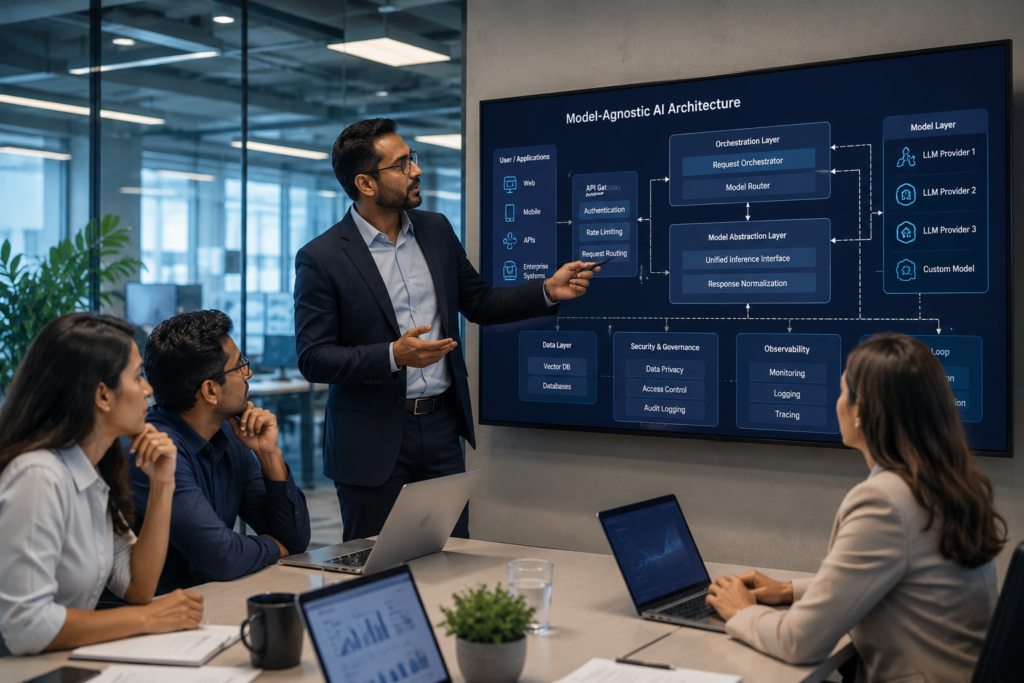
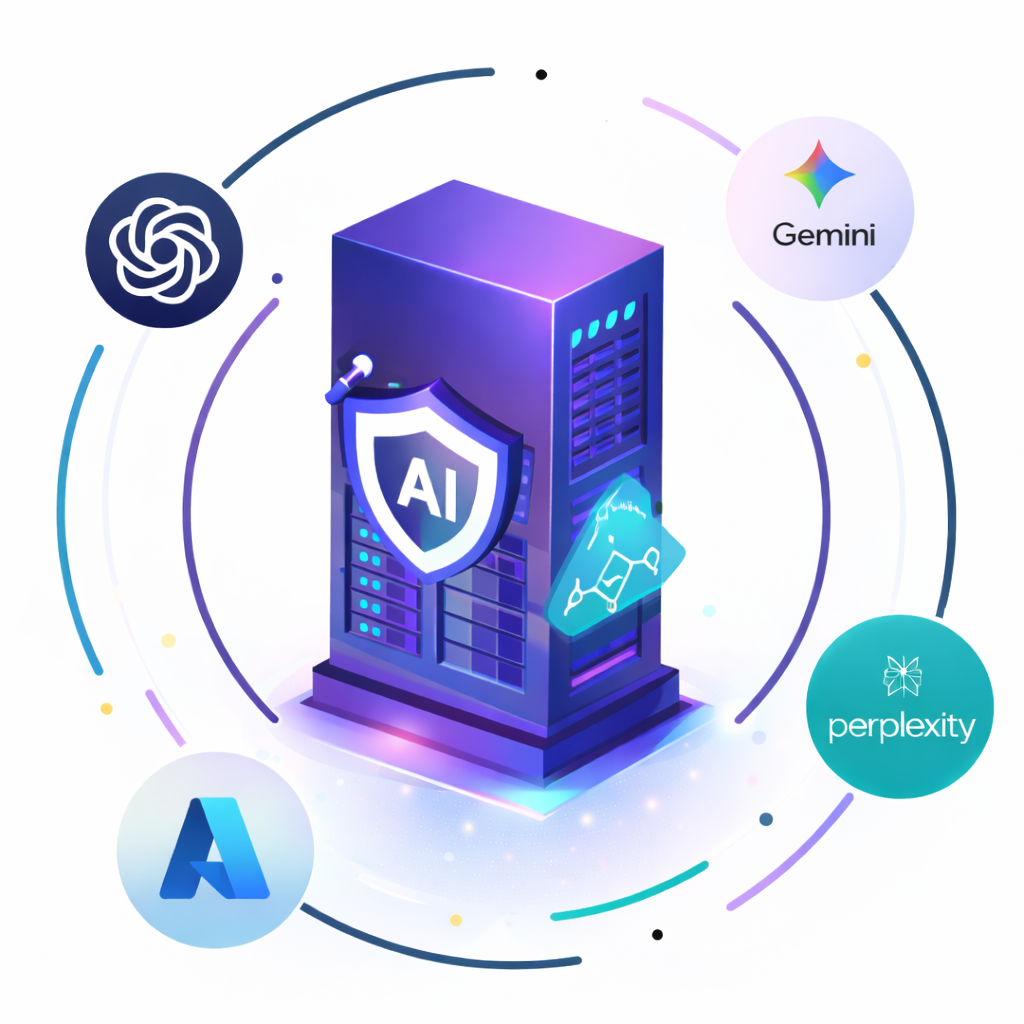
Instead of tightly coupling applications to one provider, the enterprise creates a layer between business workflows and AI models. That layer can manage routing, policy, monitoring, security, and access while allowing the organisation to use OpenAI, Gemini, Claude, Llama, DeepSeek, or local models based on business requirements.
Within a Sovereign AI strategy, this flexibility becomes especially valuable because control over models is directly connected to control over data, cost, and governance.
Model Lock-In Creates More Risk Than It Seems
It is easy to build an AI application directly around one model API.
It is also easy to become dependent on it.
Over time, prompts, workflows, integrations, monitoring systems, and operational processes may become designed specifically around one provider. If the organisation later wants to switch models, the change may affect much more than one API call.
This creates technical and commercial lock-in.
A provider may change pricing. A new model might deliver better performance. A regulator may require certain data to remain inside the country. A business unit may need a locally hosted LLM for sensitive workloads.
Without model independence, adapting to those changes can become expensive.
A model-agnostic approach keeps the workflow separate from the model layer.
The business process remains stable while the underlying model can change.
Different Workloads Need Different Models
There is no reason every enterprise task should use the same AI model.
A complex research workflow may need advanced reasoning.
Document classification may only require a smaller, faster model.
A customer-facing assistant may need low latency.
A financial workflow containing sensitive data may need to run locally.
An internal coding assistant could use another provider entirely.
This is where AI model routing becomes important.
Rather than selecting one model for the whole organisation, routing policies can decide which model handles each request.
The decision can consider capability, cost, response time, workload type, security, data sensitivity, and deployment requirements.
This gives CTOs more control while allowing teams to use the most appropriate model for each task.
An Enterprise AI Gateway Creates the Abstraction Layer
A practical model-agnostic architecture usually needs a control point between enterprise applications and AI providers.
An Enterprise AI Gateway can perform this role.
Applications send requests to the gateway rather than connecting directly to individual models. The gateway can then apply policies and route the request to the appropriate provider.
This simplifies application design.
Developers do not need to build separate integrations for every model. Business workflows can remain consistent even when models are changed behind the scenes.
It also creates a central location for logging, policy enforcement, usage monitoring, and governance.
For CTOs, this reduces architectural fragmentation.
Instead of dozens of teams independently connecting to AI providers, the organisation gains a reusable model access layer.
Model-Agnostic Does Not Mean Model-Blind
A common misconception is that all models can be treated as interchangeable.
They cannot.
Models differ in reasoning ability, context length, multimodal support, latency, cost, safety controls, deployment options, and output quality.
A good model-agnostic architecture acknowledges those differences.
The objective is not to pretend every model behaves the same.
It is to prevent business workflows from becoming permanently dependent on those differences.
The routing layer can maintain profiles for approved models and determine which workloads they are suitable for.
That creates flexibility without sacrificing performance.
Cost Control Becomes Easier
Model flexibility also has a direct financial benefit.
Sending every request to a premium model can become expensive as AI usage grows.
A production workflow may involve multiple model calls for one transaction. At enterprise scale, those costs can accumulate quickly.
LLM cost management becomes much easier when the architecture can route workloads based on complexity.
A simple extraction task might use a lower-cost model.
A difficult analysis could use a more advanced model.
Bulk internal workloads may run on a local model where economics are more predictable.
AI usage monitoring can then show which models, applications, and departments are generating the most consumption.
This allows CTOs and CFOs to make informed decisions instead of discovering AI costs after they have already escalated.
Data Sovereignty Can Influence Routing
Model selection is not only about performance and cost.
Sometimes the most important factor is where data is allowed to go.
AI data sovereignty becomes critical when organisations operate in financial services, government, telecommunications, healthcare, or other regulated sectors.
Some workloads may be permitted to use external models.
Others may require sensitive information to remain inside a private environment.
A Sovereign AI architecture can support both.
For example, a workflow could mask sensitive customer information before sending a request to an external model. Another workload could be routed entirely to an on-premise LLM.
The application does not need to change every time the data policy changes.
The routing and governance layer handles the decision.
Governance Should Follow the Request
Enterprise AI governance becomes more complex when multiple models are involved.
Different providers may have different policies, deployment locations, data handling requirements, and capabilities.
An AI Governance Gateway can apply consistent organisational controls regardless of which model ultimately processes the request.
Policies can define which departments can access certain models, what types of data are permitted, whether human approval is required, and which workloads must remain local.
Generative AI governance can also define which actions AI systems are allowed to take after producing an output.
That matters increasingly as enterprises move from chatbots toward agentic workflows.
The model should never determine governance.
The organisation should.
Security Boundaries Need to Remain Consistent
A multi-model environment should not create multiple security standards.
Enterprise LLM security needs to remain consistent across providers.
That can include authentication, role-based access, retrieval permissions, data masking, logging, tool restrictions, and approval controls.
An employee should not gain access to sensitive information simply because one application happens to use a different model.
Centralised controls help maintain the same security policies across all AI workloads.
They can also support Shadow AI prevention by giving employees access to approved models through a managed enterprise layer rather than encouraging independent subscriptions and unmanaged integrations.
Local Models Should Be Part of the Strategy
Model-agnostic architecture should not be limited to public AI providers.
Local and private models can be important for organisations with strict privacy, latency, or sovereignty requirements.
A company may use a locally deployed Llama or another open model for sensitive workloads while using commercial models for tasks where external processing is acceptable.
This hybrid approach gives CTOs more flexibility.
It also creates leverage.
If a provider becomes too expensive or no longer meets policy requirements, the organisation has alternatives.
That is one of the biggest strategic advantages of model independence.
Avoid Rebuilding the Workflow Around Every New Model
The AI market will keep changing.
New providers will emerge. Existing models will improve. Prices will fall in some areas and rise in others. Regulations will evolve.
The enterprise workflow should not have to change every time that happens.
A customer onboarding process should remain a customer onboarding process regardless of which model performs document extraction.
A compliance workflow should remain stable even if the organisation replaces one reasoning model with another.
This is the architectural principle CTOs should protect.
Separate the business logic from the model layer.
That makes AI systems more durable.
Start With One Workflow and Build the Abstraction Properly
A model-agnostic strategy does not require the organisation to support every available model from day one.
Start with one high-value workflow.
Connect the models that genuinely serve that use case.
Define routing rules.
Establish governance.
Measure cost and performance.
Then expand.
This creates a controlled architecture instead of an oversized platform project.
Forward Deployed Engineers can help here by working directly with enterprise teams to understand the workflow, connect systems, define model policies, and deploy the architecture around real operational requirements.
The result should be something employees use, not simply an impressive architecture diagram.
Model Independence Is Really Business Independence
For CTOs, model-agnostic architecture is not only a technical design choice.
It is a strategic one.
It protects the organisation from unnecessary vendor lock-in. It gives teams access to the best model for each workload. It improves cost control. It supports AI data privacy and sovereignty requirements. It also makes governance easier to apply consistently.
Most importantly, it keeps the enterprise in control of how AI evolves.
A well-designed Sovereign AI architecture allows models to change without forcing the business processes around them to change as well.
That is what makes the architecture durable.
The goal is not to predict which model will win.
The goal is to build an enterprise AI foundation that does not depend on being right about that prediction.