
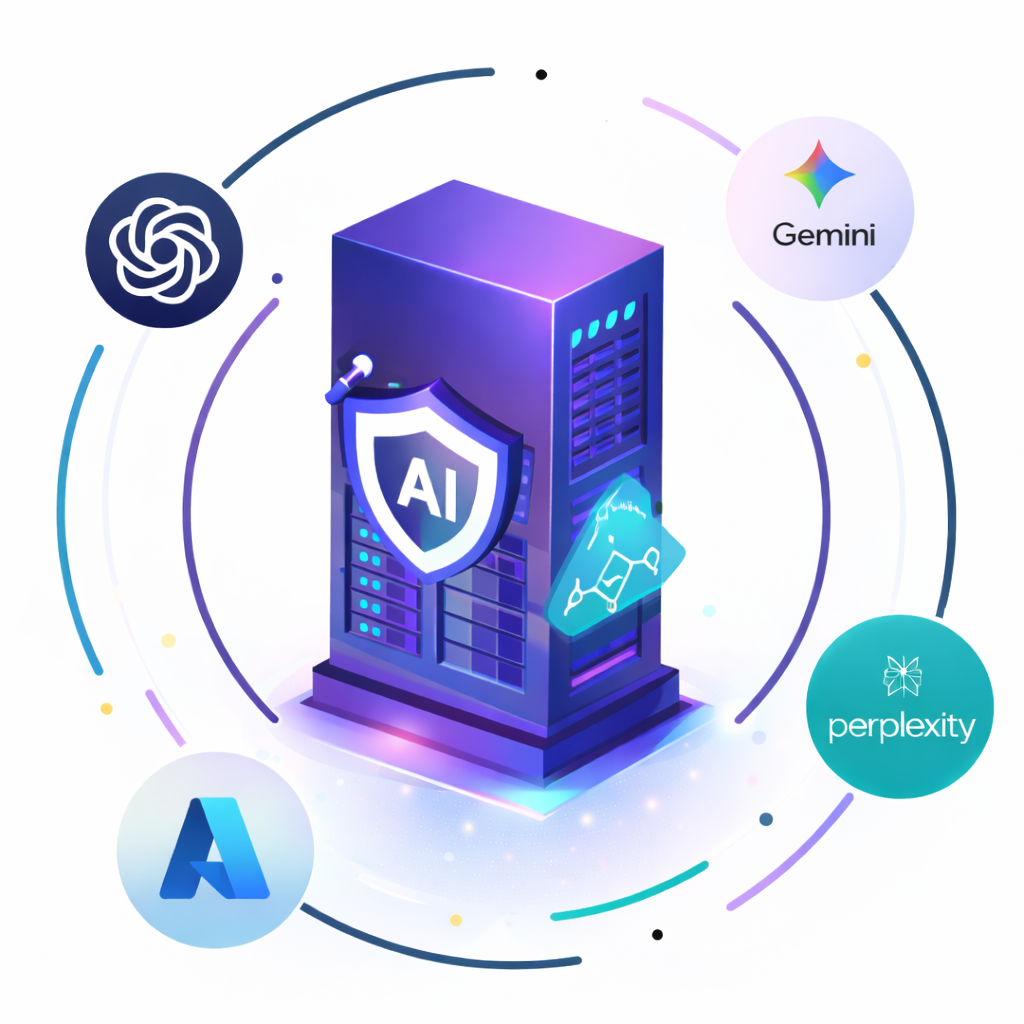
Enterprise AI has reached a new stage in 2026. Organisations are no longer asking only whether they should use artificial intelligence. They are asking where their data goes, who controls the models, how AI decisions are governed, and what happens if their preferred provider changes.
These questions are driving growing interest in Sovereign AI.
At its core, the concept is about maintaining meaningful control over the data, infrastructure, models, governance, and operational environment supporting artificial intelligence. Red Hat describes sovereign AI as an approach that reduces reliance on external gatekeepers and gives organisations greater control over the AI lifecycle, including data, models, infrastructure, and inference.
For enterprises, that does not necessarily mean building everything locally. It means deciding what should stay local, what can use external providers, and which rules apply to every AI interaction.
What Is Sovereign AI?
Sovereign AI is an approach to building and operating AI systems while maintaining defined control over data, models, infrastructure, access, and governance.
Traditional enterprise AI deployments often depend heavily on external model providers and cloud infrastructure. A sovereign architecture introduces greater choice.
An organisation might use OpenAI for one workload, Gemini or Claude for another, and a locally hosted Llama model for sensitive data.
The important difference is that the enterprise controls those decisions.
This idea is increasingly broader than simple data residency. IBM’s current sovereign architecture approach, for example, extends sovereignty to operational authority, model execution, administrative access, identity, logging, and governance.
Why Enterprises Are Paying Attention in 2026
AI has moved beyond standalone chatbots.
Enterprise systems are increasingly expected to analyse documents, retrieve internal knowledge, interact with applications, call APIs, and support multi-step business processes.
That makes control more important.
An employee asking AI to rewrite public marketing copy creates relatively little data risk. An AI agent processing loan applications or customer records creates an entirely different risk profile.
AI data sovereignty helps organisations establish where information can be processed and which environments can access it.
For regulated industries, this can include requirements around local processing, customer-controlled infrastructure, private environments, or stricter governance boundaries. Red Hat has highlighted financial services, healthcare, and the public sector as areas where sovereign infrastructure and operational independence are particularly relevant.
Data Control Is Only One Part of the Architecture
Sovereignty is sometimes misunderstood as simply storing data inside a particular country.
That is too narrow.
An enterprise may store information locally while still depending completely on an external AI platform for inference, administration, logging, and model access.
A stronger architecture considers several layers.
The organisation needs to understand where data is stored, where prompts are processed, who controls encryption and identity systems, which models are available, and where logs are retained.
This is why AI data privacy needs to be designed throughout the workflow.
Sensitive customer information might be masked before an external model receives a request. Highly confidential workloads could remain on-premise. Less sensitive tasks may use commercial cloud models.
The enterprise decides the boundary.
Model Independence Is a Major Advantage
No CTO can confidently identify which model will dominate enterprise AI several years from now.
The market changes too quickly.
A model-agnostic approach allows organisations to connect multiple providers without designing every business workflow around one vendor.
An Enterprise AI Gateway can sit between applications and models, giving enterprise systems a common access layer.
AI model routing can then choose the appropriate model according to factors such as capability, cost, latency, workload type, or data sensitivity.
One workflow might use a commercial reasoning model.
Another might use a smaller model for classification.
A regulated workload could use a local model inside the enterprise environment.
The workflow remains stable even when the underlying model changes.
Governance Becomes a Technical Capability
Enterprise AI governance cannot depend entirely on employees remembering a policy document.
Controls need to exist inside the AI architecture.
An AI Governance Gateway can help determine who can access models, what information can be processed, which models are approved, and what actions AI systems are permitted to perform.
This becomes especially important with agentic AI.
An assistant that answers questions presents one level of risk. An agent that can modify records, communicate with customers, or execute business processes presents another.
Generative AI governance can define where human approval is mandatory and what actions can happen automatically.
The organisation sets the rules instead of leaving those decisions to individual applications.
Sovereign AI Can Help Address Shadow AI
Employees frequently adopt AI faster than organisations can govern it.
Teams may create personal accounts, subscribe to different platforms, upload internal documents, or connect directly to model APIs.
This creates fragmented visibility.
Shadow AI prevention does not necessarily mean blocking every external tool.
A stronger strategy is providing employees with approved AI access that is useful enough to replace unmanaged alternatives.
Central access also enables AI usage monitoring.
Technology leaders can see which teams use AI, which models receive the most requests, and where sensitive workloads are occurring.
This helps security, governance, and finance teams work from the same information.
Cost Control Matters as AI Scales
Small experiments can make AI costs appear insignificant.
Production automation changes the equation.
A single workflow may generate several model requests for every transaction. Multiply that across thousands of transactions and multiple departments, and costs can rise quickly.
LLM cost management should therefore be part of the architecture from the beginning.
Not every task needs the most expensive model.
Routine extraction, classification, or summarisation may be handled by efficient models, while advanced reasoning models are reserved for more demanding tasks.
Model-independent routing gives enterprises greater freedom to optimise those decisions.
Does Sovereign Mean Everything Must Be On-Premise?
No.
There are different levels of sovereignty.
Red Hat describes approaches ranging from dependence on external providers through partial sovereignty to more complete control over data, infrastructure, models, and operations.
For enterprises, hybrid architectures may often be practical.
Highly sensitive information can remain inside controlled infrastructure.
Approved cloud models can handle appropriate workloads.
Local models can support regulated or latency-sensitive applications.
IBM’s 2026 sovereign architecture also reflects this broader approach, focusing on customer control and governed AI within sovereign boundaries rather than treating sovereignty as a single hosting location.
Where Should Enterprises Start?
Do not begin by attempting to make the entire organisation sovereign overnight.
Begin with one meaningful workflow.
Loan document analysis, KYC, policy search, procurement review, CV screening, compliance research, and customer complaint intelligence can all provide useful starting points.
Identify the systems involved.
Classify the data.
Define which models may process it.
Establish governance rules.
Connect the workflow to existing applications.
Then measure the outcome.
Forward Deployed Engineers can support this process by working alongside business and technology teams to understand operational realities and deploy AI around real workflows rather than isolated demonstrations.
Sovereignty Is Ultimately About Enterprise Control
The importance of Sovereign AI in 2026 is not simply about keeping everything inside national borders.
It is about preserving choice.
Enterprises need control over their data, models, infrastructure, policies, costs, and business workflows as AI becomes more deeply embedded in operations.
Current sovereign AI strategies from major technology providers increasingly emphasise this wider combination of operational control, governance, local authority, and model flexibility.
For CTOs, that creates a practical principle: build AI so that the organisation remains in control even when the models, providers, regulations, and technologies around it change.
That is what turns Sovereign AI from an infrastructure concept into a durable enterprise strategy.