
AI governance is often treated as a brake on innovation. Security teams want tighter controls. Business teams want to move faster. Technology leaders are caught in the middle, trying to support experimentation without creating data, compliance, or cost risks.
The problem is not governance itself. The problem is governance that arrives too late, lives only in policy documents, or creates so much friction that employees work around it.
A better approach is to build governance directly into the AI operating environment. With the right architecture, enterprises can give teams room to experiment while maintaining control over data, models, access, usage, and risk.
That is where Sovereign AI can become valuable. It gives organisations a framework for balancing flexibility with control.
Start With Clear Risk Levels
Not every AI use case needs the same level of oversight.
Using AI to draft a marketing headline is very different from using it to analyse customer financial records.
A practical Enterprise AI governance framework should classify use cases by risk.
Low-risk tasks may use public information and require minimal controls.
Medium-risk workloads may involve internal documents, business data, or employee information.
High-risk use cases may involve customer data, regulated information, financial decisions, or AI agents that can take actions inside enterprise systems.
This allows governance to match the actual risk instead of applying the strictest policy to every use case.
That alone can make innovation much faster.
Make Approved AI Easier Than Unapproved AI
One of the biggest reasons shadow AI appears is simple: employees can access public AI tools faster than approved enterprise alternatives.
If governance creates friction, users often find shortcuts.
Shadow AI prevention therefore requires more than blocking tools.
Enterprises need to provide approved AI access that is useful, flexible, and easy to adopt.
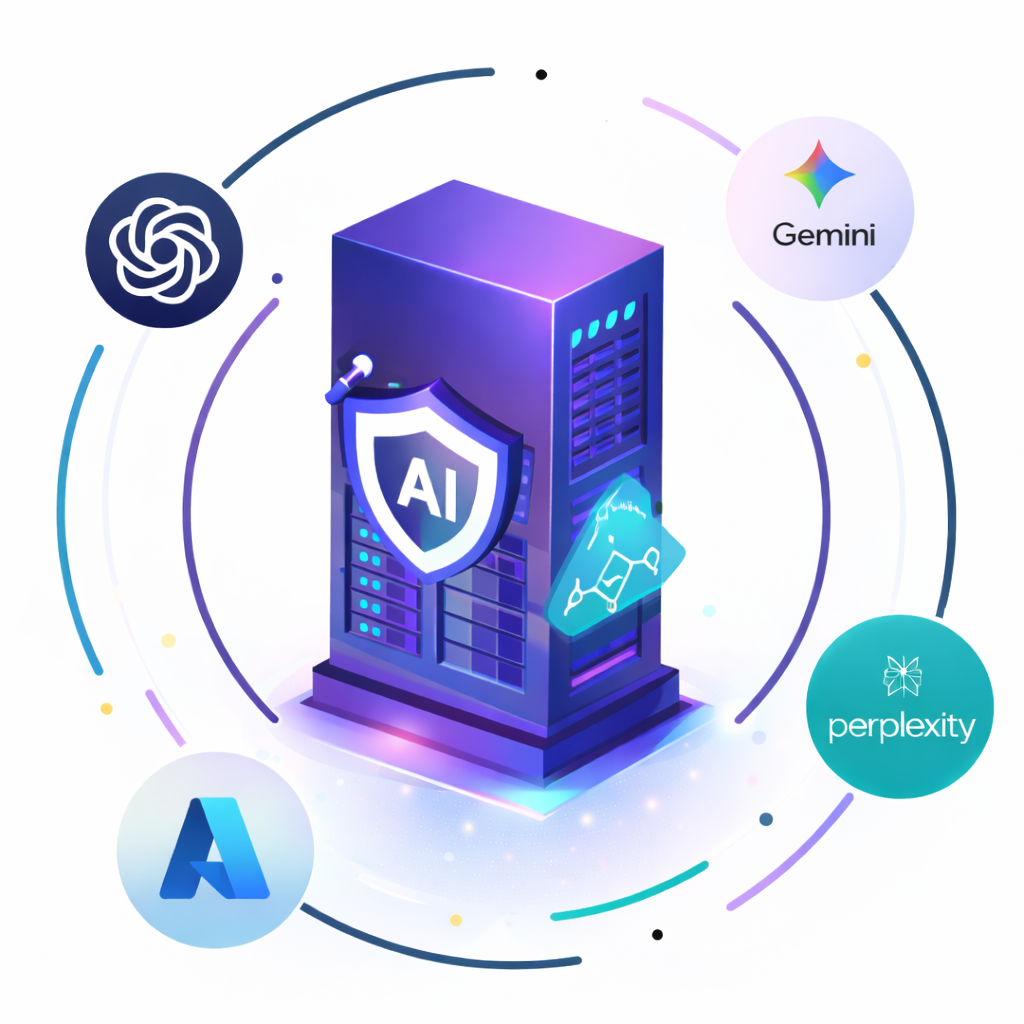
An Enterprise AI Gateway can help by giving teams access to approved models through one controlled layer.
Employees still get access to powerful AI capabilities, while the organisation maintains visibility over which models are used and how data is processed.
The easiest path should also be the safest path.
Put Policies Into the Technology
Governance should not depend entirely on employees remembering rules.
An AI Governance Gateway can enforce policies automatically.
For example, it can prevent sensitive information from being sent to unapproved external models.
It can require masking before data leaves the enterprise environment.
It can restrict specific models to authorised teams.
It can also require human approval before an AI agent performs a high-risk action.
This makes Generative AI governance part of the workflow itself.
Instead of asking users to interpret policy every time they interact with AI, the system applies those rules automatically.
That creates stronger governance with less friction.
Separate Data Policy From Model Choice
AI teams should not need to rebuild applications every time data requirements change.
AI data sovereignty helps organisations define where different types of information can be processed.
Some workloads may use external models.
Others may need private cloud environments.
Highly sensitive applications could require locally hosted models.
A Sovereign AI architecture allows those decisions to be controlled centrally.
AI data privacy rules can also determine whether information needs to be masked, filtered, or restricted before model processing.
This means developers can focus on the business workflow while the governance layer manages where the data is allowed to go.
Give Teams Access to Multiple Models
Innovation slows when every team is forced to use one model for every task.
Different models are better suited to different workloads.
A research team may prefer one provider.
A developer may need another.
A regulated workflow may require a local LLM.
AI model routing can allow enterprises to support multiple models while maintaining central policies.
The routing layer can select models based on capability, cost, security, data sensitivity, or latency.
This gives teams flexibility without creating dozens of uncontrolled integrations.
Model choice becomes governed, not restricted.
Monitor Usage Without Micromanaging Employees
Governance also requires visibility.
Technology leaders need to know where AI is being used, which departments are consuming resources, and whether policy violations are occurring.
AI usage monitoring provides that visibility.
The objective should not be to inspect every employee interaction.
It should be to understand patterns.
Are certain teams rapidly increasing AI usage?
Are expensive models being used for simple tasks?
Are employees repeatedly attempting to send restricted data to external providers?
These insights allow organisations to improve policies without creating unnecessary barriers.
They also support LLM cost management.
Control Costs Before They Become a Constraint
AI experimentation feels inexpensive at small scale.
That changes when workflows move into production.
A single automated process may call several models for each transaction. Across thousands of transactions, costs can increase quickly.
Strong governance should include cost controls from the beginning.
Teams can receive budgets.
Departments can have usage thresholds.
Simple workloads can use smaller models.
Complex reasoning tasks can use more capable options.
An Enterprise AI Gateway can make these controls consistent across the organisation.
This allows teams to experiment while preventing unexpected spending from becoming the reason innovation is eventually restricted.
Build Strong Enterprise LLM Security
Innovation cannot scale if security teams cannot trust the environment.
Enterprise LLM security should include identity controls, role-based permissions, retrieval boundaries, data masking, logging, and restrictions on what AI agents can access or execute.
But security should also be proportional.
A low-risk internal writing assistant does not need the same controls as an AI agent connected to a banking platform.
The goal is not maximum restriction.
It is appropriate restriction.
That distinction helps organisations maintain both speed and control.
Keep Human Approval Where It Matters
AI governance becomes easier when the organisation defines where automation should stop.
A document processing system may automatically extract and classify information.
A financial recommendation may still require human approval.
A policy assistant might answer standard questions but escalate uncertain cases.
A customer service agent may draft responses while employees approve sensitive communications.
This risk-based approach allows automation to move quickly in lower-risk parts of a workflow while keeping human judgment around higher-impact decisions.
Create a Fast Path for Experimentation
Governed enterprises should still have a safe environment for experimentation.
Teams need room to test new models, prompts, and workflows before they become production systems.
A controlled sandbox can provide access to approved models, synthetic or masked data, usage limits, and logging.
If an experiment proves valuable, it can move into a more formal production review.
This creates a clear path from idea to deployment.
Without such a path, innovation often happens outside official systems.
Measure Governance by Business Outcomes
Governance should not be measured only by the number of policies created.
A better measure is whether teams can deploy AI faster without increasing risk.
Useful indicators may include reduced shadow AI, faster approval times, higher usage of approved models, lower policy violations, better cost visibility, and shorter paths from experimentation to production.
If governance creates control but dramatically slows every project, it needs improvement.
If teams move quickly but leadership has no visibility, governance is too weak.
The goal is balance.
Governance Should Enable Scale
AI governance works best when it gives people clear boundaries instead of constant roadblocks.
Teams should know which data they can use, which models are approved, when human review is required, and how to move experiments into production.
A Sovereign AI approach can support that by combining AI data sovereignty, model flexibility, security, monitoring, and policy enforcement within one controlled environment.
That gives enterprises something much more useful than restrictive rules.
It gives them a repeatable way to innovate safely.
The strongest AI governance frameworks do not slow innovation down.
They make responsible innovation easier to scale.