
A successful AI demo can be built quickly. A production-ready AI system is different.
It has to work with real data, real users, real business rules, and real operational risk. It must remain reliable when documents are incomplete, users make unexpected requests, models return inconsistent answers, or systems become unavailable.
For enterprises, production readiness means moving beyond experimentation. It means building AI that employees can depend on every day without sacrificing governance, security, cost control, or data sovereignty.
This is where Sovereign AI becomes important. It gives organisations a framework for deploying AI with more control over models, data, infrastructure, and business workflows.
Production AI Must Solve a Real Business Problem
The first requirement is simple: the system needs a clear purpose.
AI should not reach production because the technology is impressive. It should reach production because it improves a measurable business outcome.
That might mean reducing document review time, accelerating KYC processing, improving policy search, shortening recruitment cycles, or helping analysts process information faster.
Before deployment, the organisation should know:
What workflow is changing?
Who will use the system?
What does the process cost today?
Which steps can AI automate?
Where is human judgment still required?
How will success be measured?
If those questions are unclear, the project is probably still an experiment.
Real Enterprise Data Has to Be Part of Testing
AI systems often perform well during demonstrations because the data is clean and predictable.
Production data rarely is.
Documents may be incomplete. Formats vary. Internal records may conflict. Users may ask unclear questions. Some information may be outdated.
A production-ready deployment should be tested against these conditions.
For document analysis, that means testing different layouts, missing fields, low-quality documents, and unusual cases.
For a knowledge assistant, it means testing conflicting policies, permission restrictions, and questions where no reliable answer exists.
The system should know when to respond and when to escalate.
Governance Must Be Built Into the Workflow
Governance cannot be added after launch.
Enterprise AI governance should define what models can be used, what data they may process, and which actions require human approval.
An AI Governance Gateway can help enforce these policies automatically.
For example, a financial workflow may allow AI to extract information and identify inconsistencies but require a human before a final decision is made.
Generative AI governance should also define what happens when confidence is low or information is incomplete.
The goal is controlled automation, not uncontrolled autonomy.
Data Privacy Must Be Designed From the Start
Production AI often works with information that should not move freely between systems.
Customer records, employee information, financial data, internal reports, and intellectual property may all require stronger controls.
AI data privacy should determine what information a model is allowed to receive.
Sensitive fields may need to be masked before external processing.
Some workloads may need to remain completely inside the enterprise environment.
AI data sovereignty allows organisations to decide where different workloads are processed.
This can include public cloud models, private environments, or locally deployed LLMs depending on the sensitivity of the data.
The Architecture Should Not Depend on One Model
Model quality changes quickly.
A production workflow should not need to be rebuilt whenever the organisation wants to change providers.
A model-agnostic architecture separates the business process from the model.
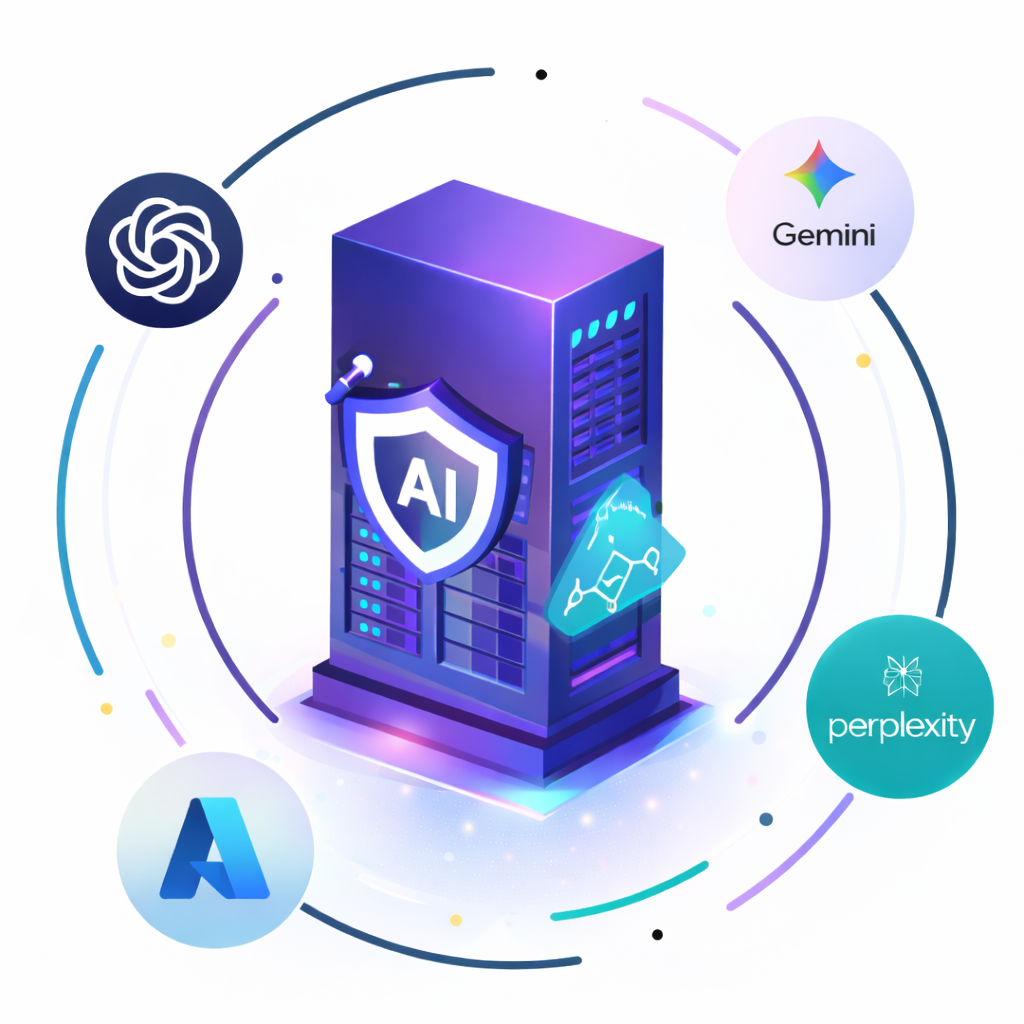
An Enterprise AI Gateway can provide a common layer between enterprise applications and multiple AI providers.
AI model routing can then select the appropriate model based on capability, cost, latency, security, or data sensitivity.
One task might use OpenAI.
Another could use Gemini, Claude, Llama, DeepSeek, or a local model.
The workflow remains stable even when the model changes.
That is a major part of long-term production readiness.
Enterprise LLM Security Needs Clear Boundaries
Production AI systems often connect to internal applications.
That makes security more complex.
Enterprise LLM security should control what users and AI agents can access.
A knowledge assistant should only retrieve documents the employee is authorised to see.
An AI agent connected to a CRM should not automatically gain access to unrelated financial systems.
Production deployments need role-based access, retrieval restrictions, secure credentials, logging, data masking, and tool permissions.
The principle should be simple.
Give AI only the access required to complete the workflow.
Every Important Interaction Should Be Traceable
If AI contributes to a business process, the organisation should be able to understand what happened.
Production systems need logging.
Teams may need to know which user initiated a request, which model processed it, what data was accessed, what output was produced, and whether a human approved an action.
This is particularly important in regulated environments.
AI usage monitoring also gives technology leaders visibility into adoption patterns.
It can show which workflows are heavily used, which models generate the most traffic, and whether unusual activity needs investigation.
Production AI Needs Cost Controls
An AI system can work perfectly and still become difficult to scale if its operating costs are unpredictable.
LLM cost management should be part of production design.
Not every task needs the most expensive model.
Simple extraction or classification workloads may use smaller models.
Advanced reasoning tasks can be routed to more capable options when required.
Central monitoring can track consumption by department, application, workflow, or model.
This makes AI spending easier to forecast and prevents successful pilots from becoming unexpectedly expensive when usage grows.
Human Escalation Paths Must Be Clear
Production AI should know its limits.
There will always be cases where information is missing, confidence is low, or business rules require human judgment.
A good workflow should define exactly when the AI stops.
For example, a KYC system could automatically process standard documents but escalate inconsistencies.
A policy assistant could answer routine questions but refer ambiguous cases to compliance.
A hiring workflow could organise candidate information while leaving final decisions to recruiters.
Human review should be part of the design, not an emergency backup.
Integration Matters More Than the Interface
A polished chatbot interface does not make an AI system production-ready.
The real test is whether it connects to the systems required to complete the work.
That may include CRM platforms, HRIS systems, core banking applications, document repositories, internal databases, APIs, and communication tools.
Production AI should fit into existing workflows rather than forcing employees to copy information between disconnected tools.
This is where Forward Deployed Engineers can add significant value.
They work alongside business and technical teams to understand how processes actually operate, connect AI to existing systems, and refine the workflow around real user behaviour.
Ownership Must Be Defined Before Launch
Who owns the system after deployment?
That question is often overlooked.
Production AI needs clear responsibility for model performance, data sources, governance policies, integrations, security, and ongoing improvements.
The organisation should also have documentation and trained internal owners.
A successful deployment should leave behind capability, not dependency.
Teams need to understand how the system works and what to do when requirements change.
A Pilot Proves Possibility. Production Proves Value.
The difference between a pilot and a production AI deployment is not simply scale.
It is operational trust.
Employees need to know the system will work when they depend on it.
Security teams need visibility.
Business leaders need measurable outcomes.
Technology teams need manageable costs and architecture.
Compliance teams need traceability.
A production-ready Sovereign AI deployment brings these requirements together.
It connects AI to a real workflow, protects sensitive data, supports multiple models, enforces governance, monitors usage, manages costs, and keeps humans involved where judgment matters.
That is what turns AI from an interesting experiment into a system the business can actually rely on.