For years, telecom operators have focused on monetizing connectivity through voice, messaging, and mobile data. But the network holds another valuable asset: location intelligence. Dialog Axiata offers a useful example of how operators can move beyond connectivity by turning network capabilities into services that enterprises and developers can actually use. For telcos exploring similar opportunities, the lesson is clear. The right LBS Service Provider can help transform location from a background network function into a foundation for new digital revenue.
Dialog Axiata Shows the Value of Opening Network Capabilities
Dialog Axiata has increasingly positioned itself beyond traditional telecom services. Its enterprise portfolio today spans areas including IoT, data insights, cloud services, communication platforms, and tools designed to help businesses digitize operations.
Location is part of this broader opportunity.
In 2023, Dialog Axiata joined Sri Lanka’s other mobile operators in commercially launching network APIs under the GSMA Open Gateway initiative. Among the first APIs introduced was Device Location, alongside OTP Validation and Carrier Billing. The initiative gave developers and enterprises standardized access across Sri Lanka’s mobile networks.
This points to an important shift for telecom operators. Instead of keeping valuable network capabilities inside the network, they can expose them securely as programmable services.
A Location API gateway makes that model easier to scale.
Turn Location Into Something Enterprises Can Buy
Having location information isn’t the same as monetizing it.
The real opportunity appears when operators package network capabilities into solutions that solve business problems.
Dialog Enterprise’s Smart Workforce service provides a practical example. The solution offers capabilities such as real-time employee location tracking, movement monitoring, location history, and workforce visibility. Dialog positions it for sectors such as FMCG, manufacturing, retail, transportation, and businesses managing distributed teams.
This demonstrates how Enterprise location services can move from technical capability to commercial product.
For another operator, that might mean fleet management. For a retailer, it could mean location-aware engagement. Logistics companies could use location data to improve operational visibility. Financial institutions could potentially combine location signals with other controls in approved use cases.
The lesson isn’t to copy one product. It is to identify where Telco location intelligence solves a measurable enterprise problem and build an offering around it.
Build a Platform, Not Just One Location Service
One of the biggest mistakes an operator can make is developing every location service separately.
A stronger strategy is to establish a reusable Location-based services platform that can support many applications.
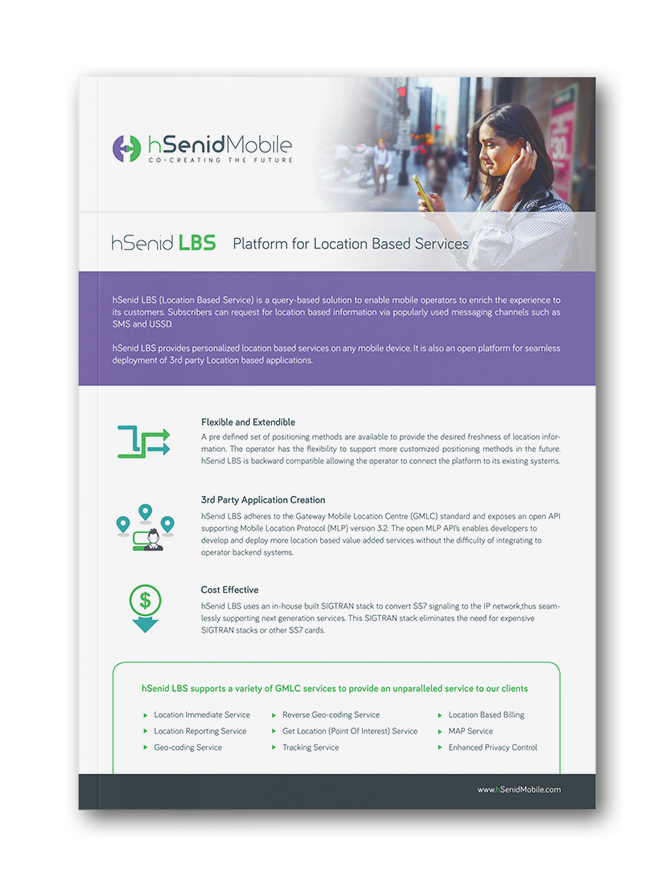
hSenid LBS is designed as a query-based platform that allows mobile operators to provide personalized location-based information while also supporting third-party location applications.
Its architecture includes an MLP interface for third-party applications and supports ATI, PSI, SIGTRAN, and customized positioning methods. Administration and charging gateway components are also incorporated into the platform architecture.
For telcos, this is important because monetization becomes easier when multiple services can share the same underlying infrastructure.
A suitable LBS Service Provider can help operators create that common layer, rather than building isolated solutions every time a new enterprise or developer needs location capabilities.
Developers Can Become Part of the Revenue Model
Dialog Axiata’s participation in GSMA Open Gateway highlights another important lesson: developers matter.
The 2023 Sri Lankan network API launch provided enterprises and developers with standardized access to APIs including Device Location. The initiative was designed to reduce fragmentation and make network resources easier to consume across operators.
This is significant because developers can create services much faster when they don’t have to understand each operator’s underlying infrastructure.
The telco can then explore several monetization models, including API consumption charges, enterprise packages, developer partnerships, or revenue-sharing arrangements.
An LBS Service Provider can support this transition by giving third-party applications controlled access to operator location capabilities while keeping the complex network integrations behind the platform.
Location-Based Marketing Creates Another Opportunity
Location intelligence can also make enterprise engagement more contextual.
The hSenid LBS material illustrates a mobile advertising scenario where people within a defined geographic area can receive promotional alerts.
Consider a restaurant that wants to reach subscribers close to one of its branches. A retailer may want to promote an offer around a shopping district. A tourism business could deliver information when visitors enter a particular destination.
Instead of broad mass communication, location makes engagement more relevant to the customer’s immediate context.
For the operator, these services can create opportunities around campaign management, enterprise subscriptions, location queries, and other value-added services.
Start With Utility and Expand From There
Not every location service has to be complex.
Simple, useful applications can establish the foundation for a much broader ecosystem.
The hSenid LBS material includes an example where subscribers can find the nearest coffee shop and receive destination information. The platform also supports functions such as reverse geocoding, location reporting, tracking, mapping, point-of-interest services, location-based billing, and enhanced privacy controls.
Each capability can become a building block.
When those building blocks are exposed through a flexible platform, operators can support services across retail, transportation, tourism, advertising, workforce management, and many other sectors.
What Other Telcos Can Learn From Dialog Axiata
Dialog’s broader digital strategy shows why operators should look at network assets differently. Connectivity remains fundamental, but enterprise solutions, IoT, APIs, and data-driven services create additional ways to participate in customers’ digital transformation.
For location specifically, the strongest model is not simply selling coordinates. It is creating useful services around network location.
That means establishing standardized APIs, supporting developers, creating enterprise solutions, and building charging models around network capabilities.
With a flexible LBS Service Provider, telcos can take existing network intelligence and convert it into services that enterprises and developers are prepared to consume.
Location is already inside the network. The revenue opportunity comes from making it usable.