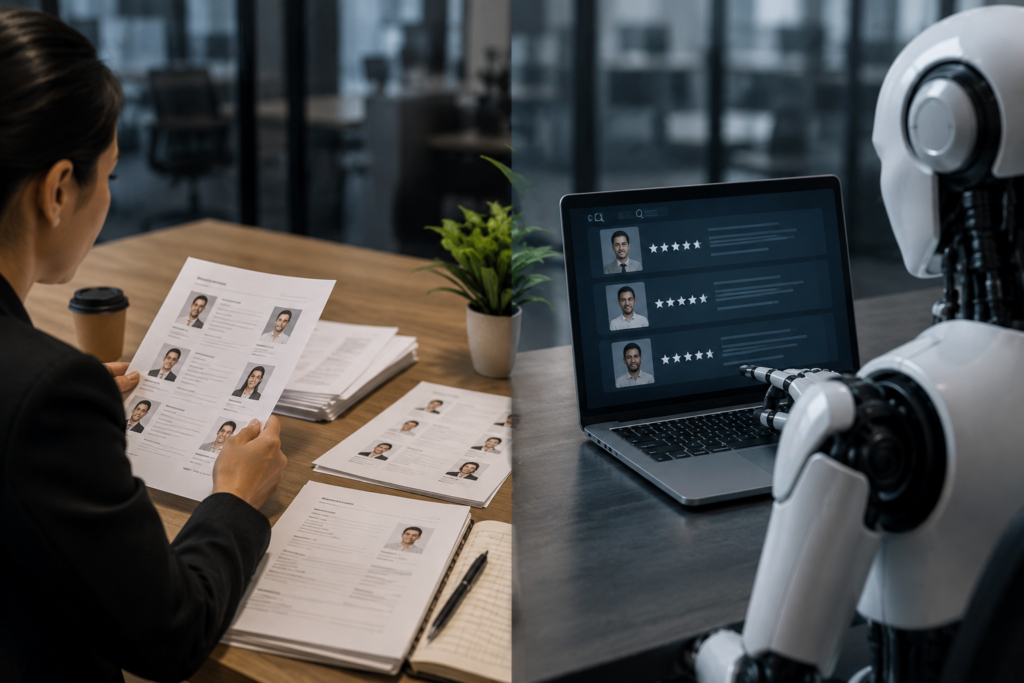
Finding the right candidate has always involved judgment, experience, and a fair amount of time. Traditional hiring relies heavily on recruiters manually reviewing CVs, coordinating interviews, taking notes, and comparing applicants. That approach can work, but it becomes harder to maintain when application volumes increase.
An AI Hiring Platform changes the process by automating many early recruitment activities while giving hiring teams structured information about each candidate. The goal isn’t to replace recruiters. It’s to help them spend more time evaluating strong candidates and less time managing repetitive screening tasks.
So, when AI hiring and manual hiring are compared, which approach actually identifies better talent?
Manual Hiring Relies Heavily on Recruiter Capacity
Manual recruitment gives recruiters direct control over candidate evaluation. A recruiter can consider personality, communication style, experience, and contextual details that may not appear clearly on a CV.
The problem is scale.
When hundreds of applications arrive for one position, reviewing every candidate with the same level of attention becomes difficult. According to the hSenid Hiring Intelligence overview, traditional recruitment can become slow and inconsistent when HR teams are overwhelmed by large application volumes, contributing to delayed hiring and poor candidate experiences.
A strong candidate can therefore be missed simply because recruiters don’t have enough time to investigate every application thoroughly.
AI Hiring Creates a More Structured First Evaluation
An AI Hiring Platform can automate the initial stages of recruitment and create a consistent evaluation framework for every applicant.
Instead of relying only on quick CV scans, AI-powered systems can compare candidate experience and skills against defined job requirements. hSenid Hiring Intelligence, for example, combines NLP with data-driven analytics to automate early recruitment stages and help HR teams concentrate on selecting the best talent.
This gives recruiters a structured starting point before human interviews begin.
AI Can Evaluate More Than a Resume
Manual screening often begins with a CV. That means candidates with well-written resumes may naturally receive more attention, even when another applicant could be better suited to the actual role.
AI interview software can help recruiters move beyond the resume by analysing responses to role-specific interview questions.
hSenid Hiring Intelligence supports automated conversational interviews with customizable question banks, evaluation keywords, and time limits. Its natural language processing capabilities can also process responses in real time.
This allows candidates to demonstrate their knowledge and communication ability rather than being judged only by the presentation of their CV.
Manual Hiring Can Become Inconsistent
Two recruiters can interview the same candidate and leave with very different impressions. That’s part of human judgment, but it can also make comparisons difficult.
Interview automation software creates greater consistency by asking candidates applying for the same position a standardized set of questions.
A Real-time candidate evaluation tool can then capture responses using the same evaluation framework. Recruiters still review the outcome, but each applicant has been assessed against more consistent criteria.
This becomes particularly valuable when multiple departments or recruiters are involved in the hiring process.
AI Hiring Makes Candidate Comparison Easier
Manual recruitment often produces scattered information. CVs may sit in one system, interview notes in another, while feedback is shared through email or messaging platforms.
AI recruitment analytics can centralize much of this information.
The hSenid Hiring Intelligence recruiter dashboard provides real-time application metrics, shortlist information, pipeline visualizations, and AI-generated score distributions. These insights can help hiring teams identify high-performing candidates and recruitment bottlenecks more quickly.
Rather than comparing applicants from memory or separate notes, recruiters gain a clearer view of candidate performance across the pipeline.
Weighted Scoring Can Improve Role-Specific Selection
Not every qualification should influence a hiring decision equally.
A sales role might place greater importance on communication skills. A senior engineering role may prioritize technical experience. Manual interviews can consider these differences, but applying them consistently across dozens of candidates can be challenging.
hSenid Hiring Intelligence allows recruiters to create weighted scoring models using qualitative and quantitative criteria, including factors such as fluency and years of experience.
An AI Hiring Platform can therefore help recruitment teams evaluate candidates according to what actually matters for each role.
AI Also Changes the Candidate Experience
Better talent can disappear from a recruitment pipeline if the process moves too slowly.
Candidates increasingly expect quick communication and flexible experiences. hSenid Hiring Intelligence supports automated confirmations and interview invitations while allowing candidates to participate in interviews according to their own schedules.
Manual hiring can offer a highly personal experience, but automation can make that experience faster and easier to access.
So, Which Approach Finds Better Talent?
AI hiring and manual hiring work best when they aren’t treated as complete opposites.
Manual recruitment brings human judgment, contextual understanding, and meaningful interaction. AI hiring contributes speed, standardized evaluation, analytics, and the ability to process much larger candidate volumes.
The strongest approach is often to use technology for repetitive and data-heavy stages while allowing recruiters to focus on decisions that require deeper human judgment.
An AI Hiring Platform can identify promising candidates earlier, provide structured evidence for comparison, and help recruiters avoid spending valuable time on applicants who don’t meet essential requirements. Human recruiters can then concentrate on culture, motivation, potential, and the final hiring decision.
Better hiring isn’t about choosing humans or AI. It’s about giving recruiters better information so they can recognize better talent.