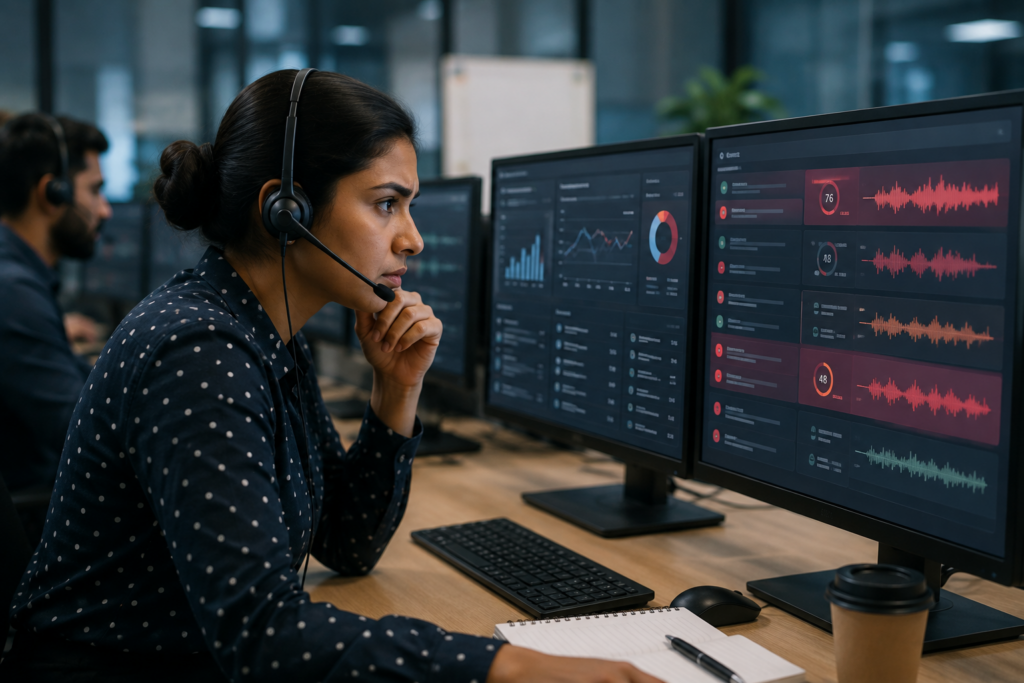
Not every difficult customer call becomes a serious business problem. But some do.
A frustrated customer may be preparing to leave. A repeated complaint may point to a larger service issue. A policy mistake may create compliance risk. The challenge is identifying those conversations early enough to act.
Manual reviews make this difficult because customer service teams often rely on sample-based monitoring. Important conversations can go unnoticed until the issue becomes more serious. The hSenid Voice Operations Platform addresses this by analyzing customer calls and turning them into actionable insights that help teams identify risks, improve service quality, and respond faster.
With AI Call Monitoring Software, customer service leaders can move from reacting to problems after escalation to spotting warning signs while there is still time to intervene.
High-Risk Conversations Are Often Hidden in Everyday Calls
A high-risk conversation does not always sound dramatic.
Sometimes the warning signs are subtle. A customer may repeatedly mention the same unresolved problem. Someone may sound increasingly frustrated while remaining polite. Another customer may question why they should continue using a service.
These conversations are easy to miss when supervisors manually review only a limited sample.
The source material for the hSenid Voice Operations Platform highlights several common challenges, including difficulty monitoring large call volumes, slow issue resolution, limited visibility into service interactions, and missed opportunities to identify at-risk customers.
The real risk is not simply receiving a complaint. It is failing to recognize the pattern behind it.
Look for Repeated Complaints
One complaint may be an isolated incident.
The same complaint appearing across many conversations is different.
Repeated issues can reveal problems with a product, service process, billing experience, campaign, or customer support workflow. If these patterns are buried inside hundreds of recordings, managers may not recognize them quickly.
AI speech analytics software can help teams organize conversation data and detect recurring themes more efficiently.
A call transcription and analysis tool can also make customer issues easier to review by converting conversations into structured information. Instead of manually listening for the same complaint again and again, supervisors can identify common problem categories and investigate the causes behind them.
The Voice Operations Platform supports automatic issue classification, helping teams prioritize important problems for faster handling.
Pay Attention to Changes in Customer Sentiment
What customers say matters.
How they feel during the conversation matters too.
A customer may begin a call calmly but become increasingly frustrated when an issue remains unresolved. Another may repeatedly express disappointment or dissatisfaction without directly asking to cancel.
Call sentiment analysis software can help customer service teams detect these emotional signals across larger volumes of conversations.
This matters because negative sentiment can become an early indicator of customer risk.
The hSenid Voice Operations Platform uses sentiment and complaint patterns to support proactive customer care. It is designed to help teams detect at-risk customers early so concerns can be addressed before they escalate.
That allows customer service teams to intervene while there is still an opportunity to rebuild trust.
Identify Issues That Keep Returning
Repeat calls deserve attention.
If a customer contacts support several times about the same issue, the problem may not be the customer. It may indicate that the original resolution was incomplete.
Recurring conversations can increase frustration and place additional pressure on service teams.
AI Call Monitoring Software can help managers identify high-impact issues that may require faster intervention. The Voice Operations Platform can classify and prioritize customer problems with the aim of improving response times and reducing repeat calls.
This gives supervisors an opportunity to look beyond individual agent performance.
Perhaps agents need better information. Maybe a process is too complicated. Or perhaps the issue needs escalation to another department.
Finding those patterns early can prevent a manageable service issue from becoming a larger customer experience problem.
Watch for Potential Compliance Issues
Some high-risk calls are not about customer dissatisfaction at all.
They are about compliance.
A missed disclosure, incorrect explanation, or failure to follow an internal policy can create operational risk. When businesses depend on manual sampling, these conversations may never be reviewed.
The Voice Operations Platform supports policy and compliance assurance by identifying potential violations that may require attention. Its goal is to help organizations reduce operational risk while strengthening customer trust.
AI Call Monitoring Software can therefore help teams focus their attention on conversations that deserve closer examination rather than relying entirely on random reviews.
Find Customers Showing Multiple Risk Signals
One negative comment does not necessarily mean a customer is preparing to leave.
Several warning signs appearing together are more meaningful.
Imagine a customer who has called three times, repeatedly mentions an unresolved issue, and shows increasingly negative sentiment. That combination deserves attention.
This is where Call sentiment analysis software becomes particularly useful.
By connecting sentiment with complaint patterns and recurring issues, teams can gain a clearer understanding of which customers may require proactive support.
The Voice Operations Platform specifically includes customer risk identification as a key capability. It helps teams identify at-risk customers so concerns can be addressed before they escalate, with the aim of reducing churn and improving loyalty.
Give Supervisors Context, Not Just Alerts
Finding a risky conversation is only the first step.
Supervisors also need to understand what happened.
Was the problem caused by poor communication? Was the customer given incorrect information? Did the agent fail to resolve the issue? Or is the underlying service process creating frustration?
A call transcription and analysis tool can give supervisors more context before they decide how to respond.
The Voice Operations Platform evaluates call quality, problem resolution, and agent performance to provide clearer insight into how effectively and empathetically teams communicate with customers.
This makes intervention more useful.
Instead of simply telling an agent that a call was problematic, managers can identify what went wrong and determine the right next action.
Use Risk Insights to Improve Agent Coaching
High-risk conversations can also reveal valuable coaching opportunities.
If several agents struggle with the same type of complaint, the problem may require broader training. If one agent repeatedly has difficulty de-escalating frustrated customers, targeted coaching may help.
The Voice Operations Platform supports coaching and quality management by helping managers identify opportunities to improve empathy, professionalism, and resolution skills.
This is another benefit of AI Call Monitoring Software.
It does not simply identify problematic conversations. It can help teams understand what those conversations reveal about service quality and agent development.
Move From Reactive Service to Proactive Customer Care
Traditional monitoring often tells you what already went wrong.
Modern customer service operations need to know what might go wrong next.
AI speech analytics software, Call sentiment analysis software, and structured conversation analysis can help teams detect patterns earlier. That means customer service leaders can investigate recurring complaints, identify potential compliance concerns, prioritize major issues, and support customers showing signs of dissatisfaction.
The goal is not to label every negative call as high risk.
It is to give teams enough visibility to recognize when several warning signs point in the same direction.
With AI Call Monitoring Software, customer conversations become more than recordings stored for later review. They become an early-warning system for service problems, customer dissatisfaction, and operational risk.