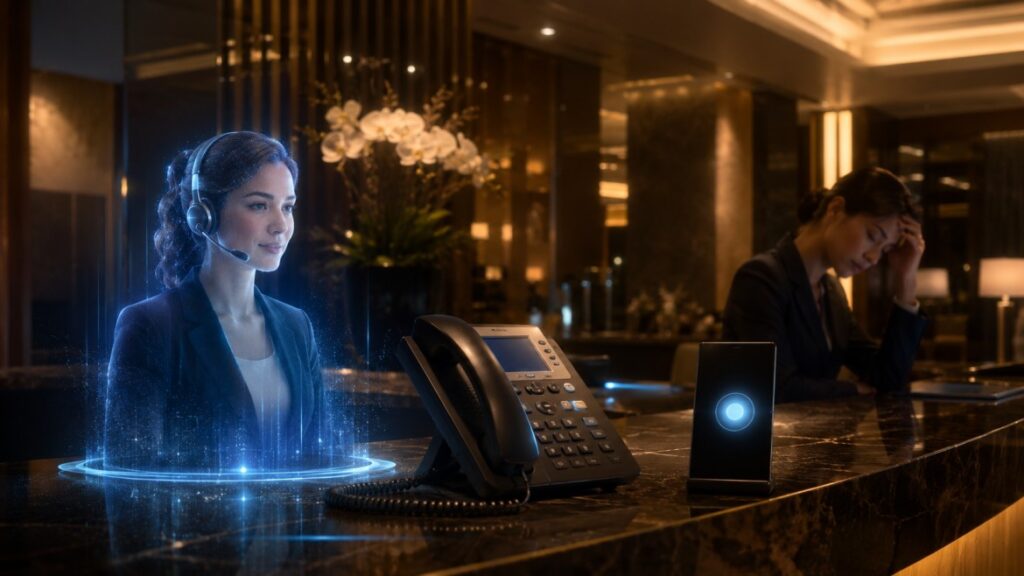
Hotels never really close. A guest may want to confirm a late check-in at midnight, ask about airport transfers at 1 AM, or call about tomorrow’s reservation at 2 AM. Yet reception teams have limits. Staff may be helping guests at the desk, handling another call, or operating with a smaller overnight team. An AI Call Agent gives hotels another way to stay responsive without expecting receptionists to be available for every conversation, every hour of the day.
The Front Desk Has More to Manage Than Phone Calls
Hotel receptionists rarely have one responsibility.
They welcome arriving guests, coordinate check-ins and check-outs, answer questions, communicate with housekeeping, manage requests, handle complaints, process reservations, and deal with unexpected issues throughout a shift.
Then the phone rings.
During quieter periods, answering that call may be easy. During check-in hours or late-night shifts with limited staffing, it can become another competing priority.
One missed call could be a simple question. It could also be a guest trying to confirm a reservation or a potential customer considering a booking.
The challenge isn’t that hotel teams aren’t working hard enough. It is that one person can only handle so many interactions at once.
An AI Call Agent Doesn’t Need a Night Shift
This is where conversational automation becomes useful.
The hSenid solution is designed to answer incoming calls instantly through natural, human-like conversations instead of forcing every caller to wait for a customer support employee or navigate complicated phone menus.
For hotels, that creates a practical opportunity to extend phone availability beyond the capacity of the front desk.
A guest doesn’t necessarily want to hear a list of menu options at 2 AM. They may simply want to ask, “Can I check in after midnight?” or “Is breakfast included with my booking?”
An AI voice agent can provide a more conversational starting point by allowing callers to explain what they need naturally.
Guests Want Conversations, Not Menu Mazes
Traditional IVR can be useful for structured call routing, but hospitality interactions aren’t always predictable.
A guest might ask several things in the same conversation. They could want to confirm their reservation, ask whether an extra bed is available, and check the airport transfer schedule before arriving.
Making that caller navigate separate menu paths can create unnecessary friction.
The hSenid AI solution is designed around conversation rather than “Press 1” menus. Callers describe their request, and the system routes the query toward a relevant resolution instead of making them search through options that may not fit their problem.
That makes voice AI particularly relevant to hospitality, where customer questions often sound more like conversations than support tickets.
Automation Should Support Receptionists, Not Replace Hospitality
Hotels are built around human service. Technology shouldn’t remove that.
There will always be conversations that require a person. A guest may be upset, have a complicated booking issue, need special assistance, or want to speak directly with hotel staff.
An effective AI Call Agent should know when to step aside.
The hSenid solution includes human handoff, allowing callers to move to a live agent or request a callback when necessary.
This creates a more balanced approach to contact center automation. Routine questions can be handled automatically, while receptionists remain available for interactions where personal attention matters most.
The goal isn’t less hospitality. It is giving hotel employees more time to deliver it.
Around-the-Clock Support Can Matter in Hospitality
Travel doesn’t operate on a nine-to-five schedule.
Flights arrive late. International travelers call from different time zones. Guests make last-minute plans. People remember questions after reception teams have moved into overnight staffing.
The hSenid material specifically identifies hospitality as a use case for handling bookings and guest requests around the clock without depending on a front-desk hold queue.
This is especially useful for hotels dealing with high-volume call handling during seasonal peaks, holidays, events, and busy booking periods.
Instead of increasing staffing every time demand rises, hotels can use AI Call Automation to absorb routine calls while keeping human teams focused on guests already on the property and situations requiring direct attention.
Every Guest Call Can Also Reveal Something
Calls contain valuable information.
Guests repeatedly asking about airport transfers may indicate that information isn’t easy to find elsewhere. Frequent questions about check-in times could reveal a communication gap. Calls about upgrades may signal an opportunity for additional revenue.
The hSenid solution logs and analyzes conversations, identifies unanswered questions that can help improve its knowledge base, uses sentiment analysis to highlight potential churn risks, and can capture signals such as upgrade requests.
For hotels, this turns an AI voice agent into more than an answering system. Conversations can become another source of insight into what guests need, ask about, and potentially want to purchase.
Give Your Reception Team Backup That Never Sleeps
Great hospitality will always depend on people. But great service also means being available when guests need an answer.
An AI Call Agent can help hotels handle routine booking questions and guest requests outside normal staffing capacity while allowing human employees to take over when a conversation requires personal attention.
Your receptionist shouldn’t have to choose between helping the guest standing at the desk and answering every phone call that comes in at 2 AM. With the right voice automation in place, they don’t have to.