
Enterprise AI is moving beyond chat.
The next generation of AI does not simply answer questions. It can read documents, access business systems, call APIs, make decisions, route work, trigger actions, escalate exceptions and record what happened.
That is the promise of agentic AI.
It is also where the risk changes.
Giving an AI model access to enterprise data is one thing. Giving it permission to act across CRM platforms, HR systems, banking applications, document repositories and internal APIs is something entirely different.
The question for enterprises is no longer:
“Can we use AI?”
It is:
“How do we let AI do real work without losing control of our data, systems and decisions?”
That is where an AI gateway, enterprise guardrails and a deployment model designed around real workflows become critical.
At hSenid Mobile, Sovereign AI combines this control layer with Forward Deployed Engineers (FDEs) who work alongside enterprise teams to move AI from experiments into secure, measurable production workflows.
From AI That Answers to AI That Acts
Traditional generative AI largely operates around a simple interaction.
A user asks something.
The model generates an answer.
Agentic AI changes that model.
An agent may receive a goal, determine the steps required, select the appropriate tools, retrieve information from multiple systems and execute actions without someone manually controlling every individual step.
Consider a recruitment workflow.
Instead of asking an AI system to summarise a CV, an agent could:
read thousands of applications, compare candidates against role requirements, retrieve additional information from an HR system, rank applicants according to approved criteria, flag exceptions and prepare a shortlist for the recruitment team.
In banking, an AI agent could extract information from documents, compare it against internal policies, identify missing information, route cases and escalate higher-risk decisions to authorised employees.
In customer operations, an agent could understand an inquiry, retrieve account information, trigger internal workflows and document the interaction automatically.
AI stops being another tool employees have to operate.
It begins participating directly in the workflow.
But the more authority an agent receives, the more important governance becomes.
Why Agentic AI Creates a Different Security Problem
AI agents may interact with tools, files, APIs, databases and external services.
That creates an attack surface very different from a standalone chatbot.
OWASP identifies risks including prompt injection, tool abuse, privilege escalation, sensitive data exposure, goal hijacking and excessive autonomy in agentic AI systems.
An agent may technically be capable of performing an action without necessarily being authorised to perform it in every situation.
That distinction matters.
An AI system connected directly to enterprise infrastructure without appropriate controls could potentially receive more information than it needs, invoke tools unnecessarily or allow malicious instructions hidden inside documents or other external data to influence its behaviour.
Enterprise AI therefore needs something between the model and the systems it can access.
It needs a control layer.
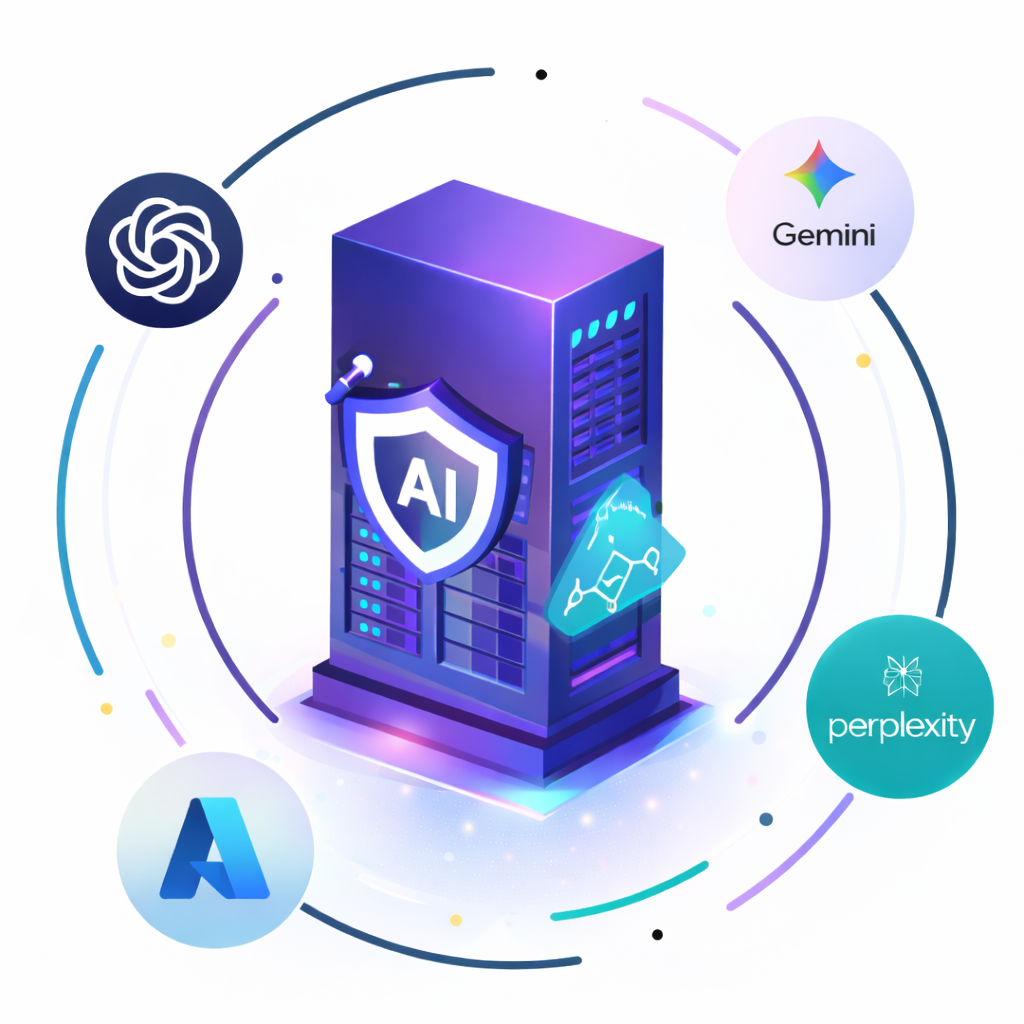
The AI Gateway: A Control Layer Between AI and Your Enterprise
An AI gateway provides a controlled layer between enterprise applications, AI models and the systems those models interact with.
Instead of every application connecting directly to individual LLM providers, enterprises can centralise how AI traffic is routed, governed and monitored.
This becomes particularly important when organisations want the freedom to work with multiple models.
One workload may perform best with OpenAI.
Another may be better suited to Gemini, Claude, Llama, DeepSeek or a locally deployed model.
The enterprise should be able to choose based on performance, cost, latency, data sensitivity and internal policy without rebuilding its workflows around a single vendor.
With Sovereign AI, organisations can create a model-agnostic architecture while retaining enterprise controls around how those models are used.
The objective is not simply access to more models.
It is controlled access to the right model for the right task.
MCP Security and Agent Guardrails: Connecting AI Without Giving It Unlimited Access
One of the technologies accelerating agentic AI is the Model Context Protocol (MCP).
MCP provides a standardised way for AI applications to connect with external tools and data sources. As those connections expand, MCP servers can become important control points between an AI agent and enterprise infrastructure.
The benefit is powerful: instead of building a completely custom integration for every AI tool, organisations can establish more standardised ways for agents to discover and interact with approved capabilities.
But connectivity should never mean unlimited authority.
OWASP’s guidance for MCP environments emphasises authentication, authorisation, validation, session isolation and secure deployment, particularly because MCP-based environments can involve delegated permissions and chained tool calls.
Enterprise implementations therefore need agent guardrails.
That means defining exactly what an agent can access, what it can change, which tools it may invoke, which actions require approval and what must be recorded.
A well-designed architecture can include controls such as:
Least-privilege tool access so agents receive only the permissions required for a specific workflow.
PII masking before sensitive information reaches external models.
Role-based access controls (RBAC) aligned with existing enterprise permissions.
Human approval checkpoints before high-impact or irreversible actions.
Model routing policies that determine where different data and workloads can be processed.
Budget and usage controls to prevent uncontrolled AI consumption.
Audit logging so every interaction, tool call and important action can be traced.
The goal is not to make an agent powerless.
It is to give it bounded authority.
Enough authority to automate meaningful work.
Not enough to operate outside enterprise policy.
Enterprise LLM Security Starts With Architecture
Many organisations initially approach enterprise LLM security at the model level.
Which model is safest?
Which provider should we use?
Should the model run in the cloud or on-premise?
Those are important questions, but they are only part of the problem.
Enterprise security also depends on everything surrounding the model.
What information enters its context?
Which system is requesting the information?
What can the model retrieve?
Which tools can an agent invoke?
What happens to personally identifiable information?
Can one department access another department’s knowledge?
Who approved a particular action?
Where is the audit trail?
This is why sovereign AI is not simply about hosting an LLM inside your infrastructure.
It is about maintaining control over the entire AI execution layer.
For sensitive environments, Sovereign AI can be deployed on-premise or within private cloud environments, allowing organisations to determine where sensitive information is processed and how it is protected.
The Model Is Only One Part of the System
Enterprises often spend significant time comparing models.
But production AI projects rarely fail because an organisation selected the wrong LLM.
The harder challenge is connecting AI to the workflow.
An AI agent may need context from a CRM, policies from a document repository, customer information from one system and approval from another team before anything useful can happen.
These integrations must work reliably.
Security rules must reflect the organisation’s actual operating environment.
Exceptions must be handled.
Employees need to trust the system.
And someone has to measure whether the workflow produces a meaningful business result.
This is where Forward Deployed Engineers change the implementation model.
Forward Deployed Engineers: Building AI Inside the Work
hSenid Mobile’s Forward Deployed Engineers work alongside enterprise teams rather than delivering an AI platform and leaving the organisation to determine what comes next.
The process begins with the workflow.
Where is specialist time being lost?
Where are employees repeatedly searching for information?
Where are documents being processed manually?
Where are decisions delayed because information sits across several systems?
Where does work continuously move between people, systems and departments?
The FDE then connects AI to those real operating conditions.
The result is not another isolated AI demonstration.
It is an AI system designed around the way the organisation actually works.
hSenid Mobile structures FDE engagements around a 90-day path to measurable production outcomes, moving from workflow mapping and integration through deployment and measurement under a defined scope.
What AI Looks Like When It Becomes Part of the Workflow
Imagine an employee receives a 60-page document.
Without agentic AI, they may read it manually, extract relevant fields, compare the information against internal policies, enter the results into another system and send the case to another employee for review.
With a governed AI workflow, the process changes.
The system reads the document.
It extracts the required information.
It retrieves the relevant enterprise policy.
It compares the information.
It identifies anomalies.
It routes the case.
It escalates anything requiring human judgement.
And it logs what happened.
The employee is still in control where judgement matters.
But they are no longer spending most of their time moving information between systems.
That is the difference between using AI and deploying AI into work.
Sovereignty Does Not Mean Isolation
Enterprises should not have to choose between the capabilities of leading AI models and control over their own environments.
A sovereign architecture can allow organisations to use multiple models while controlling what those models can see and do.
Sensitive workloads can remain inside private environments.
Other workloads can use external models with appropriate masking and policy enforcement.
Models can change as technology evolves.
Enterprise workflows do not have to be rebuilt every time the AI market changes.
That model-agnostic approach also reduces dependency on any single LLM provider.
The organisation owns the workflow.
The model becomes a component within it.
The Real Question Is Not Which AI Model to Buy
Models will continue to improve.
New models will appear.
Prices will change.
Capabilities that seem extraordinary today will eventually become standard.
The more durable competitive advantage is the infrastructure around them: your workflows, integrations, enterprise context, governance and ability to deploy AI safely into production.
An AI gateway provides the control point.
Agent guardrails establish boundaries.
MCP and enterprise integrations connect AI to the tools required to perform useful work.
Sovereign deployment keeps sensitive information under organisational control.
Forward Deployed Engineers connect all of it to measurable business outcomes.
That is how agentic AI moves from experimentation to enterprise infrastructure.
Don’t Just Adopt AI. Deploy It.
The starting point does not need to be a company-wide AI transformation.
Start with one workflow.
One process where experienced people spend too much time searching, reading, routing, checking or moving information.
One process where reducing days to hours—or hours to minutes—would produce a measurable result.
Then build from there.
What is the one workflow in your organisation where your best people spend the most time on work that should not require their level of judgement?
That may be the best place to start.
Talk to a Sovereign AI Consultant
Learn how Sovereign AI and Forward Deployed Engineers can connect AI securely to the work that actually matters.