
Most enterprise AI still talks.
It answers questions, summarizes documents and generates content.
But the real value begins when AI can execute work.
That means connecting large language models to the systems your business already runs on—your CRM, HRIS, core banking platforms, document repositories, internal APIs and operational tools.
The challenge is doing that without giving AI uncontrolled access to sensitive data or business-critical systems.
That is where an AI gateway comes in.
What Is an AI Gateway?
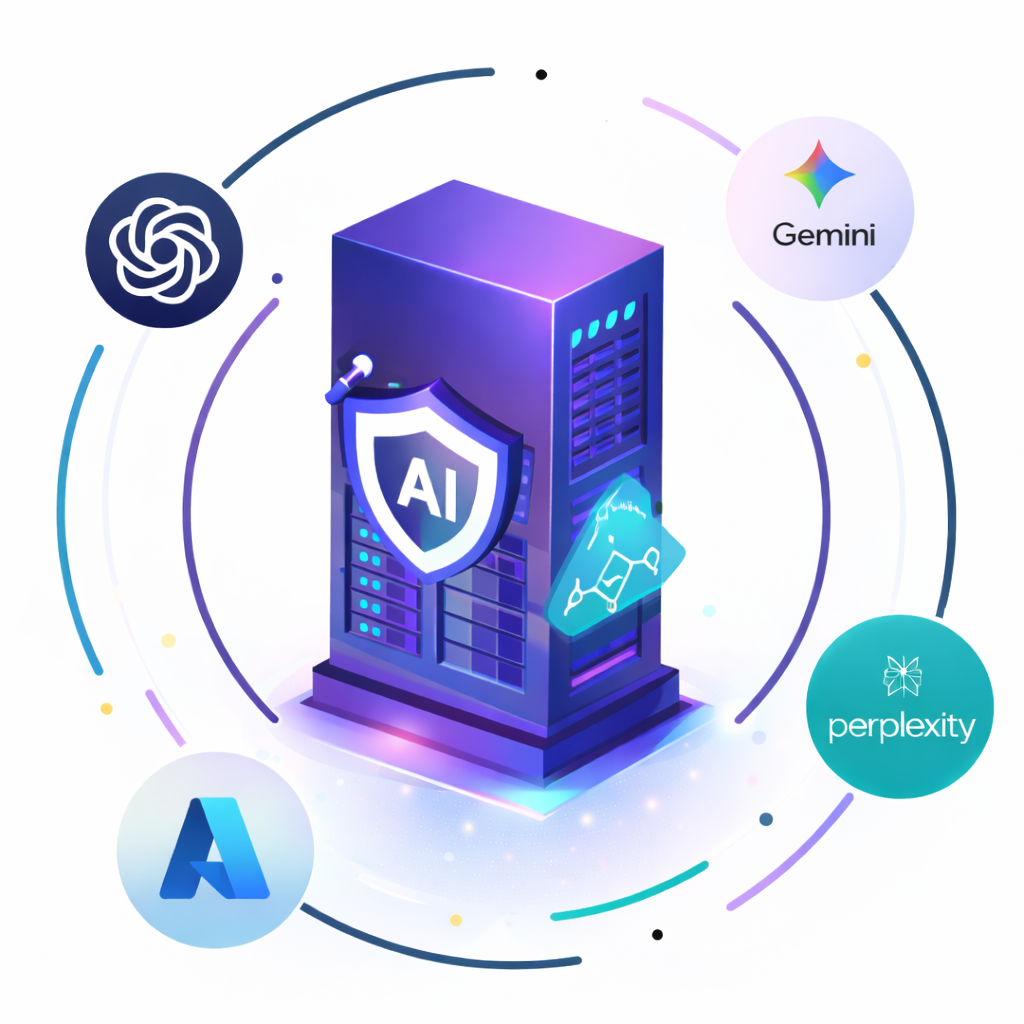
An AI gateway is a secure control layer between your enterprise systems and the AI models you use.
Instead of connecting every application directly to an LLM provider, the gateway manages how requests move between your systems, your data and different AI models.
It can determine:
which model should handle a task
what data the model is allowed to see
what information should be masked
which user or department can access a workflow
how much AI usage can be consumed
which actions need to be logged or reviewed
In simple terms, an enterprise AI gateway helps organisations use AI without losing control.
Why Direct LLM Connections Become a Problem
Connecting one AI tool to one business system may seem simple.
But enterprise environments rarely stay that simple.
A recruitment workflow may need access to an HRIS, CV repository and internal policies.
A banking workflow may need information from customer systems, documents and internal APIs.
A customer service workflow may need CRM data, support history and account information.
As the number of connections grows, so does the risk.
Different models may process data differently. Costs can become difficult to control. Sensitive information may be exposed unnecessarily. Teams may also struggle to understand which model accessed which system and why.
An AI gateway creates one governed layer across these interactions.
AI Model Routing: Use the Right Model for the Right Task
Enterprises do not need to depend on one AI model for every workload.
Different models can offer different strengths in cost, speed, reasoning, language support and deployment options.
With AI model routing, an AI gateway can direct each task to the most appropriate model.
For example, an organisation could use one model for document analysis, another for complex reasoning and a privately hosted model for highly sensitive workloads.
This creates a more flexible architecture.
The business owns the workflow.
The AI model becomes a replaceable component within it.
A model-agnostic approach also makes it easier to adopt new models without rebuilding every enterprise integration from scratch.
Protect Sensitive Data Before It Reaches the Model
Enterprise AI often works with information that should not be freely sent to external systems.
This may include customer details, financial information, employee records or personally identifiable information.
An enterprise AI gateway can apply data masking and privacy controls before information reaches an external LLM.
For example, names, account numbers or other sensitive fields can be removed or masked while still allowing the model to complete the task.
For more sensitive environments, workloads can also be routed to private-cloud or on-premise models.
The goal is simple: give the AI the context it needs without exposing more data than necessary.
Control AI Spend With Budgets and Usage Policies
AI usage can scale quickly across a large organisation.
Without controls, multiple teams, applications and automated workflows can create unpredictable usage and cost.
An AI gateway can apply budget limits at different levels, such as by team, department, workflow or model.
Organisations can then track where AI is being used and apply different policies depending on business requirements.
This turns AI spending from an uncontrolled technology expense into something that can be actively governed.
Audit Every Important AI Interaction
As AI begins executing work, visibility becomes critical.
Enterprises need to know what happened, which system was accessed and what action was taken.
An AI gateway can maintain audit logs across AI interactions, including model requests, workflow actions and system access.
This creates accountability and gives security, IT and compliance teams better visibility into how AI is operating across the organisation.
Auditability becomes particularly important when AI is involved in regulated or business-critical processes.
From AI Conversations to AI Workflows
The biggest advantage of an AI gateway is not simply better security.
It is what that security allows organisations to build.
Once AI is connected safely to enterprise systems, it can move beyond answering questions.
It can read, decide, route, escalate, execute and log.
An AI system could read a document, retrieve the correct policy, make an initial decision, update another system, route the case to the correct team and escalate exceptions to a human.
That is a very different outcome from a chatbot that simply generates a response.
Learn how Sovereign AI and Forward Deployed Engineers can connect AI securely to the work that actually matters.