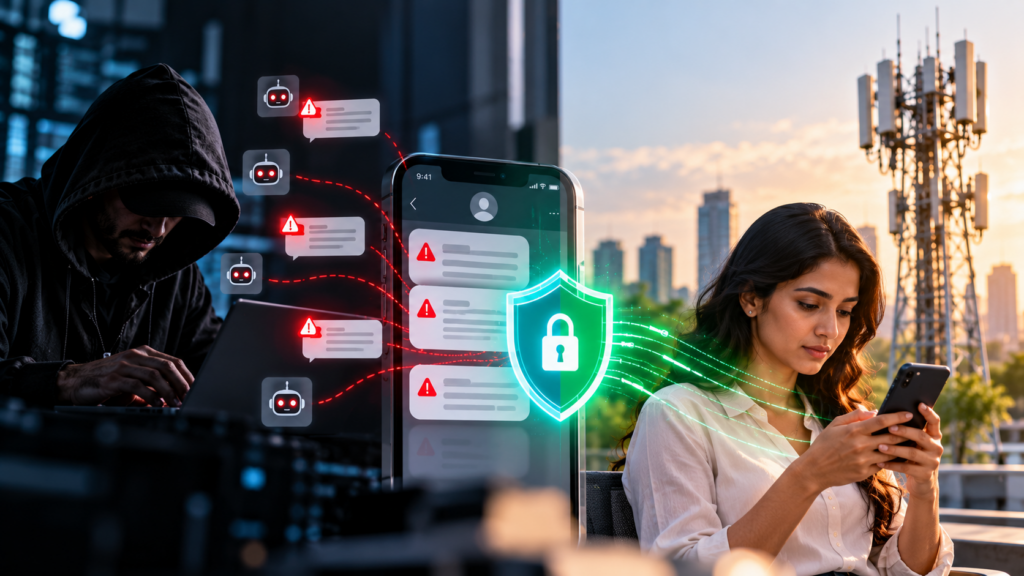
A scam SMS used to be easier to spot.
Bad grammar. Strange wording. An obviously suspicious link.
Generative AI changes that. Fraudsters can now produce convincing messages at scale, adapt the language to a particular brand or situation and remove many of the mistakes people traditionally used to identify phishing.
For mobile operators, this makes smishing more than a subscriber-security problem. When subscribers stop trusting messages from banks, retailers and other enterprises, the value of the wider A2P SMS ecosystem is affected.
What is AI smishing?
Smishing is phishing delivered through SMS.
The objective is usually to make a subscriber click a malicious link, provide credentials, disclose financial information or take another action that benefits the attacker.
AI does not fundamentally change the attack. It improves the message.
Research published in the International Journal of Information Security notes that generative AI can produce highly convincing and personalized phishing messages that closely imitate legitimate communications in tone, style and complexity.
Instead of sending one badly written message to millions of numbers, attackers can create multiple variations tailored around delivery notifications, banking alerts, account verification, taxes, rewards or other believable scenarios.
That makes simple keyword-based filtering less reliable.
Operators are already treating AI-assisted fraud as a network problem
Openmind Networks’ Future of Messaging Report 2026 is based on research with 100 senior telecom leaders from operators around the world. The research says 80% of messaging threats are now AI-assisted and cites projected global subscriber fraud losses of $71 billion in 2026.
The important shift is not simply that attackers are using AI.
Operators are increasingly responding at network level.
A real example comes from Sri Lanka.
According to a GSMA case study, a Dialog Axiata survey found that 20% of users had been targeted by scammers during the previous two years. Around half of those targeted became victims, and 30% of victims lost more than one month’s income. Dialog subsequently implemented real-time URL screening and security warnings to address scam SMS.
Those figures show why blocking a malicious message before a subscriber interacts with it matters.
Why traditional SMS filtering is becoming harder
A basic SMS filter might look for a known phrase, sender or URL.
AI-generated attacks make that approach easier to evade.
Fraudsters can change wording between messages, rotate URLs, imitate legitimate brands and create messages that sound natural. The individual SMS may not contain an obvious signal that it is fraudulent.
Detection therefore needs more context.
A modern SMS firewall can examine elements such as:
- message content and intent
- embedded URLs
- sender behaviour
- traffic patterns
- known malicious destinations
- unusually high-volume campaigns
- historical fraud signals
For example, current commercial smishing-detection systems combine URL extraction, threat intelligence and AI/ML analysis to classify suspicious messages and automate blocking.
The goal is not to block messages simply because they contain a link.
It is to understand whether the message, sender, destination and behaviour make sense together.
Blocking scams also protects A2P trust
The damage from smishing does not stop with the individual victim.
A message pretending to come from a bank can make subscribers suspicious of future legitimate banking alerts. The same applies to delivery companies, government services, retailers and other organisations using SMS.
Ofcom describes scam messaging as damaging public confidence in communication services, in addition to causing direct financial and emotional harm.
That makes fraud prevention part of A2P revenue protection.
Enterprises need confidence that their messages can reach customers through a channel users still trust.
The SMS firewall and SMSC have different jobs
An SMS firewall can inspect traffic and decide whether a message appears fraudulent.
The SMSC then needs to reliably process legitimate traffic.
This distinction matters.
hSenid SMSC provides configurable routing rules that allow operators to apply actions such as relay and reanalysis through its management interface. It also supports SMPP connections and the management of traffic from ESMEs and SMPP clients.
On the current hSenid SMSC platform, clustered architecture is designed to provide maximum availability, internal load balancing and no single point of failure. The platform can also scale capacity in response to sudden SMS traffic increases.
This becomes important when fraud controls sit in front of large volumes of legitimate enterprise traffic. Security cannot become a bottleneck for genuine messaging.
Scale makes the architecture matter
This is not theoretical infrastructure for us.
hSenid Mobile’s systems handle nearly 50 million transactions every day.
At that scale, operators cannot rely on manual review when suspicious traffic appears.
The architecture needs to identify potentially malicious traffic early, enforce network policies and continue processing legitimate messages without creating unnecessary disruption.
hSenid SMSC also includes overload protection. When messages exceed the configured Message Delivery Attempt level, excess capacity can be buffered and sent subsequently rather than simply discarded.
The objective is trust, not just blocking
AI will continue making fraudulent messages harder for subscribers to distinguish from legitimate ones.
The answer is not to make customers better at spotting every scam themselves.
More of the protection needs to happen before the message reaches them.
For operators, that means combining content-aware SMS firewall capabilities with reliable core messaging infrastructure, clear routing controls and scalable message processing.
Block the scam.
Deliver the legitimate message.
Keep SMS worth trusting.