A location-based services platform can support everything from nearest-store searches and fleet tracking to location verification and targeted campaigns.
The harder question for operators is commercial:
How should you charge for it?
There is no single LBS pricing model that works for every enterprise. A bank making occasional location-verification requests behaves very differently from a logistics company tracking thousands of devices throughout the day.
The pricing model should follow how the customer receives value.
Start With the Use Case
Before setting a price, understand what the enterprise is actually buying.
An enterprise may be paying for:
- individual location lookups
- recurring tracking
- access to a defined subscriber base
- a geographic marketing campaign
- API access with a committed usage volume
These should not automatically carry the same commercial structure.
GSMA has made a similar point about network API monetisation: for advanced APIs, including location-based services, pricing purely from infrastructure cost can miss how enterprises value the service. Enterprises are buying outcomes, not the operator’s internal cost base.
That should be the starting point for LBS pricing.
Model 1: Price Per Location Query
Per-query pricing is the simplest model.
The enterprise pays each time it requests a location-related action.
This works well for services such as:
- device location verification
- nearest branch or ATM lookup
- fraud checks
- one-time geofencing verification
- location validation
It is easy for the enterprise to understand because usage and cost move together.
For example, a bank making 100,000 verification requests can be charged according to actual API consumption rather than paying for an unlimited location service it may never fully use.
The operator can then introduce lower unit rates at higher committed volumes.
Do not invent a flat market-wide price per query. The hSenid material provided does not contain commercial rates, so those rates should be calculated from actual deployment cost, market demand and customer value.
Model 2: Price Per Subscriber or Device
Some enterprise location services run continuously rather than through occasional API calls.
Fleet management is an obvious example.
A logistics company may need location services for 5,000 connected devices throughout the month. Charging for every individual lookup could make billing difficult to predict.
A per-device or per-subscriber monthly fee may work better:
Number of active devices × monthly service fee
This gives the enterprise a predictable bill and gives the operator recurring revenue.
It can work particularly well for:
- fleet tracking
- employee or field-force applications
- asset monitoring
- recurring location reporting
Model 3: Price Per Campaign
Location-based advertising works differently again.
An advertiser may want to reach subscribers inside a specific geographic area during a defined period.
In the hSenid LBS material, one of the documented use cases shows a marketing manager sending promotional alerts to people within a defined city boundary.
That type of service can be packaged as a campaign rather than as raw API consumption.
The commercial package could consider:
campaign duration × target area × eligible audience × number of messages or interactions
This makes more sense to a marketing team than giving them a telecom API price sheet.
Model 4: Monthly Platform Access Plus Usage
For larger enterprise customers, a hybrid model can be stronger.
Charge a fixed monthly platform fee for access, support, reporting and agreed capacity, then add variable charges for actual usage.
For example:
Monthly platform fee + included API volume + additional usage charges
This creates predictable baseline revenue for the operator while still allowing revenue to grow with enterprise adoption.
It also makes room for different service tiers such as standard support, higher request limits, reporting requirements or dedicated integrations.
Use Volume Commitments Carefully
Large enterprises will usually ask for volume discounts.
That can make sense, but the discount should be tied to something valuable in return.
Instead of simply reducing the price because the customer asks, connect lower rates to:
- minimum monthly usage
- annual commitments
- prepaid API volumes
- longer contract terms
- committed subscriber numbers
A customer committing to millions of requests creates a different commercial case from a customer that may make a few thousand.
Charge Differently for Different Location Capabilities
Not every location request has equal value or cost.
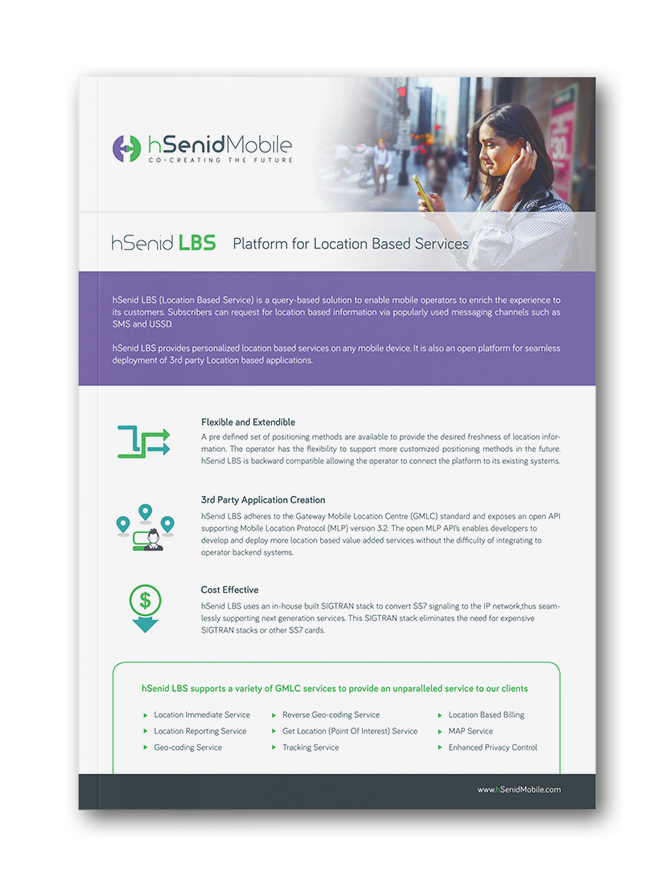
The hSenid LBS architecture supports multiple services including location reporting, geocoding, reverse geocoding, tracking, location-based billing and Enhanced Privacy Control.
The architecture also allows multiple positioning approaches, including ATI, PSI, SIGTRAN and customised positioning methods.
That means operators do not necessarily need one price for “LBS.”
A basic location lookup, continuous tracking service and customised enterprise integration can sit in different commercial tiers.
Do Not Ignore Location Freshness and Accuracy
Location quality can also influence pricing.
A customer asking only whether a subscriber is within a broad area may have different technical requirements from a service requesting fresh location information for a fraud decision.
The CAMARA Device Location Verification API, for example, allows applications to specify how recent the location information needs to be through a maximum-age parameter.
Operators can therefore think beyond simply counting API calls.
Service level, freshness, accuracy requirements and availability can all contribute to how an enterprise package is structured.
A Practical LBS Pricing Structure
For many operators, a clear enterprise offer could look like this:
Platform access → monthly or annual fee
Usage → per-query or per-device charges
Volume → committed usage tiers
Campaign services → campaign-based packages
Custom integrations → separate implementation fee
Keep the commercial model understandable.
If the customer needs a spreadsheet to understand what one location request costs, the pricing structure may already be too complicated.
Price the Outcome, Not Just the API
Enterprise location services become easier to sell when they are packaged around the customer’s problem.
A bank is not buying coordinates. It is buying another fraud signal.
A logistics company is not buying location queries. It is buying visibility into its operations.
A retailer is not buying a positioning interface. It is buying the ability to engage customers in a relevant location.
The location-based services platform provides the technical capability. The pricing model determines whether that capability becomes recurring enterprise revenue.