Telecom networks rarely move from one generation to the next in a clean cutover.
An operator may still depend on SS7-based systems for SMS, USSD, location services or subscriber lookup while running LTE through the EPC and gradually introducing 5G Core.
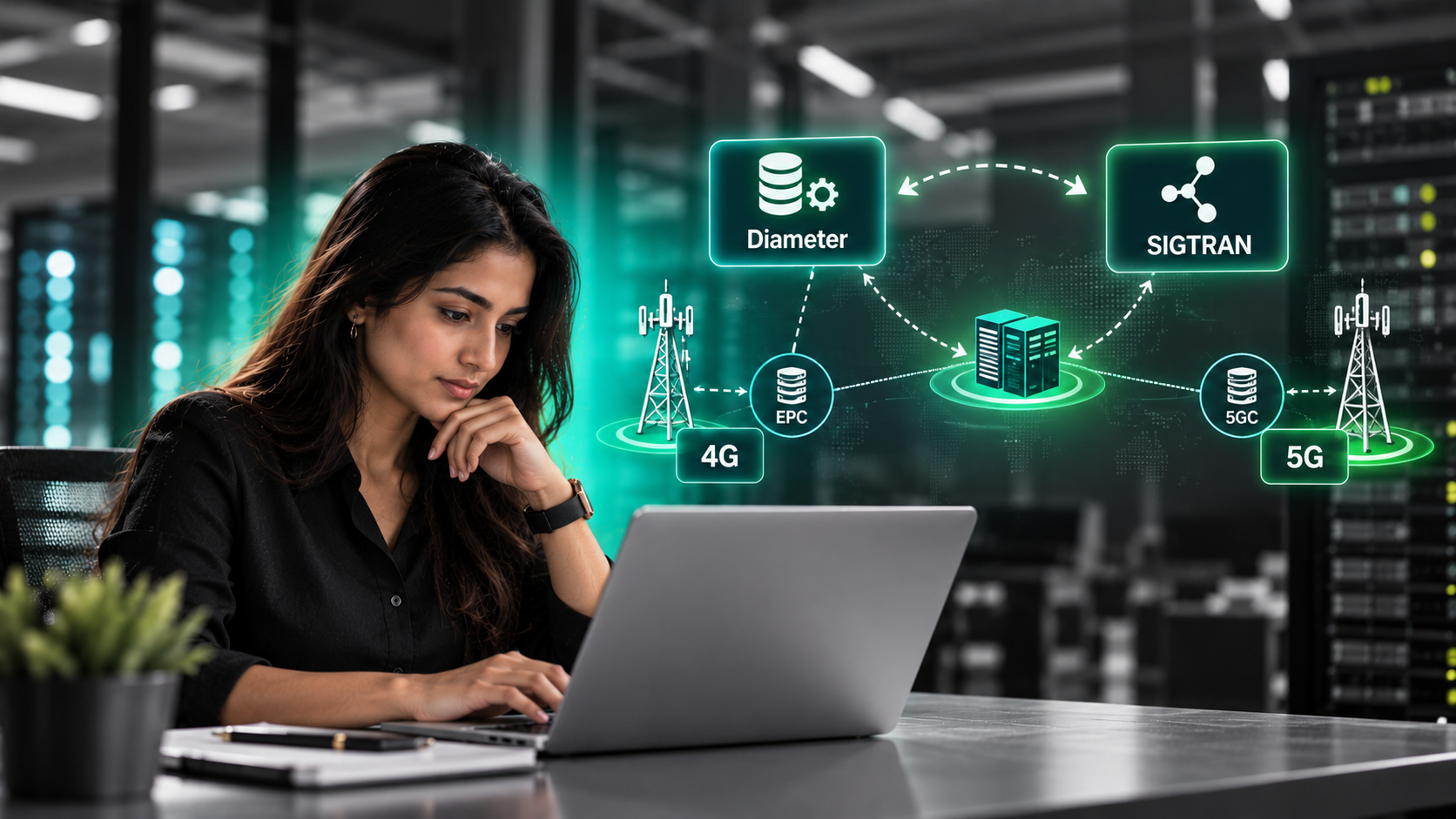
That is why Diameter vs SIGTRAN is not really a question of choosing one protocol.
For most operators, the challenge is making several signaling generations work together without rebuilding everything at once.
SIGTRAN and Diameter Solve Different Problems
SIGTRAN carries traditional SS7 signaling over IP networks.
Instead of requiring legacy TDM signaling links, operators can transport SS7 protocols across IP using components such as SCTP, MTP adaptation layers, SCCP, TCAP and MAP.
hSenid Mobile’s SIGTRAN Gateway follows this software-based model. Its documented stack includes IP, SCTP, MTP, SCCP, TCAP and MAP.
Diameter was designed for newer IP-based mobile architectures.
In LTE/EPC, Diameter is used across multiple standardized interfaces. For example, 3GPP specifies Diameter-based interfaces between the MME and HSS, as well as other EPC and IMS functions.
So, in simple terms:
| SIGTRAN | Diameter |
|---|---|
| Carries SS7 signaling over IP | IP-native signaling protocol |
| Common in legacy 2G/3G and SS7-connected systems | Widely used across LTE/EPC and IMS |
| Supports protocols such as MAP and TCAP | Supports applications such as S6a, Gx and Cx/Dx |
| Helps operators preserve existing SS7 investments | Supports newer subscriber, policy and authentication functions |
Why Operators Still Need SIGTRAN
Moving to 4G or 5G does not automatically remove every SS7 dependency.
A live operator network may still have platforms connected to the HLR, MSC or other legacy network elements.
For example, hSenid Mobile’s SIGTRAN Gateway documentation lists carrier-grade implementations covering:
- SMSC integrations
- USSD Gateway integrations
- Location-Based Service platforms
- HLR integration for authentication-vector extraction
- MNP call-control integration for fixed-line traffic
That is a practical example of why SIGTRAN can remain important even while newer signaling technologies are introduced.
Replacing every platform at once can create unnecessary cost and operational risk.
A gateway approach lets operators keep useful legacy services while exposing signaling capabilities to newer applications.
Where Diameter Fits Into 4G
Diameter became a major control-plane protocol in LTE’s Evolved Packet Core.
A typical LTE architecture includes elements such as the MME, HSS, PCRF and gateways. 3GPP’s LTE architecture shows Diameter-based interfaces such as S6a between the MME and HSS and Gx between the PCRF and packet gateway.
This means operators running LTE may simultaneously have:
SS7/MAP traffic for older network functions and Diameter traffic supporting LTE subscriber management, policy and authentication.
The two protocol families therefore often coexist rather than compete.
What Changes With 5G?
5G introduces another architectural shift.
The 5G Core moves toward a Service-Based Architecture, where network functions communicate through service-based interfaces using technologies including HTTP/2 and JSON.
3GPP describes this as a move away from some of the Diameter-based interfaces used in EPC toward web-based service interfaces inside the 5G Core.
That does not mean Diameter disappears immediately.
Operators still need interworking between LTE/EPC and 5G Core, especially during migration.
3GPP continues to define EPC-to-5GS interworking procedures, including mobility between the two architectures.
The practical signaling environment can therefore look like this:
SS7 / SIGTRAN → 2G/3G and legacy services
Diameter → LTE/EPC and IMS functions
HTTP/2-based service interfaces → 5G Core
The operator’s task is connecting these layers without disrupting existing services.
The Real Interworking Challenge
The difficulty is not simply converting one protocol into another.
Each signaling generation carries different procedures, subscriber information and service logic.
Operators need to determine which legacy functions still depend on SS7 and which should move toward Diameter or 5G-native interfaces.
3GPP even maintains a specification covering interworking between MAP-based and Diameter-based interfaces, showing that this coexistence is a recognized architectural requirement.
A practical migration therefore usually starts by mapping dependencies.
Which applications call the HLR?
Which services require MAP?
Which systems already use Diameter?
Which functions will eventually move into 5G Core?
Once those dependencies are understood, operators can modernize individual layers rather than attempting a complete replacement.
A More Practical SIGTRAN Architecture
One useful approach is to separate applications from the complexity of the signaling stack.
hSenid Mobile’s SIGTRAN Gateway exposes signaling functions through HTTP APIs for internal applications. The platform supports both Direct API calls and Flow API calls, creating a loosely coupled architecture for future integrations.
Its documentation also lists API operations for functions such as subscriber-information retrieval, authentication-vector requests, IMSI lookup and routing information.
That matters during network evolution because applications do not necessarily need to understand the underlying SS7 stack directly.
The signaling layer can handle the network integration while applications interact through simpler APIs.
Don’t Rebuild Everything Just Because 5G Arrived
The strongest migration strategy is usually coexistence with a clear path forward.
Keep SIGTRAN where SS7-dependent services still deliver value.
Use Diameter where LTE/EPC and IMS require it.
Adopt 5G service-based interfaces as functions move into 5G Core.
Then use interworking layers to connect those environments during the transition.
The goal is not to keep legacy technology forever. It is to modernize without breaking the services already running on the network.