
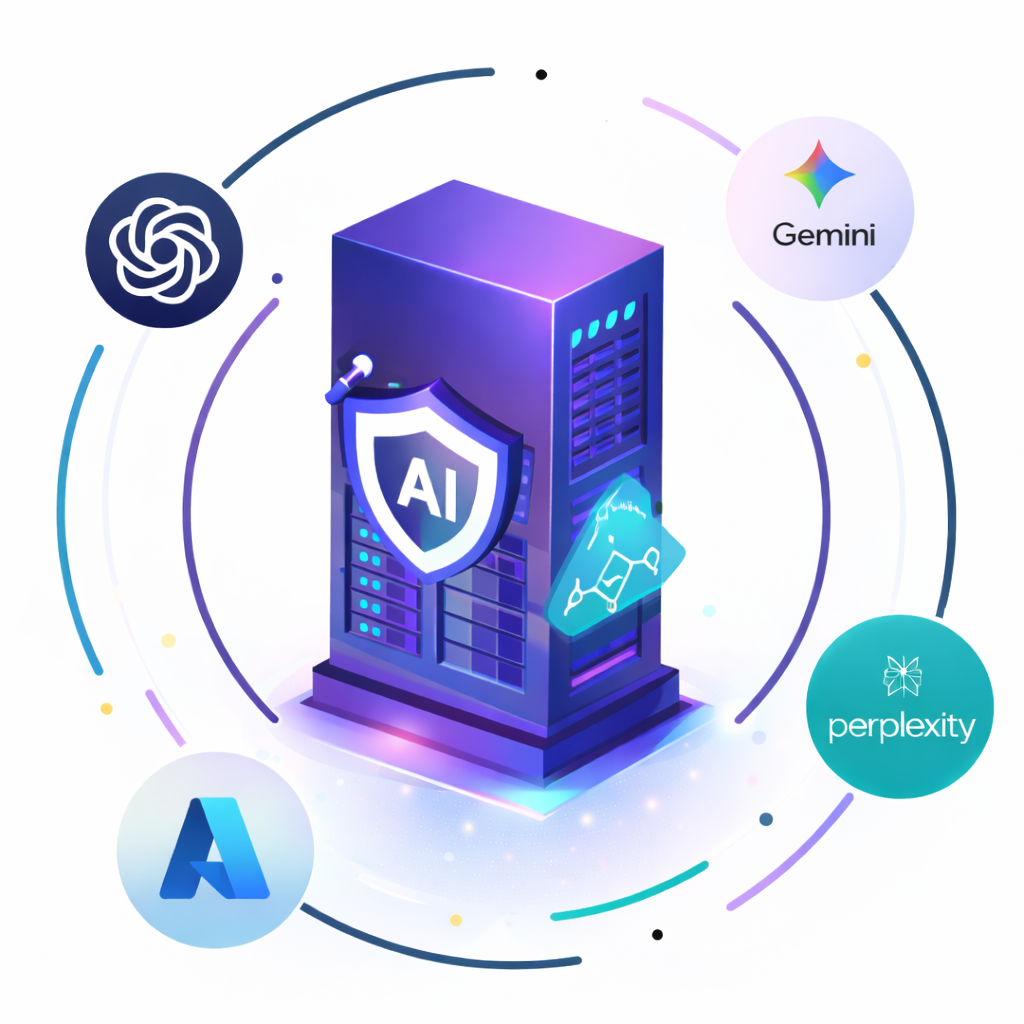
Using the most powerful AI model for every task sounds safe.
It is also an expensive way to build enterprise AI.
A document classification task does not need the same reasoning power as a complex policy analysis. A simple extraction job may not need the same model as an AI agent making decisions across several enterprise systems.
Yet many AI deployments send everything to one model.
AI model routing takes a different approach: match each task to the model that makes sense for its cost, speed, capability and data policy.
What Is AI Model Routing?
AI model routing automatically decides which large language model should handle a request.
Instead of connecting a workflow directly to one provider, requests pass through a routing layer.
That layer can choose between models such as OpenAI, Gemini, Claude, Llama, DeepSeek or a locally deployed LLM.
The decision can be based on factors such as:
- task complexity
- cost
- response speed
- data sensitivity
- model capability
- deployment requirements
- internal security policy
The result is simple: stop paying premium-model prices for work that does not require a premium model.
Not Every AI Task Deserves the Same Model
Think about the AI workloads already appearing inside enterprises.
Extract five fields from an invoice.
Summarise an internal document.
Search an employee policy.
Analyse a complex contract.
Rank candidates against multiple hiring criteria.
Generate an answer using information from several internal systems.
These are very different jobs.
Sending all of them to the same model is like assigning every task in a company to the most senior employee available.
It works.
It just does not make economic sense.
A smaller or lower-cost model may handle routine extraction or classification well. A stronger reasoning model can be reserved for decisions that actually require it.
That is where LLM cost management becomes practical rather than theoretical.
Routing Should Consider More Than Cost
The cheapest model is not automatically the right model.
Sometimes speed matters more.
Sometimes accuracy matters more.
And sometimes the deciding factor is whether the data is allowed to leave your environment at all.
A customer-facing workflow may prioritise low latency.
A document-processing workflow may prioritise cost because it runs thousands of times.
A complex enterprise analysis may justify a more capable model.
A workflow containing highly sensitive information may need to remain on a private or locally deployed LLM regardless of price.
Good AI model routing works within those boundaries.
Cost is one variable, not the only variable.
This Is How We Approach It With Sovereign AI
With hSenid Mobile’s Sovereign AI architecture, the workflow is separated from the underlying model.
That matters because the organisation does not have to rebuild the business process every time the preferred model changes.
OpenAI may handle one workload.
Gemini or Claude may handle another.
Llama, DeepSeek or a locally deployed model can be used where the economics or data policy make more sense.
The routing decision can consider cost, speed and organisational policy before the request reaches a model.
This is part of a broader approach we use with Forward Deployed Engineers: start with the actual workflow, connect the required enterprise systems and work toward measurable production results within a 90-day engagement structure.
The model is not the project.
The business outcome is.
Multi-Model AI Also Reduces Lock-In
Cost is only one reason to support multiple models.
The AI market changes quickly.
Model capabilities improve. Pricing changes. New providers appear. Internal policies evolve. Data residency requirements can change.
If an enterprise application is built directly around one model provider, switching later can affect prompts, APIs, integrations and operating processes.
A routing layer creates separation.
The application sends the task.
The AI layer determines which approved model should process it.
That means the business workflow can remain stable even when the model underneath it changes.
This is the same principle behind a model-agnostic AI architecture: own the workflow instead of designing the workflow around one AI vendor.
Put Simple Work on Simple Models
The quickest place to look for unnecessary AI spend is repetitive, high-volume work.
Consider a workflow processing thousands of documents.
The first step may simply identify document type.
The next may extract several fields.
Only a small percentage may require deeper reasoning because something is missing or unusual.
There is little reason to run every stage through the most capable model available.
Routing can send routine tasks to a lower-cost model and escalate only the difficult cases.
The same idea applies to knowledge search, customer support, recruitment, finance and internal operations.
Use expensive intelligence where expensive intelligence creates value.
Keep Sensitive Workloads Inside the Right Boundary
AI model routing can also enforce data policy.
A request containing public information may be allowed to use an external model.
Another containing sensitive customer information may require masking first.
A more restricted workflow could be routed entirely to an on-premise or private-cloud model.
The user does not need to make that decision manually every time.
The architecture applies the rule.
This is where multi-model AI becomes more than a cost optimisation strategy.
It becomes a governance strategy.
Measure Cost Per Workflow, Not Just Cost Per Token
Token prices are useful, but they do not tell you whether an AI workflow is creating value.
A cheap model that produces poor results and forces employees to redo the work is not cheap.
A more expensive model that resolves a difficult task correctly may be the better choice.
The useful question is:
What does it cost to complete this workflow successfully?
Track model consumption, but connect it to the result.
That gives teams a clearer way to tune routing rules over time.
Build for the Next Model, Not Just Today’s Model
There will always be another model.
The goal should not be to predict which provider will dominate enterprise AI.
Build so that it does not matter.
AI model routing gives enterprises the ability to use the right model for each task, control LLM costs, protect sensitive workloads and change providers without rebuilding the business process around them.
Your workflow should stay.
Your model should be able to change.
That is the point.
Talk to a Sovereign AI Consultant to explore how model routing can be applied to your enterprise workflows.