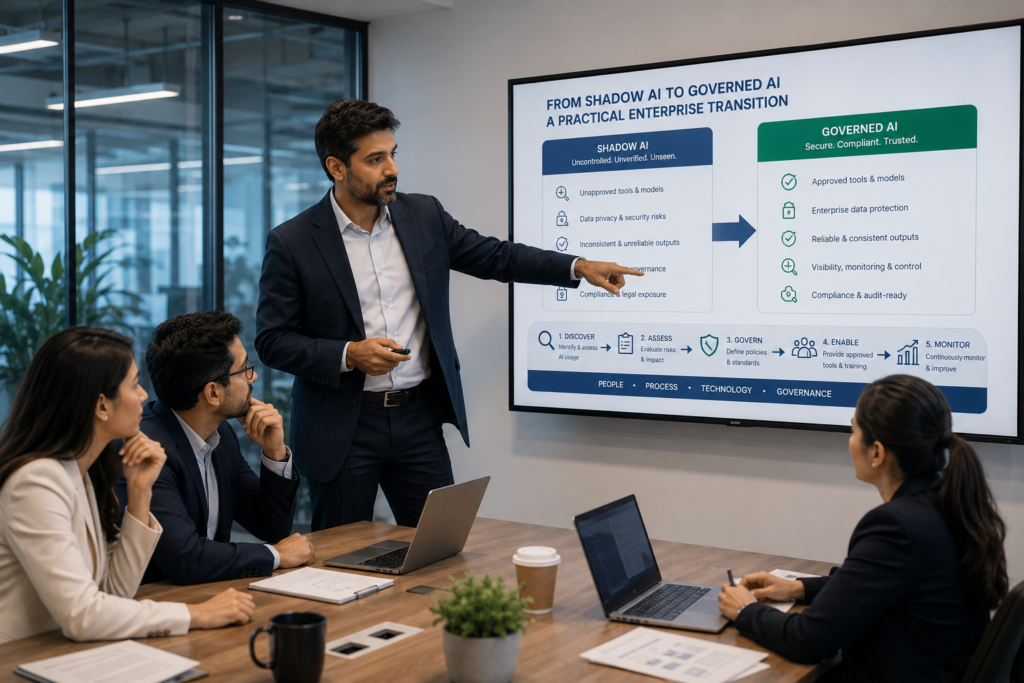
AI adoption rarely waits for a formal strategy. Employees experiment with public AI tools, departments subscribe to specialised platforms, and technical teams connect models to internal workflows long before enterprise-wide controls are in place.
That creates shadow AI.
The issue is not simply that employees are using AI. The real problem is that leadership may not know which tools are being used, what data is being shared, how much is being spent, or whether those systems meet security and compliance requirements.
Moving from shadow AI to governed AI does not mean shutting innovation down. It means creating a controlled environment where employees can use AI productively without exposing the organisation to unnecessary risk. A Sovereign AI approach can support that transition by giving enterprises greater control over models, data, infrastructure, and policy.
Start by Understanding What Employees Already Use
The first mistake many organisations make is assuming AI adoption begins when the official programme launches.
In reality, it may already be widespread.
Marketing teams may use AI for content creation. Developers may rely on coding assistants. Analysts may upload reports into public tools. HR teams could be experimenting with CV screening platforms.
The first step in Shadow AI prevention is visibility.
Technology leaders should identify which AI tools are being used, which teams rely on them, what information is entering those systems, and which business processes are already becoming dependent on AI.
This discovery phase should not feel like a crackdown.
If employees are using a tool repeatedly, there is probably a real business need behind it. The objective is to understand that need and provide a safer enterprise alternative.
Classify AI Use Cases by Risk
Not every AI interaction creates the same level of risk.
Generating ideas for a marketing campaign is very different from analysing customer financial information.
A practical governance model can group workloads according to data sensitivity, business impact, and the actions the AI can perform.
Low-risk use cases may involve public information.
Medium-risk workloads could involve internal documents or business data.
High-risk workflows may involve customer records, financial information, employee data, regulated documents, or AI agents capable of executing actions.
This classification helps organisations apply the right level of Enterprise AI governance without creating unnecessary restrictions.
The goal is proportional control.
Establish Clear Data Boundaries
One of the biggest risks in unmanaged AI adoption is data exposure.
Employees may not always know whether information pasted into an AI tool can safely leave the organisation.
AI data privacy controls should therefore be built into the architecture rather than left entirely to individual judgment.
An enterprise may decide that personally identifiable information must be masked before it reaches an external model. Some sensitive workloads may need to remain on-premise. Others may be permitted to use approved cloud models.
AI data sovereignty gives organisations the flexibility to make those decisions based on business and regulatory requirements.
Instead of forcing every workload through the same deployment model, the organisation controls where each type of information can be processed.
Create an Approved AI Access Layer
Once policies are defined, employees need a practical way to follow them.
If approved AI systems are difficult to access while public tools are easy to use, shadow AI will continue.
An Enterprise AI Gateway can provide a managed access layer between employees, applications, and AI models.
Teams can use approved models through one enterprise-controlled environment rather than creating independent integrations.
This makes it easier to enforce access controls, apply data policies, monitor usage, and manage model connections.
The organisation can still provide employees with choice while keeping that choice within defined boundaries.
Introduce Central AI Governance
Governance should answer more than “Which AI tools are approved?”
It should define how AI operates.
An AI Governance Gateway can apply policies based on users, departments, workloads, data types, and models.
For example, a policy may prevent sensitive customer information from reaching external providers.
Another could require human approval before an AI agent performs a financial action.
Certain departments may only be allowed to use specific models.
Generative AI governance can also define when outputs require review and where automation should stop.
This turns policy into something enforceable inside the workflow.
Monitor Usage Before Costs Become a Problem
Shadow AI creates financial fragmentation as well as security risk.
Different teams may subscribe to similar services. Applications may use expensive models unnecessarily. Nobody may have a complete picture of total AI consumption.
AI usage monitoring provides visibility across departments and workflows.
Leaders can see which models are being used, where demand is increasing, and whether the organisation is paying for duplicate capabilities.
This also supports LLM cost management.
Not every request requires the most expensive available model. Routine classification or extraction tasks may work perfectly well with smaller models, while advanced reasoning can be reserved for complex workloads.
Centralised visibility makes these decisions much easier.
Use Model Routing to Keep Flexibility
Governed AI should not create another form of lock-in.
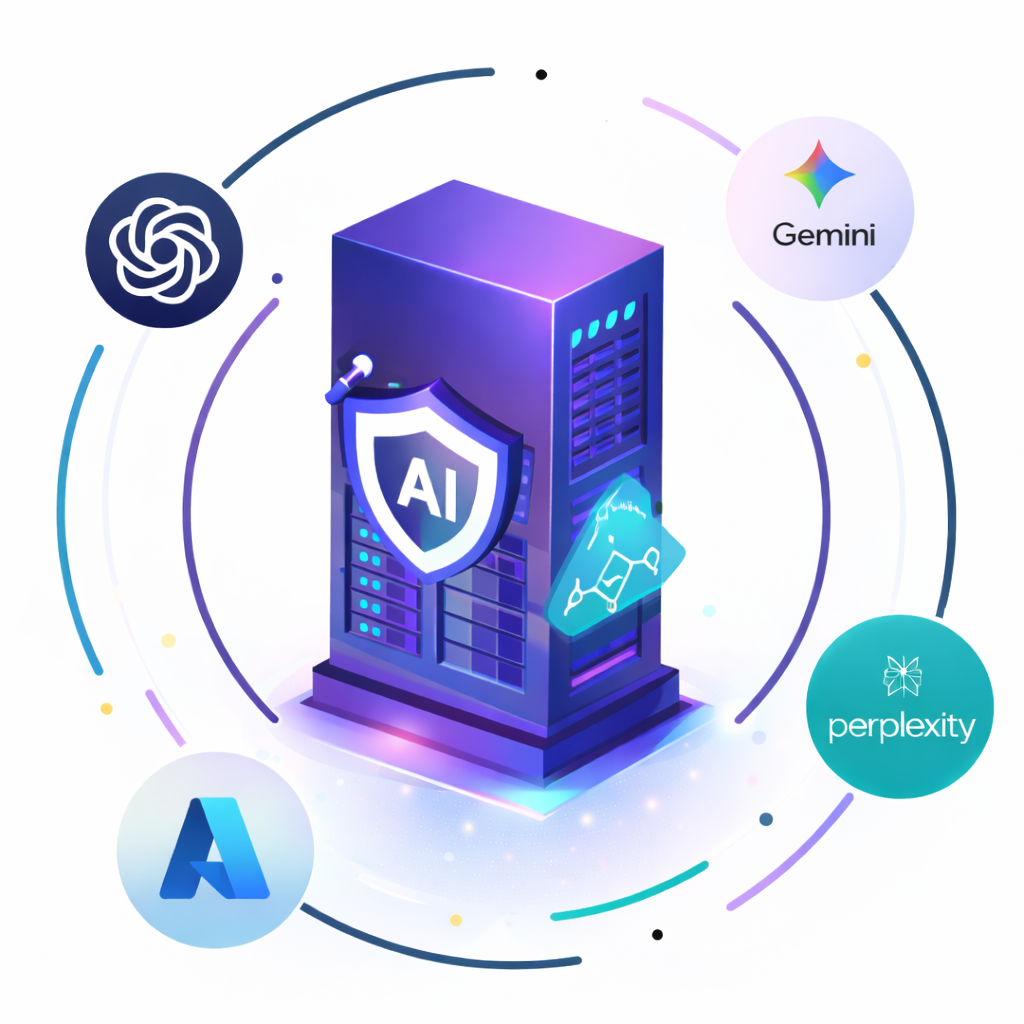
Enterprises may need OpenAI for one workload, Gemini for another, Claude for research, or a local LLM for sensitive processing.
AI model routing allows requests to be directed based on capability, cost, security, or data policy.
This makes a multi-model strategy manageable.
The employee or business application does not need to understand every provider. The routing layer handles the decision.
A Sovereign AI architecture can therefore give organisations access to different models while maintaining a consistent governance framework around them.
Strengthen Enterprise LLM Security
As AI becomes more connected to enterprise systems, security controls need to evolve.
Enterprise LLM security should consider more than login credentials.
AI systems may retrieve internal documents, call APIs, access databases, or trigger workflow actions.
That means organisations need controls around permissions, retrieval sources, data masking, logging, and tool access.
An AI assistant answering internal policy questions should not be able to access confidential finance records simply because both systems are connected to the same enterprise environment.
Each AI workload should have clearly defined boundaries.
The same principle applies to AI agents.
They should only be able to perform the actions required for their specific purpose.
Replace Unmanaged Tools With Better Enterprise Alternatives
Removing shadow AI without offering a useful replacement rarely works.
Employees adopted those tools because they solved a problem.
The transition to governed AI should preserve that value.
If staff use public AI tools for research, provide an approved enterprise research assistant.
If employees use external platforms to analyse documents, create a governed document intelligence workflow.
If developers use unmanaged model APIs, provide controlled access through the enterprise AI layer.
This is where governance becomes an enabler rather than a restriction.
Employees still gain the speed and productivity benefits of AI, while the organisation gains control.
Start With the Highest-Risk, Highest-Value Workflows
You do not need to govern every AI interaction at once.
Start where the combination of risk and business value is highest.
Financial document analysis, customer onboarding, policy research, recruitment, customer complaint intelligence, and compliance workflows can all be strong starting points.
Forward Deployed Engineers can help identify these workflows and understand how employees currently use AI within them.
They can then connect approved models to enterprise systems, establish governance controls, and redesign the process around measurable outcomes.
This creates a practical migration path instead of a large policy programme disconnected from daily work.
Measure Whether Governance Is Working
Governed AI should create measurable improvements.
Technology leaders can track indicators such as the number of unmanaged AI tools discovered, percentage of workloads using approved models, AI spending by department, policy violations, sensitive data exposure attempts, and adoption of enterprise-approved AI services.
The objective is not necessarily to reach zero experimentation.
It is to make safe experimentation easier than unmanaged experimentation.
That is an important distinction.
If employees have secure, useful AI tools available, the incentive to use unapproved alternatives decreases naturally.
From Restriction to Controlled Innovation
Shadow AI is often a sign that employees are moving faster than enterprise systems.
That can create real risk, but it also reveals strong demand.
The best response is not simply banning AI.
It is building an environment where employees can use it safely.
A Sovereign AI strategy can provide that foundation by combining AI data sovereignty, governance, security, model routing, and usage monitoring within a controlled enterprise architecture.
The transition does not need to happen overnight.
Discover existing usage. Classify risk. Define data boundaries. Provide approved access. Establish governance. Monitor costs. Then expand workflow by workflow.
That is how organisations can move from fragmented AI adoption toward a governed environment where innovation continues, but control stays with the enterprise.