
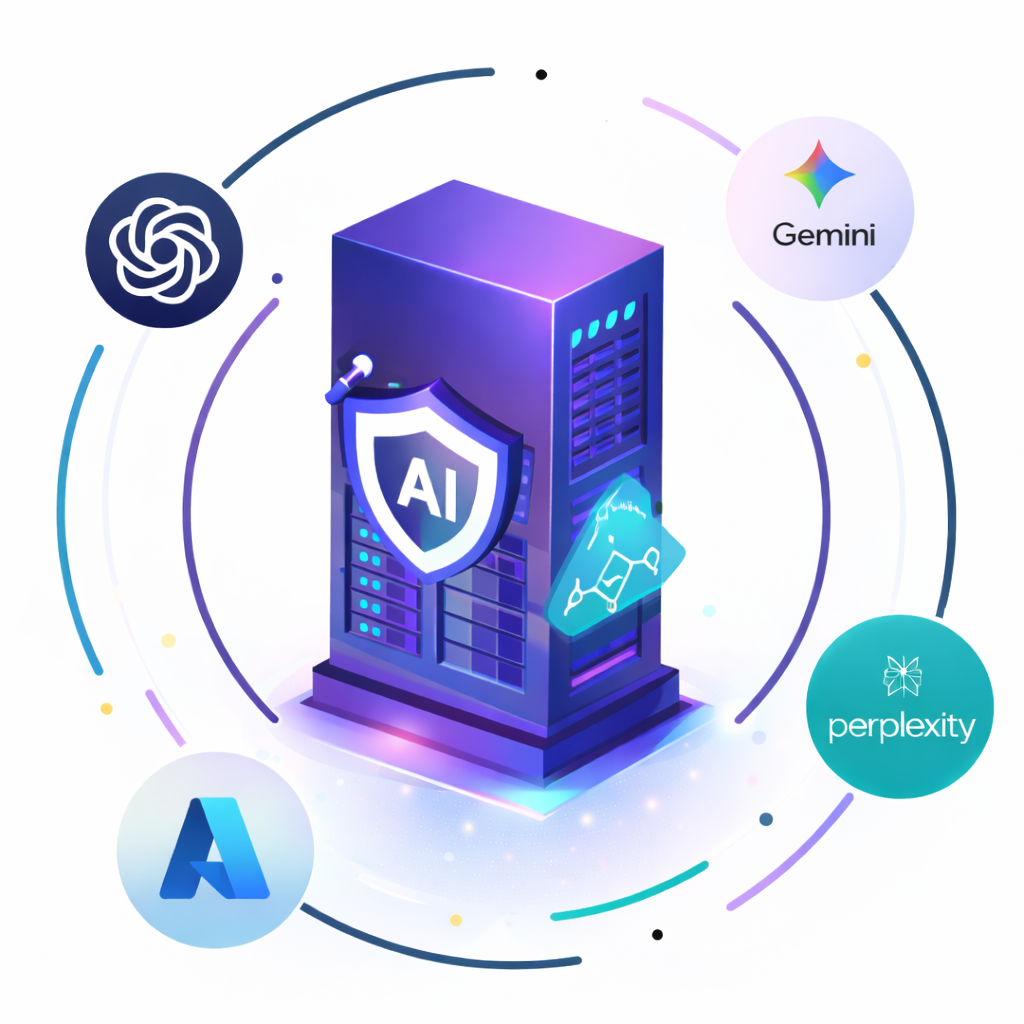
A company usually does not plan to lose control of AI.
It starts small. Marketing tries one tool for campaign ideas. HR uses another one for CV screening. Legal uploads contracts into a chatbot because reading 80 pages takes too long. Developers use coding assistants. Someone in operations tests an AI agent that can browse files, run tasks and connect to other tools.
At first, everyone feels productive. And to be fair, they are.
The problem starts when nobody can answer basic questions. Which AI tools are being used? What data is going into them? Are employees using personal accounts? Who owns the API keys? Which department is spending the most? What happens if customer data is pasted into the wrong model?
That is when an AI Gateway becomes important.
The issue is not the number of tools. Five approved tools with strong controls may be fine. Two random tools used with sensitive data can be a serious risk. The real problem is unmanaged AI.
McKinsey’s 2025 State of AI survey found that 88% of respondents said their organizations regularly use AI in at least one business function, but only about one-third said their companies have started scaling AI programs. That gap is where the risk sits. AI is already moving through the business faster than governance can catch up.
The quiet rise of shadow AI
Shadow AI is what happens when employees use AI tools without IT, security or compliance knowing about it.
Most people are not trying to break rules. They are trying to finish work. A legal executive wants a summary of a contract. A recruiter wants a faster way to screen 300 CVs. A support manager wants to understand customer complaints. The tool gives answers in seconds, so it feels harmless.
But one copy-paste can expose customer records, pricing details, source code, employee information or confidential legal text.
hSenid Mobile’s Sovereign AI: A Practical Guide to Governing Enterprise AI explains this risk clearly. Employees may upload or type sensitive information into third-party LLM web apps, creating privacy and compliance exposure. The guide also makes a practical point: blocking AI completely is not the answer, because then the business loses access to useful technology. The better approach is centrally managed, governed access.
That is exactly the job of an AI Gateway.
It gives employees one approved way to access AI models. Not one model for everything. Not one vendor forever. One controlled access layer where the enterprise can apply policies, manage usage and decide which model fits which task.
What an AI Gateway actually does
An AI Gateway sits between users, business applications and LLM providers.
A good one should route requests to different models, apply data masking, manage API keys, track usage, control budgets and keep audit trails. It should also support local LLMs, cloud-hosted models and external providers, because not every use case needs the same level of sensitivity or performance.
The Sovereign AI architecture shown on page 3 of hSenid Mobile’s guide shows this layered idea well. It includes an AI orchestration layer with provisioning, dashboards, prompt library, data management, data masking and guardrails. It also connects AI experiences such as hiring intelligence, document analysis and AI workbench with enterprise systems like CRM, HRIS, policy systems, legal systems, core banking and document repositories.
So the AI Gateway is not just a technical pipe.
It is the point where enterprise control happens.
A practical AI Gateway should help teams answer a few hard questions:
- Who is using AI and for what purpose?
- Which model handled the request?
- Was sensitive data masked before leaving the enterprise?
- Which team is consuming the most tokens?
- Which AI agents are allowed to access files, tools or internal systems?
That last point matters more now because AI agents are not simple chatbots. They can browse, call tools, access files and sometimes execute commands. hSenid’s guide warns that agentic AI apps should not run freely on employee machines with sensitive data. They need sandboxed environments with monitoring, isolation and clear policy boundaries.
The cost problem comes faster than expected
AI spend does not always look scary at first.
A few subscriptions. A few API calls. A pilot project. Then usage spreads.
Legal teams process long agreements. HR reviews CVs. Marketing creates campaign drafts. Customer service analyzes call transcripts. Developers generate test data or use copilots inside workflows. Each request consumes tokens. Each token has a cost.
Shared API keys make it worse. If five departments use the same key, finance cannot easily tell who spent what. Budgeting turns into guessing.
Flexera’s 2025 State of the Cloud Report found that 84% of respondents see managing cloud spend as the top cloud challenge. Cloud spend is expected to rise 28% in the coming year and GenAI public cloud service use jumped to 72%, up from 47% in 2024.
That is why an AI Gateway should not only focus on security. It must also handle cost visibility.
You need usage reports by user, department, project and application. You need quotas. You need alerts before spend goes out of range. You need finance, IT and business teams looking at the same numbers.
Otherwise, AI becomes another cloud cost problem with a nicer interface.
Data risk is not theoretical anymore
The security side is also very real.
IBM’s 2025 Cost of a Data Breach findings reported that 13% of organizations experienced breaches of AI models or applications, while 8% did not know whether they had been compromised. Of those compromised, 97% said they did not have AI access controls in place. IBM also found that 63% of breached organizations either did not have an AI governance policy or were still developing one.
That is the danger of letting AI usage grow without a gateway.
The company may still have good firewalls, endpoint tools and identity controls. But if employees are sending sensitive data into unknown AI tools, those controls do not cover the full risk.
An AI Gateway changes the flow.
Before a prompt reaches an external model, the gateway can redact names, account numbers, IDs, medical terms or confidential fields. It can block requests that violate policy. It can send sensitive workloads to on-premise or private cloud models instead of public APIs. hSenid Mobile’s Sovereign AI page describes this as a single, secure and governed gateway to multiple LLMs, with privacy, visibility and control built into the platform.
That is a better approach than hoping every employee remembers every rule.
The platform underneath matters too
An AI Gateway should not run like a side project under someone’s desk.
It needs secure deployment, scaling, monitoring, backup, access control and lifecycle management. This is where OpenShift and Kubernetes become part of the conversation.
CNCF’s 2025 Annual Cloud Native Survey announcement said 82% of container users now run Kubernetes in production, up from 66% in 2023. It also positions Kubernetes as a key platform for AI workloads.
For enterprises, that means AI governance and platform engineering are now linked. You may need Kubernetes consulting services to design the right cluster architecture. You may need an OpenShift migration partner if workloads are moving from legacy platforms. You may need RHEL support services for the operating layer, Ansible automation consulting for repeatable provisioning and policy automation and OpenShift managed services for stable day-two operations.
Cost also has to be handled properly. OpenShift cost optimization matters when AI traffic grows and inference workloads become unpredictable. Red Hat’s Forrester Consulting study reported 468% ROI, $4.08 million net present value over three years, 50% improved operational efficiency, 20% recouped developer time and up to 70% shorter development cycles for Red Hat OpenShift cloud services.
So choosing the best OpenShift consulting company is not only about migration. It is about building a platform that can support controlled AI adoption, secure automation and long-term scale. That is where enterprise Kubernetes platform consulting becomes valuable.
So, how many AI tools are too many?
Too many is not a number.
Too many means you cannot see them. Too many means sensitive data may leave without checks. Too many means shared keys, surprise bills and no audit trail. Too many means security finds out after something already happened.
The better path is not to block AI.
Give teams a safe way to use it. Let legal summarize documents. Let HR screen CVs. Let marketing draft campaigns. Let developers use AI support. Let customer service analyze patterns. But route it through an AI Gateway that applies governance before the risk spreads.
AI is already inside the enterprise. The question is whether the enterprise owns it.
Talk to hSenid Mobile about Sovereign AI and build a secure AI Gateway for enterprise-wide LLM access, governance, usage visibility and sandboxed AI innovation. Don’t block AI. Own it.