
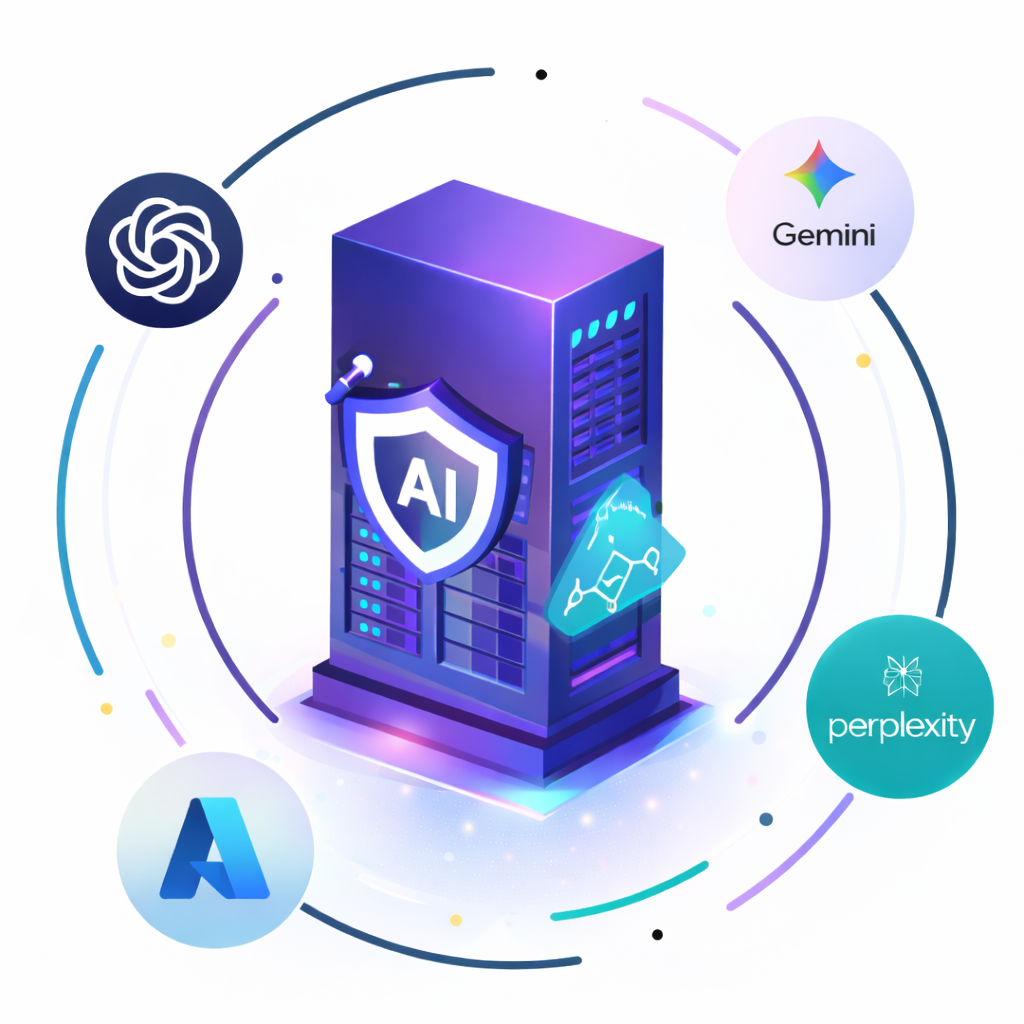
An LLM becomes far more useful when it understands what is happening inside your business.
That means giving it access to real context from systems such as your CRM, HRIS, core banking platform, document repositories and internal APIs.
But connecting an LLM directly to those systems creates a bigger problem:
How do you give AI enough context to work without exposing sensitive data?
The answer is not to give the model unrestricted access.
It is to put a controlled layer between the LLM and your enterprise systems.
Why Enterprise LLM Integration Gets Risky Fast
A standalone chatbot is relatively contained.
An enterprise AI workflow is different.
A customer service assistant may need CRM history.
A banking workflow may need account data, internal policies and transaction information.
A recruitment system may need access to an HRIS, CVs and job criteria.
A document intelligence workflow may need to read sensitive files and update another system.
Once AI touches those systems, the risk is no longer limited to a bad answer.
The bigger questions are:
What data can the model see?
Which systems can it access?
What actions is it allowed to take?
Who approved that access?
And can you trace what happened afterwards?
That is where secure enterprise LLM integration starts.
Step 1: Put an AI Gateway in the Middle
Do not connect every model directly to every business system.
Use an AI gateway as the control layer.
Instead of your CRM sending information directly to an external LLM, the request passes through the gateway first.
The gateway can decide what data is allowed through, which model should handle the request and what should happen next.
This creates one point of control across multiple systems and models.
With Sovereign AI, that control layer can sit between LLMs and systems such as:
CRM platforms
HRIS platforms
core banking systems
document repositories
internal APIs
The goal is simple: AI gets the context it needs without getting unlimited access to everything behind it.
Step 2: Mask Sensitive Data Before It Leaves
Not every field from your CRM or banking system needs to reach the model.
A customer name may not be needed.
Neither may an account number, employee ID or national identity number.
Before a request reaches an external model, sensitive values can be masked.
For example:
“Review account 0012456789 for Nimal Perera”
can become:
“Review ACCOUNT_01 for CUSTOMER_01”
The model still understands the relationship.
It does not need the real identity.
This is one of the privacy controls built into the Sovereign AI architecture.
PII masking happens before sensitive information reaches an external LLM.
Step 3: Give the Model the Minimum Access It Needs
More access does not automatically create better AI.
If the AI is only answering a customer service question, it should not need access to an entire core banking environment.
If it is screening CVs, it does not need permission to edit payroll information.
Access should follow the workflow.
Role-based controls can restrict which systems, data and actions are available to each AI workflow.
This matters because enterprise AI is moving beyond simple question-and-answer use cases.
The system may now read, decide, route, escalate and log automatically.
Every extra permission matters.
Step 4: Route Sensitive Work to the Right Model
Not all requests should go to the same LLM.
A low-risk workflow might use OpenAI, Gemini or Claude after sensitive information is masked.
A more restricted workflow may need to stay on Llama, DeepSeek or another model running inside a private environment.
A highly sensitive workload may need to remain on-premise.
Sovereign AI allows tasks to be routed based on cost, speed and policy.
That means the routing decision can consider the sensitivity of the data before a request leaves the environment.
The workflow stays consistent.
The model can change.
Step 5: Keep an Audit Trail
Once AI starts interacting with business systems, audit logs are not optional.
You should be able to trace:
which user or workflow made the request
which system supplied the data
what information was masked
which model handled the request
what action the AI took
whether the request was escalated
Sovereign AI includes audit logging alongside PII masking, role-based access and team-level budget controls.
That gives security and operations teams a record of how AI is being used across the organisation.
Step 6: Connect AI to the Workflow, Not Just the Database
This is where many enterprise AI projects stop too early.
Connecting an LLM to a CRM is not the outcome.
The outcome is what the AI can now do inside the workflow.
Across Sovereign AI use cases we track, document intelligence deployments have reduced document processing time by 80% across banking, logistics and HR workflows.
Knowledge search and policy lookup automation for 500-person knowledge-worker teams has recovered more than 40,000 staff hours annually.
In high-volume recruitment, the time from application close to a ranked candidate shortlist has moved from three weeks to one day.
Those results come from connecting AI to real processes, not simply giving employees another chatbot.
This Is Why We Use Forward Deployed Engineers
Enterprise integrations are rarely clean.
The CRM may use one data structure.
The HRIS may use another.
Policies may live in documents.
Some decisions may still require human approval.
A secure LLM integration has to work around those realities.
That is why hSenid Mobile’s Forward Deployed Engineers work inside the workflow itself.
The engagement starts with mapping the process, identifying where data moves, defining what AI can access and connecting the systems required to make the workflow work.
The target is measurable production results within 90 days under a fixed scope.
The model comes later.
The workflow comes first.
Secure Integration Is About Controlled Context
An LLM does not need unlimited enterprise access to be useful.
It needs the right context.
Connect through an AI gateway.
Mask sensitive information.
Limit permissions.
Route requests according to policy.
Keep an audit trail.
And keep highly sensitive workloads inside your own environment when required.
That is how AI can work with your CRM, HRIS and core banking systems without turning enterprise data into an uncontrolled prompt.
Talk to a Sovereign AI Consultant
Learn how Sovereign AI and Forward Deployed Engineers can connect AI securely to the work that actually matters.