
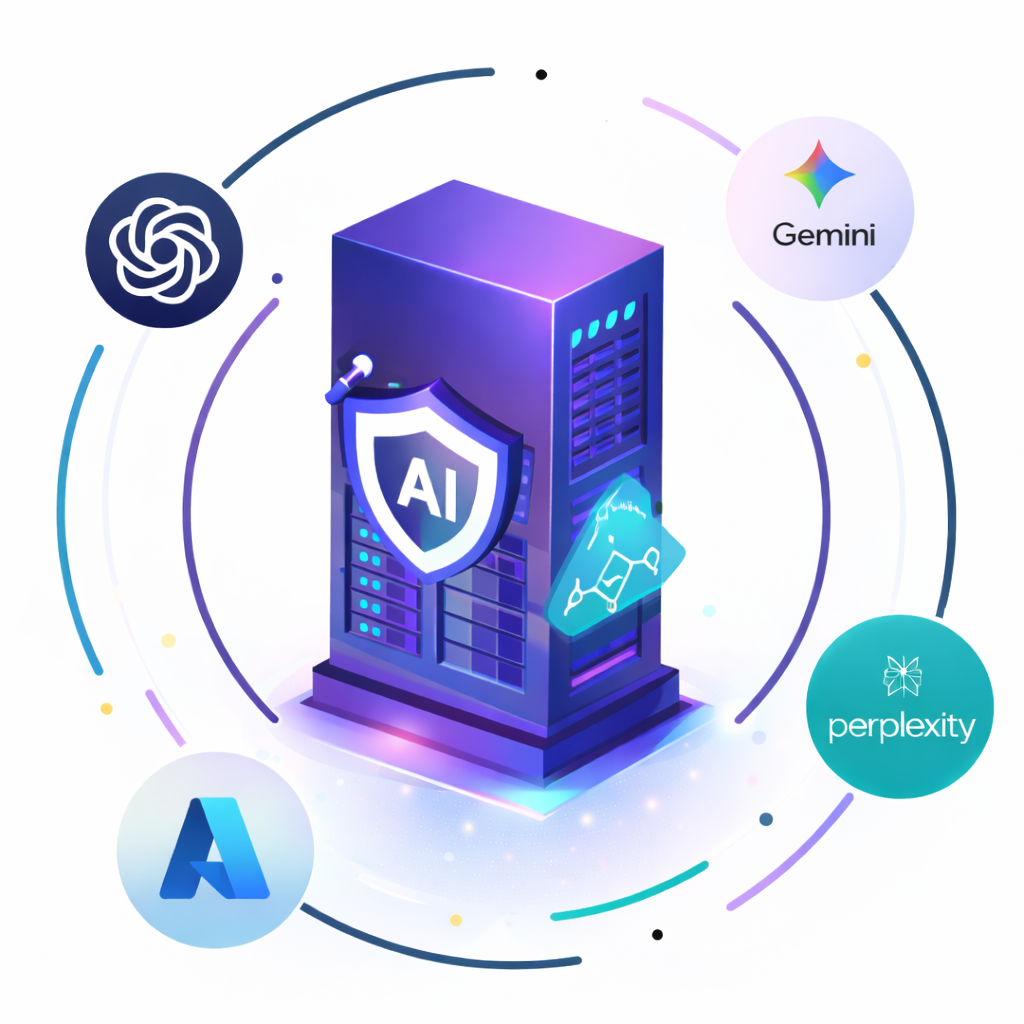
Your employees want to use AI.
Your security team wants to know what they are pasting into it.
Both are reasonable.
A customer name, account number, national ID, employee record or confidential document can easily end up inside an AI prompt when teams start using ChatGPT, Gemini or other LLMs for everyday work.
Blocking AI completely is rarely a long-term answer.
A better approach is to remove sensitive data before the prompt reaches the model.
That is where PII masking for LLMs comes in.
What PII Masking Actually Does
PII masking detects sensitive information inside a prompt or document and replaces it before the request is sent to an external model.
A prompt might originally contain:
“Review the account for Nimal Perera, NIC 901234567V, account number 0012456789.”
Before it reaches the LLM, the sensitive fields can be replaced:
“Review the account for [CUSTOMER_01], [ID_01], account [ACCOUNT_01].”
The model still receives enough context to complete the task.
It does not need the real identity behind that context.
That is the key idea: give the model what it needs, not everything you have.
Start by Deciding What Should Never Leave
Do not begin with the model.
Begin with the data.
List the information your organisation does not want leaving its controlled environment.
That may include:
customer names
national identity numbers
passport numbers
account numbers
phone numbers
email addresses
employee IDs
financial information
medical or personal records
confidential business identifiers
The exact list will differ by organisation.
A bank will have different rules from an HR department. A recruitment system will handle different sensitive fields from a customer service platform.
The masking policy has to match the workflow.
Mask Before the LLM Call
The most important part of the architecture is where masking happens.
Sensitive information should be detected and replaced before the request is sent to ChatGPT, Gemini or another external model.
The flow should look like this:
User or system sends request.
The enterprise AI layer inspects the content.
Sensitive fields are detected.
Those values are masked or replaced.
Only the sanitised prompt is sent to the external LLM.
The response returns through the controlled layer.
Where required, approved systems can reconnect the result with the original internal data.
The external model never needs to see the raw information.
This Matters More When AI Touches Real Workflows
The risk becomes more serious when AI moves beyond employees asking occasional questions.
At hSenid Mobile, the Sovereign AI workflows we work with connect AI to systems such as CRMs, HRIS platforms, core banking environments, document repositories and internal APIs.
Those systems contain the information enterprises are most careful about.
That is why privacy controls cannot sit at the end of the process.
They have to sit between the enterprise data and the model.
Our Sovereign AI architecture includes PII masking together with role-based controls, team-level budget caps and audit logging.
The model is allowed to work with the context it needs without automatically receiving every sensitive field in the source system.
Masking Should Not Break the Workflow
A common mistake is removing so much information that the AI can no longer perform the task.
Suppose the workflow needs to compare transactions belonging to the same customer.
Replacing every customer reference with the word “REDACTED” may destroy the relationship between records.
Instead, the system can use consistent placeholders.
Customer 1 becomes CUSTOMER_01.
Customer 2 becomes CUSTOMER_02.
Account 1 becomes ACCOUNT_01.
The model can still understand relationships between records without knowing the real identity behind them.
Good masking preserves structure while removing exposure.
Not Every Workload Should Go to an External Model
Masking is one control.
It is not the answer to every data privacy problem.
Some workloads should stay inside the organisation completely.
With Sovereign AI, tasks can be routed between OpenAI, Gemini, Claude, Llama, DeepSeek or locally deployed LLMs based on cost, speed and policy.
A normal knowledge-search request may be allowed to use an external model after masking.
A highly sensitive banking workflow may instead stay on an on-premise model.
The routing rule should follow the data.
Not the other way around.
Log What Happened
Enterprise LLM security also requires visibility.
You should be able to answer:
Who sent the request?
Which system did it come from?
What type of information was detected?
Was sensitive data masked?
Which model processed the request?
What action happened next?
This is why audit logging is part of the Sovereign AI control layer.
When AI begins reading, deciding, routing and acting across enterprise workflows, security teams need more than trust.
They need a record.
Privacy Controls Should Still Let AI Create Value
Security only works if the system remains useful.
Across the Sovereign AI use cases we track, document intelligence deployments have reduced document processing time by 80% across banking, logistics and HR workflows.
Knowledge-search and policy-lookup automation for 500-person knowledge-worker teams has recovered more than 40,000 staff hours annually.
In high-volume recruitment, the time from application close to a ranked candidate shortlist has moved from three weeks to one day.
The lesson is not to send more data to AI.
It is to design the workflow so AI receives exactly the information required to produce the result.
Give AI Less Data, Not Less Capability
Enterprises do not have to choose between using powerful external LLMs and protecting sensitive information.
Put a controlled layer between them.
Detect sensitive data.
Mask it.
Apply access rules.
Route the request to the right model.
Log what happened.
And keep workloads inside your own environment when masking alone is not enough.
That is how teams can use ChatGPT, Gemini and other LLMs without making every prompt a data privacy decision for the employee.
The safest prompt is not necessarily the one that contains no enterprise context.
It is the one that contains only the context the model actually needs.
That may be the best place to start.
Talk to a Sovereign AI Consultant
Learn how Sovereign AI and Forward Deployed Engineers can connect AI securely to the work that actually matters.