
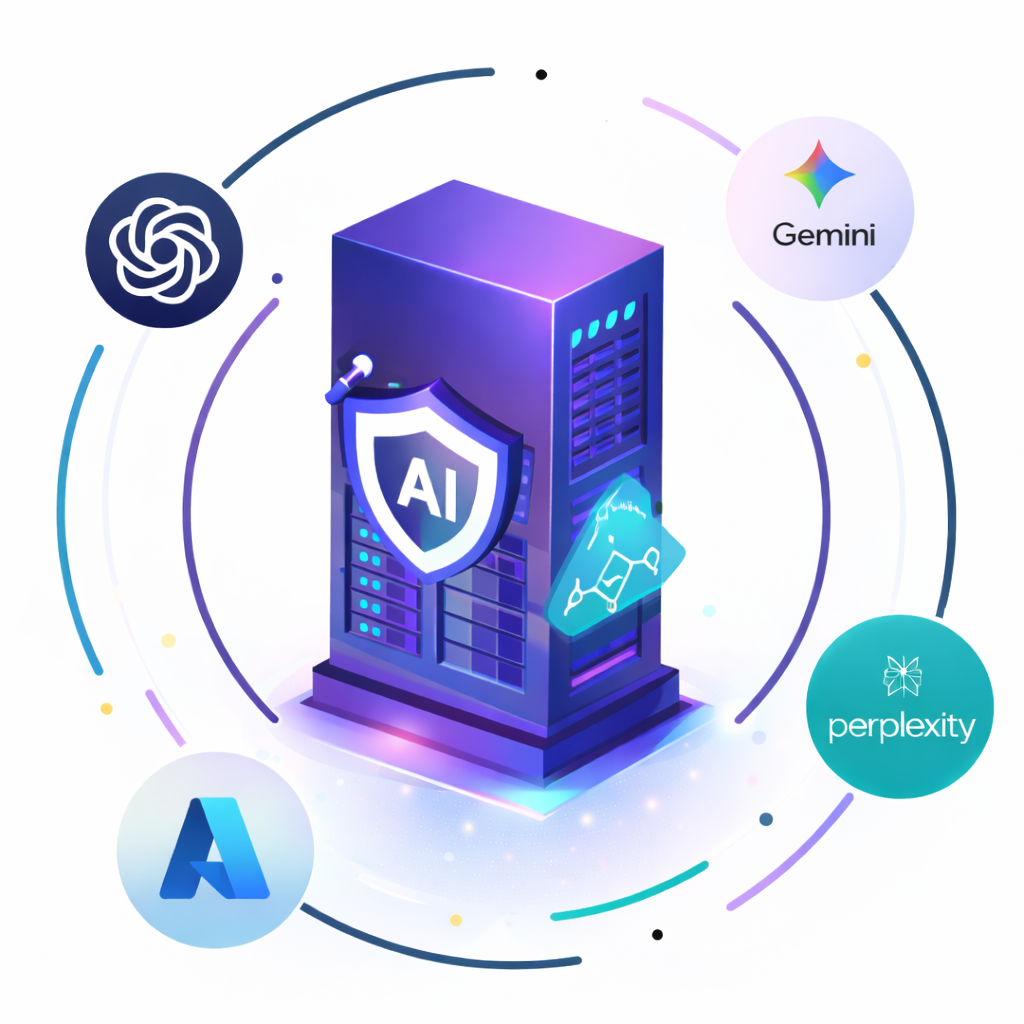
Where does your AI send your data?
For an internal marketing tool, that question may be easy to answer.
For a bank processing customer records, an HR team working with employee data, or an enterprise connecting AI to core systems, it is a different conversation.
The model matters. But where the model runs, where the data travels and who controls the infrastructure matter just as much.
That is why on-premise LLM deployment is moving from a technical option to a business decision.
Deloitte’s 2026 State of AI in the Enterprise research found that 77% of companies now factor an AI solution’s country of origin into vendor selection. Nearly three in five primarily build their AI stacks with local vendors.
Data location is now part of the buying decision.
What Is an On-Premise LLM?
An on-premise LLM runs inside infrastructure controlled by your organisation rather than sending every request to a public cloud AI service.
That infrastructure may sit inside your own data centre or another private environment designed around your security and data-residency requirements.
The important difference is control.
Your organisation determines where sensitive information is processed, which systems the model can reach, who has access and what gets logged.
For enterprises handling financial records, customer identities, employee information or confidential documents, that changes the risk conversation immediately.
Why Keep AI Data In-Country?
AI data sovereignty is about knowing where information is processed and which legal and operational controls apply to it.
If sensitive information leaves the country every time an employee uses an AI workflow, the organisation has another dependency to assess.
On-premise deployment removes that dependency for workloads that need to stay inside a defined environment.
It also gives security and compliance teams a clearer answer to a question customers increasingly ask:
Where does our data go?
That answer matters when AI stops generating text and starts working with real operational data.
We See the Difference When AI Reaches the Workflow
At hSenid Mobile, our focus with Sovereign AI is not simply giving an enterprise access to another LLM.
The difficult part starts when the model touches the business.
A document intelligence workflow may need access to confidential files. A recruitment system may process thousands of candidate records. A banking workflow may connect to internal policies, APIs and core systems.
That is where architecture matters.
Across the Sovereign AI use cases we track, document intelligence deployments have reduced document processing time by 80% across banking, logistics and HR workflows.
In knowledge-search and policy-lookup use cases for 500-person knowledge-worker teams, automation has recovered more than 40,000 staff hours annually.
In high-volume recruitment, we have seen the time from application close to a ranked candidate shortlist move from three weeks to one day.
Those gains do not come from putting a chatbot beside an existing process.
They come from connecting AI to the workflow while controlling what it can see and do.
On-Premise Does Not Mean One Model Forever
One concern with private AI infrastructure is lock-in.
It does not have to work that way.
Sovereign AI is designed around a model-agnostic architecture. Tasks can be routed to OpenAI, Gemini, Claude, Llama, DeepSeek or local LLMs depending on cost, speed and policy.
A sensitive workflow might stay entirely on a local model.
Another task might use an external model after personally identifiable information has been masked.
The decision can happen at the workflow level instead of forcing the entire organisation into one model.
That gives enterprises control without cutting themselves off from advances in the wider AI market.
The Trade-Offs Are Real
On-premise LLM deployment is not automatically the right answer for every workload.
You need infrastructure.
You need capacity planning.
Models need to be maintained and updated.
Teams need to monitor performance, security and utilisation.
Running a large model locally for a low-risk, low-volume task may cost more than using an external API.
That is why the first question should not be:
Can we run this model on-premise?
Ask:
Which workloads actually need to stay here?
Keep sensitive work inside the boundary. Route other tasks according to cost, speed and policy.
That is usually a stronger architecture than treating every AI request the same.
Sovereignty Goes Beyond Hosting
Putting an LLM on a local server does not automatically make an AI system secure.
The surrounding controls matter.
Sovereign AI applies controls such as PII masking, role-based access, team-level budget limits and audit logging while connecting models to CRMs, HRIS platforms, core banking systems, document repositories and internal APIs.
The model is only one component.
The real system includes the data it sees, the permissions it receives, the actions it can take and the record it leaves behind.
Start With One Workflow
Our Forward Deployed Engineer engagements are structured around moving from workflow mapping to measurable production results within 90 days under a fixed scope.
The starting point is not choosing a model.
It is finding the workflow where better control and faster execution would change the business outcome.
Then decide what data the AI needs.
What must remain in-country?
What can leave after masking?
Which model should handle each task?
What actions should require human approval?
Those decisions create a sovereign AI architecture that fits the business instead of forcing the business to fit the model.
On-premise AI is not about keeping everything behind a wall.
It is about knowing exactly where the wall needs to be.
That may be the best place to start.
Talk to a Sovereign AI Consultant
Learn how Sovereign AI and Forward Deployed Engineers can connect AI securely to the work that actually matters.