Location-based services can turn mobile network data into useful enterprise services: nearby search, fraud controls, transport updates, targeted offers and location-aware customer experiences.
But location data can also reveal where a person lives, works, travels and spends time. For operators, privacy cannot be added after an enterprise location service is already live. It has to sit inside the architecture.
The goal is simple: use enough location data to deliver the service, and no more.
Start With Purpose, Not Coordinates
Before requesting a subscriber’s location, define exactly why it is needed.
A “find the nearest ATM” request may only need location for a few seconds. A logistics application may need periodic location updates. An aggregated mobility report may not need identifiable subscriber-level location at all.
This follows the GDPR principles of purpose limitation, data minimisation and storage limitation: collect data for a defined purpose, limit it to what is necessary and do not retain it longer than required.
The GSMA’s Mobile Privacy Principles take a similar approach, calling for transparency, user control, security, data minimisation and limited retention across mobile services.
Make Consent Part of the Location Request
Consent should not be a checkbox disconnected from the actual service.
For services that rely on consent, the platform should know what the subscriber agreed to, which application can access the location, the permitted purpose, how long permission lasts and whether it has been withdrawn.
This is especially important in telecom environments. Under the EU ePrivacy Directive, certain location data may generally be processed for value-added services only when anonymised or with user consent. Users must also be told the purpose, duration and whether the data will be passed to a third party, with a way to withdraw consent.
Requirements differ between markets, so operators should map these controls to their local telecommunications and data-protection regulations.
Put Privacy Controls at the Location API Gateway
Do not rely entirely on every enterprise application or developer to implement privacy correctly.
A location API gateway should become the enforcement point.
When an application asks, “Where is subscriber X?”, the gateway should first verify the application, its permissions, the approved use case, subscriber consent where required, permitted location accuracy and request validity.
Only then should the request reach the underlying positioning systems.
This is privacy by design rather than privacy by documentation. GDPR Article 25 specifically requires appropriate technical and organisational safeguards to be built into processing and for only necessary personal data to be processed by default.
Use Only the Precision the Service Needs
Not every enterprise location service needs exact coordinates.
If an application only needs to know whether someone is within a city, district or geofenced area, returning precise coordinates creates unnecessary exposure.
The same applies to analytics. When individual identities are not required, use aggregated or anonymised outputs rather than subscriber-level location histories.
A good location platform should therefore control both who can request location and how much location information they receive.
A Real Example From hSenid LBS
This distinction becomes clear in hSenid’s own LBS architecture.
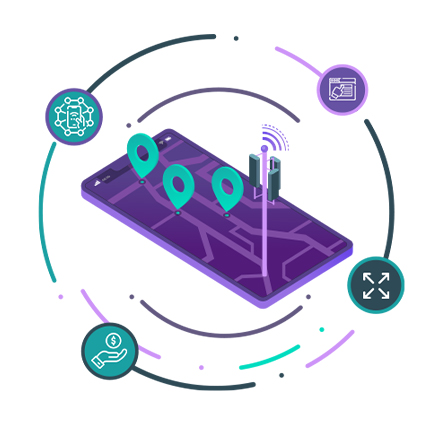
The supplied hSenid LBS design places third-party applications above an MLP interface, with the LBS layer connected to positioning methods including ATI, PSI, SIGTRAN and customised positioning methods. It also includes administration and charging gateway components.
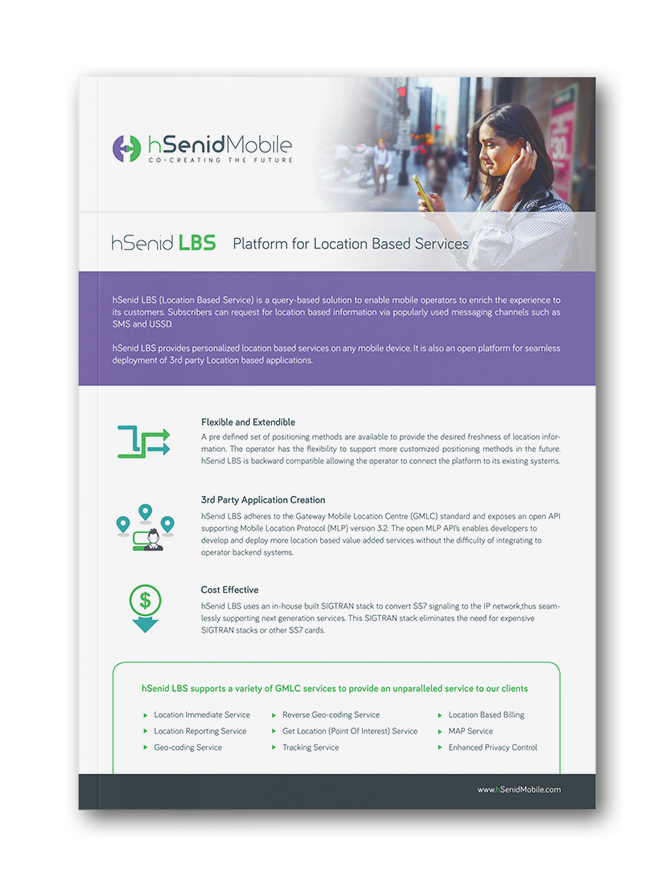
The datasheet also lists services such as location reporting, geocoding, reverse geocoding, tracking, location-based billing and Enhanced Privacy Control.
There is an important privacy lesson in the actual use cases shown in the document.
One example has a subscriber actively requesting the nearest coffee shop. Another allows a business to send promotions to people within a defined geographic boundary.
Both depend on location, but they should not automatically receive the same permissions.
A user-initiated nearby search and an enterprise-initiated marketing campaign have different purposes, consent considerations, retention needs and privacy risks. The location platform should be capable of enforcing that difference.
Log Access Without Building Another Privacy Problem
Operators also need an audit trail.
Record which application requested location, when the request occurred, which policy authorised it and whether the request succeeded. This helps security and compliance teams investigate misuse.
But avoid turning audit logs into permanent location histories. Keep operational logs separate from unnecessary subscriber movement data and apply defined retention periods.
For GDPR-covered processing, violations of certain core requirements can carry maximum administrative fines of €20 million or 4% of worldwide annual turnover, whichever is higher.
What to Look for in an Enterprise LBS Platform
The best LBS solution is not simply the platform that can return a location fastest. Operators should look for architecture that supports controlled third-party access, configurable positioning methods, consent enforcement, privacy controls, auditing, anonymisation and integration with existing network infrastructure.
That is what turns location data from a compliance risk into a manageable enterprise capability.
A privacy-first location API gateway lets operators expose valuable network capabilities without giving every connected application unrestricted access to one of their most sensitive data assets.