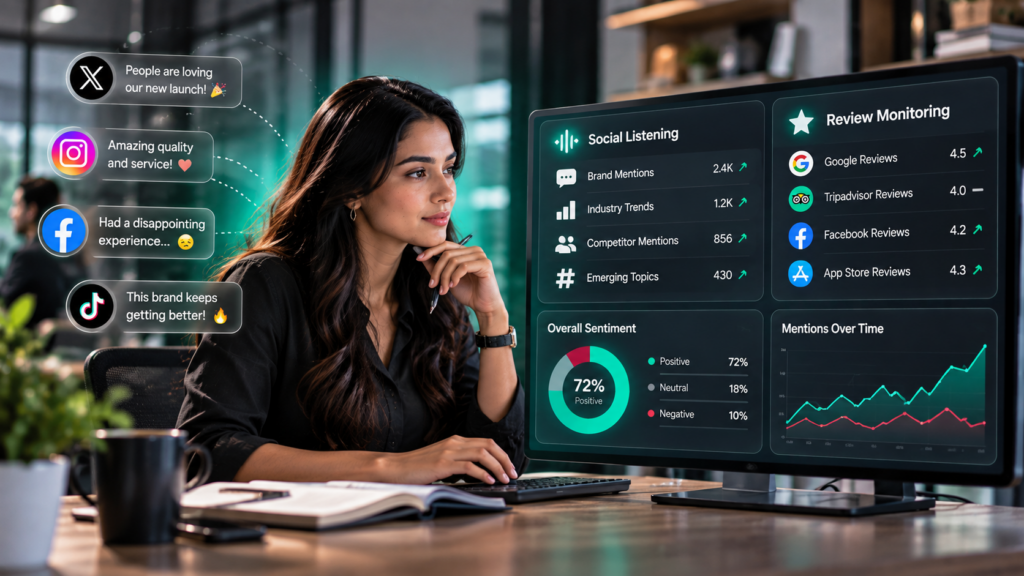
Managing a brand in the digital landscape requires constant awareness of public perception. Customers share their opinions instantly across multiple platforms, but tracking these digital conversations can quickly become overwhelming without a clear strategy. Businesses often confuse social listening with online review monitoring, assuming that implementing one automatically fulfills the role of the other. However, both play distinct roles in brand protection, audience engagement, and overall customer experience.
Understanding how these two strategies function, what data they collect, and how they impact your operational costs is essential for choosing the right approach for your organization.
What Each Strategy Catches
Social listening focuses on tracking untagged public conversations, broader industry discussions, brand mentions, and viral trends across social media platforms, online forums, blogs, and news outlets. A social listening platform scans the open web to capture indirect feedback—opinions, discussions, or complaints where users might not directly tag or contact your company. It gives you a macro-level view of customer sentiment, market perception, and emerging industry trends before they turn into mainstream news.
Online review monitoring software concentrates specifically on direct, structured customer feedback posted on dedicated review hubs such as Google, Facebook, and App Stores. Instead of scanning casual web discussions, review monitoring aggregates star ratings, written reviews, and specific service complaints across your primary customer touchpoints. It captures actionable customer feedback regarding delivery times, customer support quality, pricing issues, or product performance, allowing teams to address verified customer experiences directly.
What Each Strategy Costs
Implementing a social listening platform generally involves a higher financial investment due to the massive volume of unstructured web data processed. Licensing costs for social listening tools tend to be premium, as they require complex natural language processing engines to filter noise across social platforms. Beyond platform pricing, running a social listening program requires dedicated team resources to analyze unstructured conversations, track macro trends, and extract meaningful business insights from vast datasets.
In contrast, online review monitoring software provides a more focused and cost-effective solution for brand protection. Because it targets specific structured channels like app marketplaces, Google Business profiles, and social media review pages, setup and maintenance costs are lower. Teams can easily monitor rating trends, automate responses, and flag urgent complaints without needing an extensive dedicated analytics team, making it a high-ROI approach for immediate customer satisfaction and operational improvements.
Core Comparison: Social Listening vs Review Monitoring
- Focus area: Social listening tracks broad web conversations and untagged mentions, while review monitoring tracks structured customer ratings and review platform feedback.
- Primary goal: Social listening provides audience trend analysis and brand awareness insights, whereas review monitoring aims to improve customer satisfaction and resolve operational complaints.
- Data sources: Social listening monitors social media platforms, forums, news sites, and blogs, whereas review monitoring aggregates feedback from Google, Facebook, App Stores, and industry review sites.
- Signal type: Social listening analyzes general public sentiment and casual discussions, whereas review monitoring processes direct ratings, star scores, and detailed user experiences.
- Response requirement: Social listening focuses on broader engagement and PR positioning, while review monitoring demands direct, rapid responses to resolve individual customer issues.
Which Protects Your Brand Best?
Determining which approach offers better protection depends on your brand’s immediate operational goals and overall digital footprint. If your primary goal is understanding market trends, monitoring competitor perception, or managing PR crises before they explode, a social listening platform provides early macro-level visibility.
However, for organizations looking to safeguard their operational reputation, customer retention, and service quality, online review monitoring software provides direct, high-impact protection. Scattered negative reviews across app stores or search engines directly influence purchasing decisions and lower brand trust. Centralizing customer feedback using AI-driven tools—such as hSenid Reputation Management—helps teams monitor real-time sentiment, receive priority alerts for critical complaints, detect root causes behind recurring issues, and respond quickly across Google, Facebook, and App Stores.
For most enterprises seeking to maintain strong customer relations, automated review monitoring forms the foundation of real-time brand protection. Combined with targeted social listening, businesses can ensure total coverage over both casual online chatter and critical customer feedback.
Discover hSenid Reputation Management and explore how AI-powered multi-platform monitoring, sentiment analysis, smart alerts, and trend detection can help your organization stay on top of customer feedback across digital channels.