
Communications Platform as a Service started with a relatively straightforward promise: make communications easier for developers.
Instead of building direct connections to complex telecom infrastructure, businesses could use APIs to add SMS, voice, authentication, and other communication functions to their applications.
That changed software development.
A retailer could trigger delivery notifications automatically. A bank could send OTPs. A healthcare platform could remind patients about appointments. A digital business could integrate voice without building telecom infrastructure from scratch.
For years, this API-driven model defined the CPaaS market.
Now the model is evolving again.
The next phase is no longer only about exposing communication channels through APIs. Telecom operators are beginning to think about how their wider network capabilities can become reusable, discoverable, monetizable services for enterprises, developers, automation platforms, and AI systems.
Messaging remains important.
But messaging is becoming one capability inside something much larger.
Charging, identity-related services, USSD, IVR, voice, location, authentication, subscriptions, and other network functions can potentially become programmable building blocks.
AI systems introduce another change. Instead of every service being selected and integrated manually by a developer, intelligent applications may increasingly need to discover available capabilities, understand what those services do, and invoke them dynamically within workflows.
This is where AI CPaaS represents the next stage of the model.
The attached hSenid Mobile framework describes operators as already owning valuable assets including messaging, charging, identity, USSD, voice, and location. The problem is that these assets often fail to achieve their full commercial potential because of fragmented exposure, lengthy onboarding, partner-specific integrations, and dependence on internal delivery teams.
The evolution of CPaaS is therefore becoming less about adding another communication API and more about transforming the telecom network itself into an intelligent digital services platform.
The First Era of CPaaS Was About Making Communications Programmable
The original CPaaS proposition solved a real problem.
Telecom communications were powerful, but they were difficult for software developers to integrate.
Businesses needed specialized infrastructure.
They needed relationships with communication providers.
They had to deal with protocols, network complexity, provisioning, and different service environments.
APIs changed that.
Developers could integrate communication capabilities into applications using familiar software interfaces.
An ecommerce company could send an order confirmation.
A bank could trigger an authentication message.
A delivery platform could alert a customer when a driver arrived.
A customer support system could initiate a voice interaction.
The communications platform as a service model moved telecom functionality closer to software developers.
That shift was important because communications became embedded inside business applications rather than operating as separate telecom products.
The API became the bridge.
But early CPaaS largely centered on channels.
SMS.
Voice.
Messaging.
Authentication.
The platform helped applications communicate.
The next generation can help applications consume much more of the telecom network.
Messaging APIs Were the Entry Point, Not the Final Destination
Messaging was an ideal starting point for CPaaS.
The value was easy to understand.
Developers wanted their applications to send messages.
Enterprises wanted customer notifications.
Banks wanted OTP delivery.
Retailers wanted transactional communication.
Digital platforms wanted scalable messaging without managing telecom infrastructure.
An API provided a simple interface.
That model demonstrated something much more significant than messaging itself.
Telecom capabilities could be abstracted.
A developer did not need to understand the entire network architecture behind SMS.
They needed to understand how to make the API call.
Once that principle worked for messaging, the same logic could extend to other network services.
Why stop at SMS?
Why not expose charging?
Why not USSD?
Why not IVR?
Why not location?
Why not voice?
Why not other operator capabilities?
This is where CPaaS begins to move from a communication API layer toward a broader network service platform.
The hSenid Mobile framework reflects this shift by describing a structured platform through which SMS, OTP, charging, USSD, IVR, voice, and location can be exposed as callable telecom capabilities.
That is a much broader opportunity than traditional messaging CPaaS.
The Second Era Is About Network Capabilities as Products
The next stage of CPaaS requires operators to think differently about network infrastructure.
Traditionally, network systems are viewed internally.
Charging exists because the operator needs charging.
Location infrastructure exists because the network needs location capabilities.
Messaging exists because subscribers and enterprises need messaging.
Voice infrastructure exists because the operator provides voice services.
The platform model asks another question:
Which of these capabilities could become external digital products?
That question changes the commercial potential of the network.
A charging function can become a service for digital merchants.
A location capability can support logistics, mobility, contextual applications, and other approved use cases.
USSD can become an access channel for digital services.
OTP can become a reusable authentication capability.
Voice and IVR can become components inside automated customer journeys.
Once capabilities are standardized and exposed consistently, the operator can sell consumption rather than repeatedly building integrations.
That is an important economic shift.
From Integration Projects to Platform Consumption
Traditional telecom integration tends to be project-oriented.
A partner identifies a requirement.
Commercial discussions begin.
Technical teams assess the need.
An integration is designed.
Provisioning happens.
Testing follows.
The service eventually goes live.
Then another partner arrives.
Another project begins.
This approach works for high-value, customized engagements.
It becomes difficult when the operator wants to support hundreds or thousands of applications.
The hSenid Mobile material describes this challenge clearly. Partner-specific integrations, long onboarding cycles, fragmented exposure, and heavy reliance on internal delivery capacity can restrict monetization and scale.
The platform model changes the relationship.
Instead of rebuilding common functions for each partner, capabilities can be exposed once and consumed repeatedly.
The same SMS service supports many customers.
The same charging interface supports many applications.
The same location capability can be reused.
The same authentication service can participate in many workflows.
A CPaaS platform becomes the repeatable distribution layer.
That repeatability is what allows digital ecosystems to scale.
CPaaS Is Becoming a Telecom Monetization Platform
This evolution has a major commercial consequence.
CPaaS stops being only technical middleware.
It begins to function as a Telecom monetization platform.
The distinction matters.
An API allows access.
A commercial platform handles everything needed to turn that access into a business.
Partners need to be onboarded.
Applications need provisioning.
Usage must be recorded.
Subscriptions may need to be managed.
Commercial plans need to be applied.
Billing needs to work.
SLAs must be monitored.
Reporting needs to be available.
Policies need enforcement.
Access must be governed.
The hSenid Mobile architecture places functions such as partner management, application provisioning, customer care, reporting, governance, subscription management, workflow management, SLA management, billing, and logging around its platform layer.
That is what separates API exposure from API commercialization.
A collection of endpoints can support integration.
A platform can support a revenue model.
API Management Platform Capabilities Still Matter
As CPaaS expands, the importance of API management does not disappear.
It increases.
More APIs mean more applications.
More applications mean more traffic.
More traffic means more security policies, credentials, access rules, quotas, lifecycle changes, and operational visibility.
An API Management Platform helps operators control this environment.
Authentication needs to be enforced.
Authorization needs to be consistent.
Traffic needs to be monitored.
Rate limits may be applied.
API versions need to be managed.
Policies need to be enforced.
Usage needs to be visible.
Security needs to remain strong.
These technical controls create the foundation for reliable service exposure.
But the next generation of CPaaS adds another layer on top.
It asks not only how an API is managed, but how the underlying capability is understood.
That is where AI begins to change the architecture.
The Third Era of CPaaS Is About Intelligent Service Discovery
Traditional APIs assume that a developer knows which service they need.
A developer reads documentation.
They inspect an OpenAPI definition.
They choose an endpoint.
They write the integration.
They decide how the service should participate in the application.
A human supplies the meaning.
AI-driven applications may operate differently.
An intelligent system may begin with a goal.
“Verify this customer.”
“Send a notification.”
“Initiate a voice interaction.”
“Complete an onboarding workflow.”
“Trigger a communication when this event occurs.”
The system then needs to understand which capabilities are available.
It needs to understand what each capability does.
It may need to select the appropriate one.
It may need to combine several services.
This creates a new requirement.
Telecom capabilities need to become discoverable in a structured, machine-understandable form.
The hSenid Mobile framework introduces Model Context Protocol as an AI-native service layer that supports this direction. It describes MCP as allowing telecom capabilities to be exposed in a structured format where services can be dynamically discovered and used without creating another one-off integration for every use case.
This is one of the biggest changes in the evolution of CPaaS.
The platform no longer serves only developers.
It begins serving intelligent software as well.
Model Context Protocol Changes the Service Layer
Traditional API exposure answers a technical question:
How do I call this service?
MCP introduces another dimension:
What is this service, and how can an intelligent system use it?
The attached hSenid Mobile material describes telecom APIs being represented as structured service endpoints through MCP. It also describes services being discovered and invoked dynamically and complex workflows being orchestrated without repeatedly rebuilding integrations.
That creates a more flexible consumption model.
Imagine a customer onboarding application.
The workflow may require OTP.
Messaging may be needed afterward.
Charging may be required for a service activation.
Another capability may participate in identity verification.
Today, developers generally connect these services manually.
They define every interaction beforehand.
An AI-ready service layer creates the possibility of making these capabilities easier for intelligent systems to understand and orchestrate.
The underlying network functions remain the same.
The consumption model becomes more intelligent.
OpenAPI and Semantic Service Discovery Can Work Together
OpenAPI remains useful in this new model.
It provides structured descriptions of REST-based interfaces.
Developers and tools can understand endpoints, request formats, parameters, authentication requirements, and responses.
That is still necessary.
Semantic discovery addresses a different problem.
It adds meaning.
OpenAPI can explain how an OTP endpoint is called.
A semantic service layer can help communicate that the capability is appropriate when a workflow requires a particular verification action.
OpenAPI describes the interface.
Semantic discovery describes the purpose.
These layers can complement each other.
That becomes particularly important as telecom platforms expose more capabilities.
A developer can manually navigate 10 APIs.
A catalog of hundreds of capabilities becomes more difficult.
AI systems need even more context.
The platform therefore evolves from an API directory into a capability environment.
AI Agents Could Become a New Type of CPaaS Consumer
Developers have historically been the primary consumer of CPaaS APIs.
AI agents could expand that audience.
An AI agent may have access to a set of approved tools.
It receives a task.
It decides which tool is relevant.
It invokes that service.
It interprets the result.
It determines the next action.
Now imagine telecom capabilities participating in this model.
An enterprise agent may need to send an SMS.
Another may need to trigger authentication.
A customer service agent may need voice.
A commerce agent may need an approved charging capability.
A logistics application may need location-related services.
This doesn’t mean AI agents should receive unrestricted access.
The environment must remain governed.
But if services can be exposed in a structured and controlled way, AI agents become another potential source of telecom service consumption.
That could significantly expand the addressable market for CPaaS solutions for telecom.
The Platform Is Shifting From API Calls to Capabilities
This shift may seem subtle.
It is actually fundamental.
A traditional CPaaS platform says:
“Here are our APIs.”
An intelligent network service platform says:
“Here are the capabilities your application can use.”
The first language is technical.
The second is outcome-oriented.
That matters because developers, businesses, and AI systems do not necessarily care about the internal architecture.
They care about what they can accomplish.
Send a message.
Verify a user.
Initiate a voice interaction.
Charge for a digital service.
Provide access through USSD.
Use an approved location capability.
Once those functions are represented as clear digital capabilities, the platform becomes easier to consume.
Telecom complexity remains behind the abstraction layer.
That is exactly where it belongs.
AI CPaaS Could Reduce Repeated Development
A large amount of telecom integration work is repetitive.
One enterprise needs messaging plus OTP.
Another needs messaging plus voice.
Another needs charging plus notifications.
Another needs several services combined into a workflow.
The underlying capabilities already exist.
The repeated cost comes from connecting them.
This is where AI CPaaS can create operational leverage.
If services are exposed consistently and workflows can be orchestrated more dynamically, operators and partners may reduce the amount of custom integration required for every new use case.
The hSenid Mobile framework explicitly positions MCP-based exposure as a way to reduce fragmented, one-off integrations and create a more unified method for accessing telecom services.
That creates two benefits.
Partners can launch faster.
Operators can scale without increasing internal delivery complexity at the same rate.
Faster Partner Onboarding Becomes a Competitive Advantage
Time matters in digital ecosystems.
A developer evaluating telecom capabilities may have several alternatives.
An enterprise launching a new product wants to move quickly.
A startup cannot wait months for integration.
An AI product team may expect services to be accessible almost immediately.
Operators that depend on long partner-specific integration cycles risk losing these opportunities.
The hSenid Mobile framework identifies faster time to revenue as one outcome of reducing onboarding and service launch cycles.
This is not only an operational improvement.
It is a commercial advantage.
A partner cannot generate API revenue until it reaches production.
The faster the journey from discovery to production, the sooner consumption begins.
Multiply that across hundreds of partners and the impact becomes significant.
Self-Service Becomes Essential
Traditional telecom enterprise engagement is often high-touch.
Sales teams participate.
Solution architects participate.
Technical teams participate.
Support teams participate.
That model remains valuable for major strategic customers.
It does not scale efficiently across a developer ecosystem.
A modern CPaaS platform needs self-service.
Developers should be able to discover capabilities.
They should understand documentation.
They should be able to register applications.
They should access appropriate testing environments.
They should understand usage.
They should have a clear route toward production.
The hSenid Mobile framework identifies self-service onboarding and simplified service creation as important elements of its developer- and business-friendly model.
Self-service is especially important as AI-driven applications increase the potential number of service consumers.
More consumers require a lower-cost onboarding model.
CPaaS Is Expanding From Communications to Ecosystem Enablement
Traditional CPaaS focused on helping businesses communicate.
The emerging model focuses on helping ecosystems build.
That is a much broader ambition.
Enterprises can consume services.
Developers can build applications.
Startups can experiment.
Partners can create industry-specific solutions.
AI applications can access network capabilities.
The operator provides the foundation.
This allows innovation to happen outside the telecom organization.
The operator does not need to build every healthcare solution.
Every fintech workflow.
Every ecommerce experience.
Every mobility application.
Every AI service.
It provides reusable capabilities.
Partners create the final products.
The hSenid Mobile framework explicitly positions ecosystem enablement as a key platform objective, supporting enterprises, developers, startups, and partners rather than limiting the technology to internal operator use.
This is one of the clearest signs of CPaaS maturity.
The platform becomes an ecosystem business.
API Monetization Telecom Strategies Also Need to Evolve
The early CPaaS commercial model was often straightforward.
Messages generated revenue.
Voice minutes generated revenue.
Authentication requests generated revenue.
As capabilities expand, monetization can become more flexible.
Some services may still be message-based.
Others may work better through usage-based pricing.
Conversational applications may fit session-based models.
Enterprise service packages may use subscriptions.
High-value capabilities may support different commercial tiers.
The hSenid Mobile framework identifies usage-based, message-based, session-based, and subscription-based approaches as supported monetization options.
This flexibility matters for API monetization telecom strategies because intelligent network services may generate different consumption patterns.
A messaging service can generate high-volume transactions.
A specialized service may be called less frequently but deliver greater value.
An enterprise may prefer predictable subscription pricing.
A startup may prefer usage-based entry.
A mature platform needs to support these differences.
Intelligent Network Services Can Increase Asset Utilization
One of the strongest financial arguments for this evolution is simple.
Operators already own many of the underlying capabilities.
The infrastructure exists.
Messaging exists.
Charging exists.
Voice exists.
USSD exists.
Location exists.
Authentication-related capabilities exist.
The challenge is making these assets usable by more customers and applications.
The hSenid Mobile material identifies higher asset utilization as one of the direct benefits of platform-based monetization, where existing capabilities can generate increased usage and revenue.
This is why the evolution of CPaaS can be commercially powerful.
Operators do not always need to invent a new network capability.
Sometimes they need a better distribution and monetization layer for capabilities they already have.
Intelligent Discovery Can Improve Cross-Sell
A larger capability portfolio creates another commercial opportunity.
Cross-sell.
A developer may enter the platform for SMS.
During development, they discover OTP.
Later they add voice.
Then charging.
Then another service.
This becomes easier when capabilities are presented through one unified environment.
Semantic discovery could make this even more effective.
Instead of waiting for the developer to know the product name, the platform can potentially help surface services according to intent.
A developer asks how to verify a customer.
The platform identifies relevant capabilities.
A business wants to communicate with users who may not have mobile data.
The platform surfaces USSD-related options.
A developer wants to build an automated customer journey.
The platform identifies messaging, voice, IVR, or other relevant services.
Discovery becomes part of monetization.
The easier customers can find additional capabilities, the greater the potential value of each relationship.
The Digital Telco Platform Emerges From This Evolution
The long-term destination is larger than CPaaS in the traditional sense.
It is the Digital telco platform.
In this model, the operator is not only providing connectivity.
It provides programmable network capabilities.
It supports developers.
It enables partners.
It manages APIs.
It monetizes consumption.
It governs access.
It supports automation.
It makes services discoverable to intelligent systems.
This places the operator closer to the application economy.
The attached hSenid Mobile framework describes this strategic movement as evolving from connectivity provider to digital platform enabler, with operators positioned at the center of AI-driven service ecosystems.
That positioning matters.
Without a strong service layer, operators risk remaining infrastructure providers underneath digital platforms owned by somebody else.
With it, they can participate more directly in value creation.
Governance Becomes More Important as Intelligence Increases
Intelligent service consumption creates enormous potential.
It also creates responsibility.
An AI agent should not simply discover every network capability and use it freely.
Applications should receive only appropriate access.
Partners need authentication.
Permissions must be enforced.
Usage must be logged.
Sensitive services may require approval.
Commercial policies need to apply.
Rate limits may be necessary.
Service-level commitments must remain visible.
Billing has to remain accurate.
This is why intelligence cannot replace governance.
It must operate within it.
The platform should make services easier to understand while remaining strict about who can invoke them.
Discoverability and authorization must remain separate concerns.
A service can be known without being accessible.
That distinction becomes essential in the AI era.
The Developer Portal Will Evolve Too
The traditional developer portal reflects the first generation of CPaaS.
Documentation.
API keys.
Code samples.
Endpoint references.
Sandbox access.
The next generation may become much more intelligent.
A developer could describe what they want to build.
“I need to verify customers and notify them when onboarding is complete.”
The platform could identify relevant capabilities.
The developer could ask which services work together.
An AI assistant could explain the integration.
Machine-readable descriptions could allow development tools to discover capabilities directly.
The developer portal evolves from documentation repository to intelligent service discovery environment.
That creates a better developer experience.
It also creates a stronger commercial channel.
The Future of CPaaS Is Less About Channels and More About Outcomes
The traditional CPaaS conversation revolves around channels.
SMS.
Voice.
Messaging.
Email.
Authentication.
The intelligent network services model shifts the conversation toward outcomes.
Verify a customer.
Complete a transaction.
Reach a subscriber.
Activate a service.
Create a customer journey.
Support a digital payment.
Enable an AI workflow.
This is an important maturation.
Business customers do not ultimately buy APIs.
They buy outcomes enabled by APIs.
AI systems operate similarly.
They begin with goals.
The platform that can map goals to capabilities becomes more useful than one that simply publishes a large endpoint catalog.
That is where intelligent service discovery can create a significant competitive advantage.
Operators Need Different Measures of CPaaS Success
If CPaaS is evolving, the metrics should evolve too.
Counting messages remains useful.
Counting API calls remains useful.
But operators should also look at broader platform outcomes.
How many active partners are building?
How quickly does a new partner reach production?
How many network capabilities generate external revenue?
How many customers consume more than one service?
How much custom integration work has been removed?
How much existing infrastructure is being monetized?
How many applications are built on the platform?
How much revenue comes from API and platform services?
How frequently are services combined into workflows?
These metrics measure whether the platform is becoming a real digital business.
The hSenid Mobile framework similarly emphasizes commercial outcomes such as new API revenue streams, improved onboarding efficiency, lower integration overhead, flexible monetization, higher asset utilization, ecosystem growth, and faster time to revenue.
The Competitive Advantage Will Be Ease of Consumption
Telecom operators have traditionally competed through coverage, network quality, pricing, reliability, and customer service.
The platform era introduces another competitive dimension.
How easy is your network to build with?
Two operators may own similar capabilities.
Both may offer messaging.
Both may provide authentication-related services.
Both may have location and charging infrastructure.
But one may require weeks of integration.
The other may offer standardized APIs, self-service onboarding, consistent governance, flexible pricing, semantic discovery, and AI-ready service exposure.
Which one will developers prefer?
Which one will enterprises integrate first?
Which one will AI application developers build around?
Technical capability alone may not determine success.
Accessibility could.
From Messaging API Provider to Intelligent Capability Provider
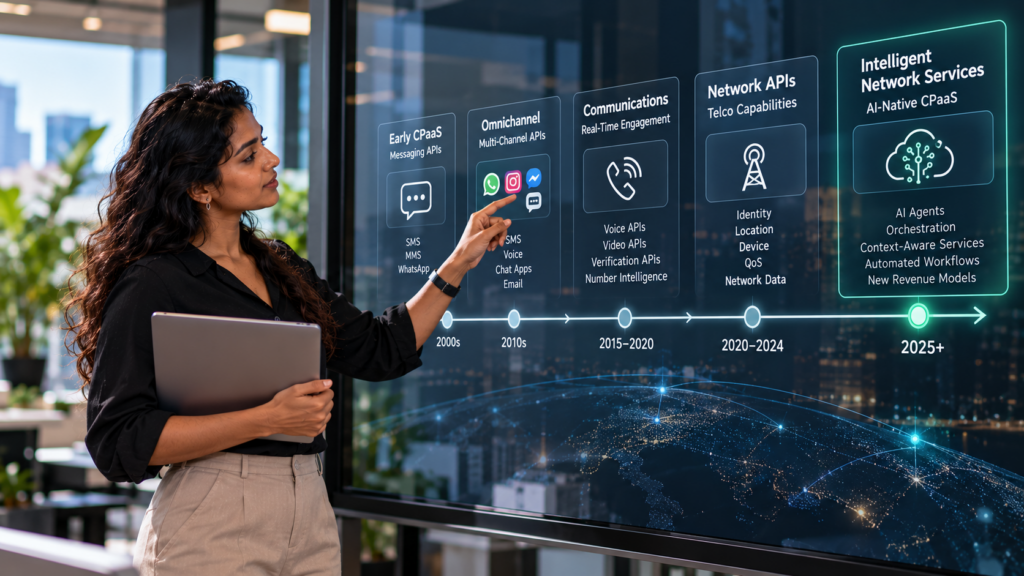
The evolution of CPaaS can be summarized through three broad stages.
The first made communication channels programmable.
The second expanded those APIs into a broader network capability portfolio.
The third makes those capabilities easier for intelligent systems to understand, discover, combine, and use.
Messaging remains essential throughout.
It simply becomes part of a much wider value proposition.
The operator is no longer selling only an SMS API.
It is exposing pieces of the network as reusable digital services.
The platform is no longer only transporting communications.
It is helping applications access telecom capabilities.
The developer is no longer the only consumer.
AI systems and agents can increasingly participate.
AI CPaaS represents this next stage by combining structured telecom service exposure, platform monetization, partner enablement, governance, and an AI-ready service layer.
The attached hSenid Mobile framework describes the ultimate objective clearly: help operators move beyond connectivity and transform existing network capabilities into revenue-generating engines for digital and AI-driven services.
The Next Generation of CPaaS Has Already Started
CPaaS is not abandoning its roots.
Messaging APIs will continue to matter.
Voice will continue to matter.
OTP will continue to matter.
What is changing is the scope of the platform around them.
More network capabilities can become programmable.
More partners can consume them.
More commercial models can support them.
More workflows can combine them.
More AI-driven systems can potentially discover them.
More of the network can become part of the digital economy.
That is the evolution operators should prepare for.
The competitive question is no longer simply:
“Do we have communication APIs?”
It is becoming:
“Can developers, enterprises, partners, and intelligent applications easily discover and consume the capabilities inside our network?”
Operators that answer yes can move beyond traditional communications enablement.
They can build ecosystems.
They can increase asset utilization.
They can create new API revenue.
They can reduce dependence on custom integration.
They can position their infrastructure as a programmable layer for the next generation of digital applications.
The evolution from messaging APIs to intelligent network services is not simply another technical upgrade.
It represents a new commercial model for telecom.