
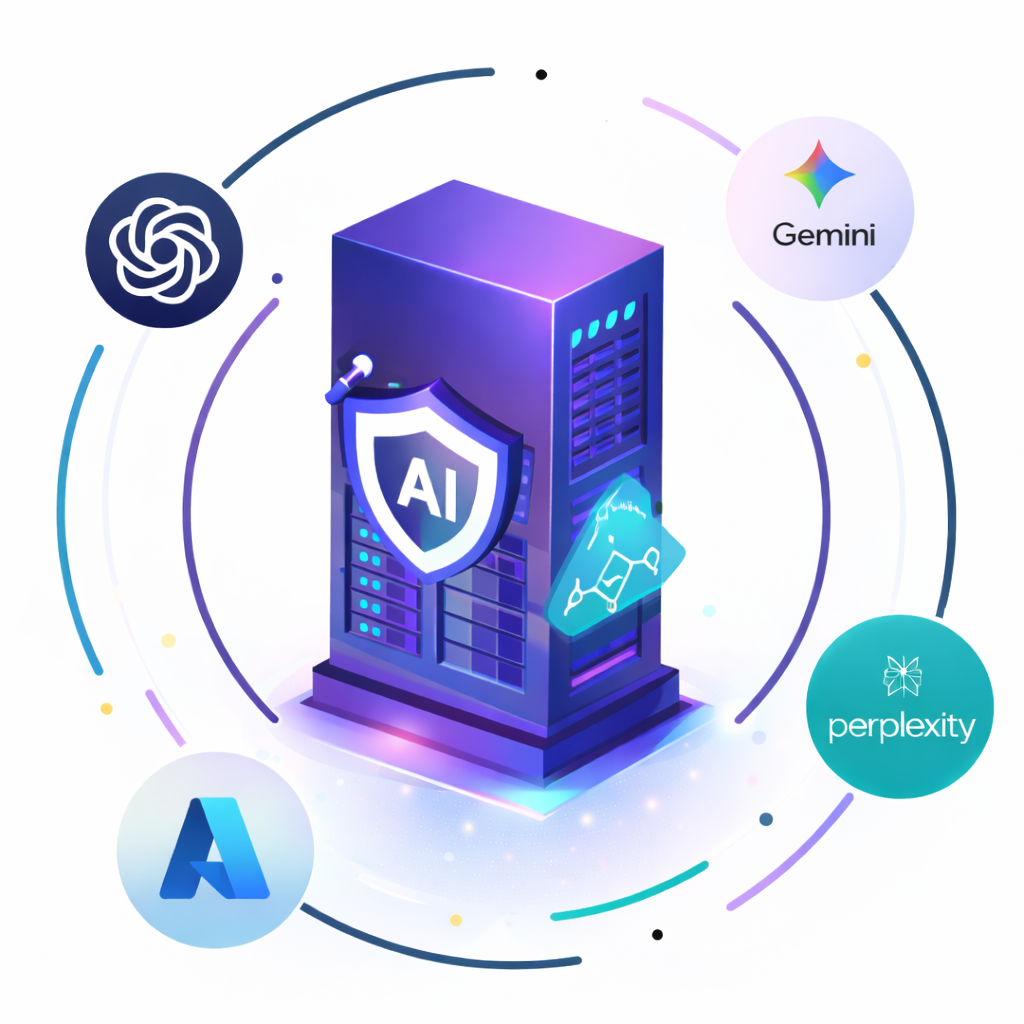
Walk into any large company right now and ask five teams how they’re using AI. You’ll probably get five completely different answers.
Marketing is using ChatGPT or Jasper to write content. Sales teams are experimenting with Salesforce Einstein. HR might be screening CVs with tools like HireVue or even simple GPT workflows. Developers are using GitHub Copilot. Someone in product is testing Claude or running an open-source model like LLaMA locally.
These aren’t niche tools. These are the most widely used ones right now.
ChatGPT alone has hundreds of millions of users and dominates AI usage globally . Microsoft Copilot has already crossed 20 million paid enterprise users, with companies rolling it out to tens of thousands of employees at once . Google Gemini, Claude, and Copilot are now standard tools inside many organizations.
Sounds innovative, right? It is… at first.
But give it a few months and things start getting messy. Costs spike. Data risks creep in. Nobody really knows who’s using what, or how much it’s costing. That’s when leadership starts asking uncomfortable questions.
This is exactly where the idea of an Enterprise AI Gateway starts to matter.
The Rise of “DIY AI” Inside Enterprises
AI adoption rarely starts with a centralized plan. It starts with curiosity.
A developer experiments with an API. A marketer signs up for a tool. A team finds a shortcut using a model. And suddenly, AI is everywhere.
The problem is, it spreads faster than governance.
According to McKinsey, around 55% of organizations have already adopted AI in at least one business function. But only a small portion of them have enterprise-wide governance in place.
That gap is where trouble begins.
Because when every team builds AI their own way, you don’t get innovation alone. You get fragmentation.
What Actually Breaks First
Let’s not overcomplicate this. The issues show up pretty quickly.
1. Data starts leaking in ways you don’t notice
One employee uploads a contract into a public LLM. Another pastes customer data into a chatbot.
It doesn’t feel like a breach. But it is.
As highlighted in the Sovereign AI guide, employees often use external AI tools without visibility, which can expose sensitive enterprise data without realizing it .
And here’s the uncomfortable part. Blocking tools doesn’t fix it. People will find workarounds.
2. Costs quietly spiral out of control
AI pricing isn’t simple. It’s usage-based. Tokens, API calls, compute hours.
Now imagine multiple teams using different vendors, different models, and shared API keys.
Suddenly:
- Finance can’t track spend properly
- Teams don’t know their own budgets
- Leadership gets surprised by invoices
The same guide points out that token-based pricing and shared access make cost tracking extremely difficult across departments .
3. Duplicate work everywhere
This one is subtle but expensive.
Two teams build similar chatbots. Three teams test different summarization tools. Nobody shares learnings.
You end up paying multiple times for the same outcome.
4. Security risks go beyond data
Modern AI tools aren’t just chatbots anymore. Many are agent-based.
They can:
- Execute commands
- Access files
- Browse the web
Now imagine employees installing these tools locally without controls.
That’s not experimentation anymore. That’s a security incident waiting to happen.
The Hidden Infrastructure Problem
Here’s something most teams don’t think about early.
AI isn’t just about models. It’s about where and how they run.
You need:
- Scalable compute
- Containerized environments
- Secure deployment pipelines
This is where Kubernetes consulting services and enterprise Kubernetes platform consulting quietly become critical. Because without a solid foundation, AI projects don’t scale. They stall.
And when organizations try to fix this later, it costs way more.
Why Centralization Feels Hard (But Is Necessary)
At some point, leadership realizes the chaos.
The natural reaction is to centralize AI.
But teams resist.
Why?
Because they don’t want to lose flexibility. They don’t want to wait for approvals. They don’t want a “slow IT layer” blocking innovation.
So the goal isn’t to control everything.
It’s to guide it.
That’s a big difference.
Enter the Enterprise AI Gateway
This is where things start to make sense.
An Enterprise AI Gateway doesn’t replace AI tools. It sits in between.
Think of it as a smart layer that:
- Routes requests to the right model
- Applies security policies
- Tracks usage and cost
- Enforces governance without blocking innovation
Instead of every team connecting directly to AI providers, everything flows through a controlled system.
And that changes everything.
What This Looks Like in Practice
Let’s break it down without making it too theoretical.
Smart routing of AI workloads
Different teams need different models.
- Legal might need high-accuracy document analysis
- Marketing needs fast content generation
- Product teams may need open-source experimentation
A centralized layer can route each request to the best model, whether it’s on-prem, cloud, or external APIs.
Exactly like the Sovereign AI architecture suggests, where requests are routed across multiple models depending on sensitivity and use case .
Built-in privacy before data leaves
This is a big one.
Instead of trusting users to “be careful”, the system enforces it.
- Data masking
- Redaction
- Policy checks
So even if someone sends sensitive input to a third-party model, it’s protected.
Real cost visibility
No more guessing.
You can:
- Track usage by team
- Set budgets
- Apply limits
- Generate reports
Which means finance finally gets clarity.
Safe environments for experimentation
Teams still want to try new tools. That doesn’t go away.
But instead of running risky tools on local machines, you provide sandboxed environments.
Controlled, monitored, safe.
Where OpenShift and Automation Come In
Now, this layer doesn’t run on thin air.
To make it work at scale, companies rely on platforms like OpenShift.
That’s why working with the best OpenShift consulting company or a strong OpenShift migration partner becomes relevant. Especially if you’re modernizing legacy systems while introducing AI.
Because:
- AI workloads need container orchestration
- Security policies need enforcement at platform level
- Scaling requires automation
And this is where Ansible automation consulting and OpenShift managed services help reduce operational overhead.
You don’t want your AI team worrying about infrastructure.
The Cost Side No One Talks About Enough
Everyone talks about AI ROI.
Very few talk about AI waste.
Gartner estimates that up to 30% of AI projects fail due to poor governance and lack of scalability.
That’s not a technology problem. That’s an architecture problem.
Without cost control, usage monitoring, and optimization, enterprises overspend without realizing it.
This is where OpenShift cost optimization and proper governance layers make a difference. Not in theory, but in actual monthly bills.
So… What Happens If You Don’t Fix This?
Let’s be blunt.
If every team keeps building AI their own way:
- You lose control over data
- Costs become unpredictable
- Security risks increase
- Innovation slows down eventually
It feels fast in the beginning. But it doesn’t scale.
And scaling is what actually matters.
The Smarter Way Forward
You don’t need to stop teams from using AI.
You just need to stop them from doing it in isolation.
A centralized approach with an Enterprise AI Gateway gives you:
- Flexibility without chaos
- Innovation without risk
- Visibility without micromanagement
And honestly, that balance is what most enterprises are struggling to get right today.
Final Thoughts
AI is not slowing down. If anything, it’s getting more embedded into daily workflows.
The real question is not whether teams will use AI.
It’s whether your organization is ready to handle how they use it.
If not, things break quietly first. Then all at once.
To explore how enterprise-ready AI platforms can help you scale securely while keeping full control over cost and data, visit Sovereign AI.