
Financial institutions are moving quickly to explore generative AI for document processing, customer service, compliance research, fraud investigation, internal knowledge search, and lending operations. The opportunity is substantial, but so is the responsibility.
Banks, insurers, fintech companies, and other financial organisations work with highly sensitive customer and transactional data. They also operate under strict regulatory, security, and audit requirements. Introducing AI without clear controls can create risks that traditional application governance was never designed to manage.
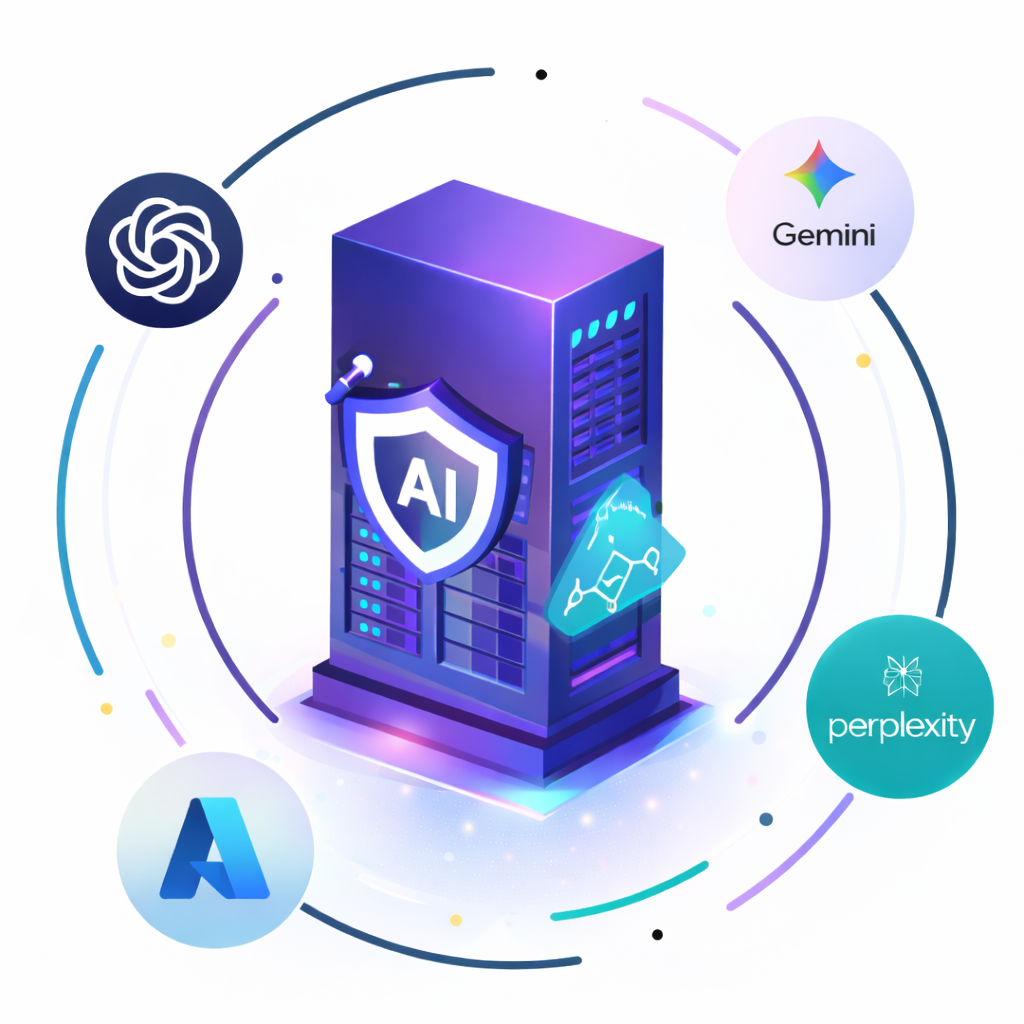
An AI Governance Gateway provides financial institutions with a practical way to control how AI models are accessed, what data they receive, how employees use them, and what happens when AI becomes part of a business workflow.
Financial AI Needs More Than a Good Model
Selecting the right large language model is only one decision in a much larger architecture.
A bank might use AI to analyse loan applications, summarise compliance documents, answer internal policy questions, or investigate unusual transactions. Each workflow has different data, risk, and decision-making requirements.
A loan-processing system may access customer identity information and financial records. An internal research assistant might only use approved public reports. A compliance assistant may retrieve confidential policies that should only be visible to authorised employees.
Treating all these interactions in the same way creates unnecessary risk.
Enterprise AI governance allows financial institutions to define different policies for different workflows, users, data types, and models.
Sensitive Data Cannot Flow Freely Into AI Models
AI data privacy is one of the biggest concerns for financial institutions adopting generative AI.
Employees can easily copy customer information, account details, internal reports, or transaction data into external AI tools if proper controls are missing. Once AI adoption spreads across departments, identifying where sensitive information is being processed becomes much harder.
This is where AI data sovereignty becomes important.
Financial institutions need the ability to determine where information is processed and whether a workload should use an external model, private cloud deployment, or locally hosted LLM.
An AI Governance Gateway can enforce those decisions before data reaches a model.
Personally identifiable information could be masked before external processing. Highly sensitive workloads could remain inside the institution’s infrastructure. Lower-risk tasks could use approved external models.
Governance becomes an active technical control rather than simply a written policy.
Shadow AI Creates a Visibility Problem
Employees often adopt useful AI tools faster than enterprise governance frameworks can catch up.
A marketing department might subscribe to one AI service. Developers may use another. Analysts could upload documents into public tools. Different teams may build separate integrations with OpenAI, Gemini, Claude, or other providers.
This creates shadow AI.
Effective Shadow AI prevention starts with providing employees with approved, practical alternatives while giving technology teams visibility into AI activity.
Centralising model access makes AI usage monitoring easier. Financial institutions can understand which models are being used, which applications are generating requests, and which departments are consuming the most resources.
That visibility supports security, compliance, and financial control at the same time.
Every AI Interaction Should Be Traceable
Financial institutions are accustomed to audit trails.
AI should not become an exception.
If AI contributes to a compliance workflow, document assessment, internal recommendation, or customer-related process, organisations need to understand what happened.
Who initiated the interaction? Which model processed it? What information was provided? What policy was applied? What output was generated? Was a human required to approve the next action?
An AI Governance Gateway can provide a central layer for logging these interactions.
This becomes especially important as financial institutions move from AI assistants toward agentic AI systems that can retrieve information, call APIs, update systems, or initiate processes.
The more AI can do, the more important traceability becomes.
Governance Must Define What AI Is Allowed to Decide
Generative AI governance should not focus only on which tools employees can access.
It should also define the limits of automation.
Consider loan document analysis.
AI might extract application information, compare documents, identify inconsistencies, and flag potential risk signals. That does not necessarily mean the AI should approve or reject the loan.
The institution can establish a policy where routine information processing is automated while higher-risk decisions remain with authorised employees.
The same principle can apply to KYC, compliance reporting, fraud investigation, and internal policy interpretation.
Human oversight should be based on business risk rather than added randomly after the system has been built.
Financial Institutions Need Strong Enterprise LLM Security
Large language models introduce security challenges that go beyond standard user authentication.
An AI system may retrieve internal documents, process confidential information, interact with APIs, or execute actions through connected enterprise applications.
Enterprise LLM security therefore requires controls around model permissions, user access, retrieval sources, sensitive data, tool execution, and workflow boundaries.
An employee using an internal policy assistant should only retrieve information they already have permission to access.
An AI agent assisting with customer onboarding should not automatically gain access to unrelated banking systems.
Each AI workflow should operate with only the permissions required for its purpose.
Multi-Model AI Needs Central Control
Financial institutions are unlikely to rely on one AI model forever.
Different workloads may require OpenAI, Gemini, Claude, Llama, DeepSeek, or locally hosted models.
A model-agnostic architecture makes it easier to adapt as capabilities, pricing, and regulatory requirements change.
AI model routing can direct each request based on factors such as capability, data sensitivity, cost, latency, or deployment policy.
This also strengthens LLM cost management.
A simple classification task may not need an expensive reasoning model. A complex compliance analysis might.
Central governance allows the institution to balance performance, risk, and cost without rebuilding every workflow around a different provider.
Sovereign AI Brings Governance and Deployment Together
For financial institutions, Sovereign AI is ultimately about maintaining control while benefiting from modern AI.
It enables organisations to determine where models run, where sensitive data remains, which models can access specific workloads, and how AI activity is monitored.
An AI Governance Gateway becomes an important part of this architecture because it creates a governed point between enterprise systems and AI models.
Instead of allowing uncontrolled model access, the institution can apply consistent security, privacy, routing, monitoring, and audit policies across AI workloads.
This makes expansion easier too.
A bank might begin with internal policy Q&A, prove the governance model, and then expand into KYC, document intelligence, compliance automation, or lending workflows.
Governance Makes AI Easier to Scale
Financial institutions do not need less AI innovation. They need a safer way to expand it.
Without governance, every new AI project can introduce another model connection, another security review, another data concern, and another potential blind spot.
With an AI Governance Gateway, institutions can create reusable controls that support multiple teams and workflows.
That changes governance from a barrier into an enabler.
Teams can innovate because the boundaries are clear. Security teams gain visibility. Compliance teams gain traceability. Technology leaders maintain control over models and costs.
For financial institutions, that foundation is essential if AI is going to move beyond experimentation and become part of everyday operations.