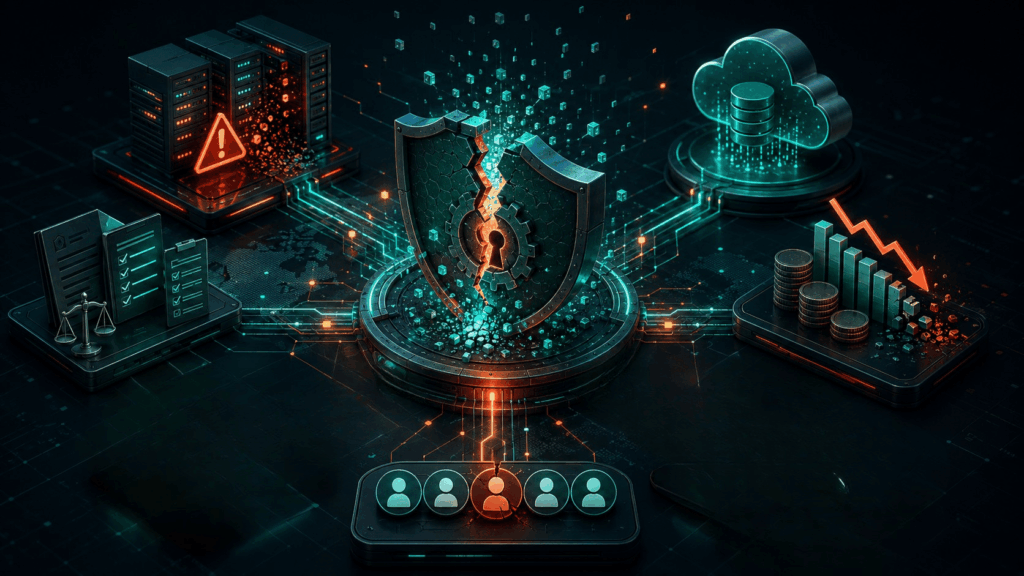
When people hear about a data breach, they often focus on the ransom demand or the immediate technical cleanup. In reality, the ransom is often only one visible line item in a much larger business crisis that can include downtime, customer churn, reputational erosion, legal exposure, regulatory scrutiny, and prolonged recovery work.
IBM’s Cost of a Data Breach research has repeatedly shown that the financial impact of a breach extends well beyond initial incident response. The 2025 report notes that the global average cost of a data breach remains substantial, while the 2024 reporting cycle highlighted how disruption and lost business continue to drive total costs higher.
That is why cybersecurity should be framed as a business resilience investment, not a discretionary IT expense. The cost of prevention is usually far lower than the compound cost of detection delays, operational outages, legal response, and damaged trust after an incident.
The first bill is rarely the biggest one
A ransomware payment or emergency forensic engagement may be the first cost leaders see, but it is rarely the full story. Breach costs typically unfold in waves: investigation, containment, legal review, customer notifications, infrastructure recovery, regulatory response, insurance negotiations, and business rebuilding.
IBM’s long-running research breaks breach impact into categories such as detection and escalation, post-breach response, notification, and lost business. Lost business is especially important because it captures the costs that do not always appear on a single incident invoice, such as service interruption, customer turnover, delayed deals, and reputation damage.
This is why the phrase “we paid the ransom and moved on” is usually misleading. Even where systems are restored, the organization may still face months of operational drag, strained customer relationships, and higher oversight from regulators and auditors.
Downtime is a revenue problem, not just an IT problem
One of the most underestimated breach impacts is downtime. When critical systems are unavailable, employees cannot work normally, customers cannot access services, partners may suspend transactions, and internal teams shift from growth work to emergency recovery.
The cost of disruption can accumulate quickly. A Forbes Insights report on the reputational impact of IT risk noted that lost revenues, downtime, and restoration costs can accrue at very high rates even for what organizations might first consider a minor disruption.
IBM’s breach reporting also connects faster identification and containment with lower overall cost, reinforcing the idea that every extra day of disruption has a financial multiplier effect. The longer an attacker remains in the environment, the more systems may be affected, the more records may be exposed, and the harder it becomes to restore operations cleanly.
For business leaders, the lesson is simple: an outage caused by a breach is not only a technical incident. It is also a productivity event, a customer service event, and in many sectors a direct revenue event.
Reputation damage lasts longer than the headlines
Reputation damage is harder to measure than a ransom payment, but it often lasts much longer. Customers may not leave immediately after a breach, yet trust weakens when people feel their data was not adequately protected or when they believe the organization handled the incident poorly.
IBM’s analysis has linked customer trust and churn directly to breach costs. In its 2018 findings, organizations that lost more customers after a breach incurred materially higher average total breach costs, while companies that took visible trust-preserving actions reduced those losses.
That pattern still matters today because modern breaches are public, searchable, and often amplified through media coverage, social media, and mandatory disclosures. Even after systems are restored, procurement teams, investors, and customers may continue to ask how the incident happened and what has changed since then.
Reputational harm also affects future revenue, not just current accounts. Sales cycles may slow, prospects may demand stronger contractual guarantees, and partners may treat the organization as a higher-risk vendor.
Regulatory and legal fallout keeps expanding
Another hidden cost comes from compliance and disclosure obligations. Depending on the jurisdiction and industry, a breach can trigger regulator notifications, formal investigations, documentation demands, outside counsel costs, audit work, and potential fines.
For public companies in the United States, the SEC has emphasized the importance of timely and accurate disclosure of material cybersecurity incidents and cyber risk management practices. That means breach handling is now closely tied not only to IT and legal teams, but also to executives, investor relations, and board oversight.
For organizations subject to privacy regimes such as GDPR and sector-specific rules, the financial exposure may extend beyond remediation into penalties and enforced corrective action. Even where a fine is avoided, the time and cost required to respond to regulators can be substantial.
Legal exposure can also continue long after the initial event. Contract disputes, class actions, customer claims, and third-party recovery costs may outlast the technical remediation phase by months or years.
Lost customer trust has compounding effects
Customer trust is not just a public relations concept. It influences retention, renewal, cross-sell potential, brand referrals, and how much friction customers are willing to tolerate during recovery.
After a breach, even customers who stay may change their behavior. They may reduce data sharing, delay onboarding new services, insist on extra reviews, or move high-value workloads to a competitor they perceive as safer.
This trust erosion is dangerous because it compounds over time. A breach can weaken confidence just as the organization is trying to recover revenue, and that timing makes the commercial impact worse than the initial incident cost alone.
The organizations that recover best usually communicate clearly, show measurable improvements, and demonstrate accountability through leadership, transparency, and security upgrades. IBM’s earlier analysis found that customer-protection measures and senior leadership involvement helped reduce churn-related losses after breaches.
Why proactive security is an investment
The strongest argument for proactive security is not fear. It is economics. Breach costs rise when organizations are slow to identify intrusions, lack tested response capabilities, and allow security debt to accumulate until a crisis forces emergency spending.
Preventive investment changes that equation. Strong identity controls, monitoring, segmentation, backup resilience, employee awareness, vendor risk management, and rehearsed incident response reduce both the likelihood of a breach and the cost if one occurs.
This is why boards and executives should evaluate cybersecurity the same way they evaluate insurance, continuity planning, and operational resilience. Security spending protects uptime, revenue, customer confidence, and regulatory posture, all of which are business assets rather than purely technical concerns.
A useful way to explain this to non-technical stakeholders is that proactive security buys options. It gives an organization more time to detect abnormal behavior, more control over containment, more credibility with customers, and a better chance of avoiding the expensive cascade that follows a major breach.
Practical points to emphasize in the article
To keep the article grounded, the following business impacts are worth highlighting:
- Immediate costs: forensics, containment, legal review, notifications, restoration, and crisis communications.
- Operational costs: downtime, delayed projects, productivity loss, and emergency technology replacement.
- Commercial costs: churn, slower sales, lost renewals, brand damage, and reduced partner confidence.
- Compliance costs: regulator engagement, disclosure obligations, audits, and potential penalties.
- Strategic costs: management distraction, postponed innovation, and long-term erosion of trust.
The core message is clear: the hidden costs of a data breach often outweigh the ransom itself. Organizations that invest early in prevention, detection, response readiness, and trust-building usually spend less overall than those that wait until an incident forces them to react under pressure.
Protect your business, data, and critical systems with reliable cybersecurity solutions designed to reduce risks and strengthen resilience.
Explore Cybersecurity Solutions