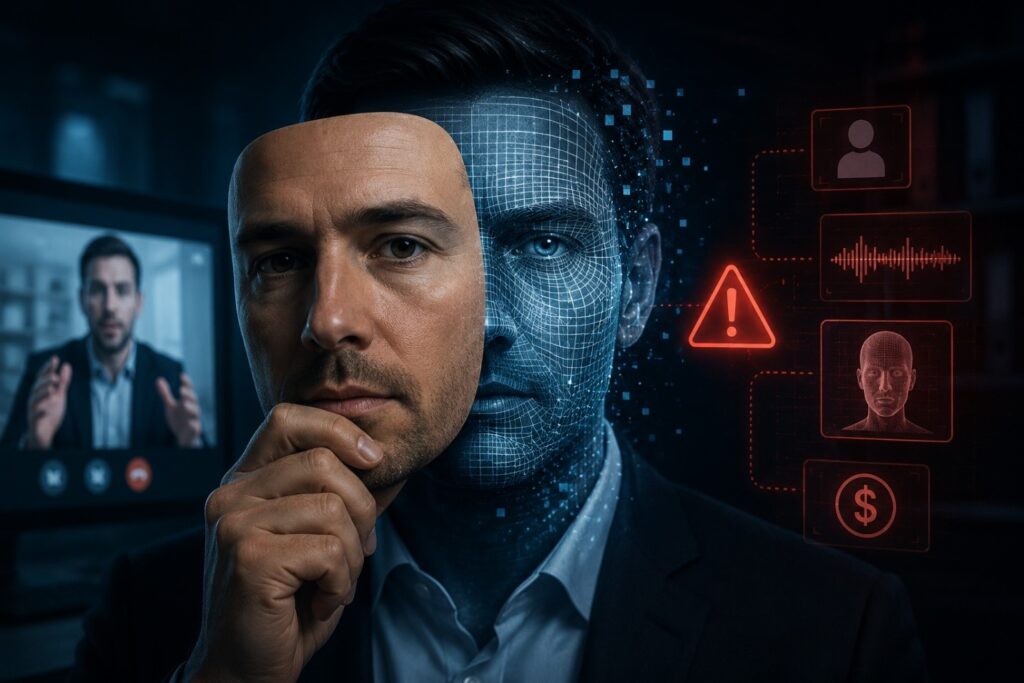
The era of relying on bad grammar and generic greetings to spot a scam is officially over. Today, enterprise fraud has evolved from basic phishing emails into hyper-realistic, AI-generated synthetic identities. Attackers are weaponizing deepfake video and AI voice cloning to bypass human judgment and corporate defenses, turning everyday business communications into high-stakes vulnerabilities.
The Scale of the Synthetic Threat
Artificial intelligence has fundamentally changed the speed and quality of cyberattacks. AI-powered scams surged a staggering 1,210% in 2025 alone. This rapid acceleration is driven by how accessible the technology has become. It no longer takes a team of experts months to craft a fake identity; it only requires a text prompt or a single image.
- The Three-Second Rule: Fraudsters need just three seconds of audio to create a voice clone with an 85% accuracy match.
- The Indistinguishable Threshold: Voice cloning technology has reached a point where human listeners can no longer reliably distinguish an AI-cloned voice from a genuine one.
- A Sixfold Jump: Deepfake identity fraud is on track to increase nearly 500% in 2026 compared to the previous year.
Case Study: The $25.6 Million Deepfake Meeting
The financial exposure from a single AI-driven attack can reach into the tens of millions of dollars. In a landmark case that shook the corporate world, a multinational firm in Hong Kong lost $25.6 million after an employee fell victim to a highly sophisticated deepfake scam.
The attack began with an email purportedly from the company’s UK-based Chief Financial Officer requesting a “secret transaction”. When the employee grew suspicious, they were invited to a video conference call. The meeting appeared entirely legitimate, featuring the CFO and several other recognizable colleagues.
However, every single participant on that call, except the targeted employee was an AI-generated deepfake recreation. Convinced by the fabricated meeting environment, the employee executed 15 separate transfers to five different bank accounts.
Why Legacy Defenses Are Failing
Most cybersecurity awareness training programs were built to address email-based threats, leaving organizations completely unprepared for real-time deepfake impersonations. Because voice and video carry inherent authority, these synthetic attacks easily bypass the skepticism that employees have developed toward traditional phishing. Furthermore, detection technology is struggling to keep pace, degrading faster than it can be updated against new AI cyberattack variants.
How Enterprises Can Fight Back
To navigate this evolving landscape of digital trust, organizations must adopt a layered defense strategy that addresses both the human and technical elements of the threat.
- Mandatory Out-of-Band Verification: No wire transfer or access authorization should be executed based solely on a phone call or video meeting. A secondary verification step through a trusted, independent channel must be required.
- Zero-Trust Voice Architecture: Assume no communication channel is inherently trustworthy. Treat all voice communications as unverified until independently validated, regardless of the caller ID.
- Behavioral Detection Systems: Deploy Network Detection and Response (NDR) and Identity Threat Detection and Response (ITDR) systems to catch anomalous network and data-flow patterns that traditional content-based security tools miss.
- Deepfake Simulation Training: Expose employees to realistic AI vishing and deepfake scenarios to build the human judgment layer that technology alone cannot supply.
As scammers continue to refine their enterprise-grade fraud infrastructure, the threat of synthetic identities is no longer a niche concern, it is a core business risk. By modernizing verification protocols and recognizing that every video call and voice message is potentially suspect, businesses can protect their assets against the next generation of AI-driven deception.
Protect your business, data, and critical systems with reliable cybersecurity solutions designed to reduce risks and strengthen resilience.
Explore Cybersecurity Solutions