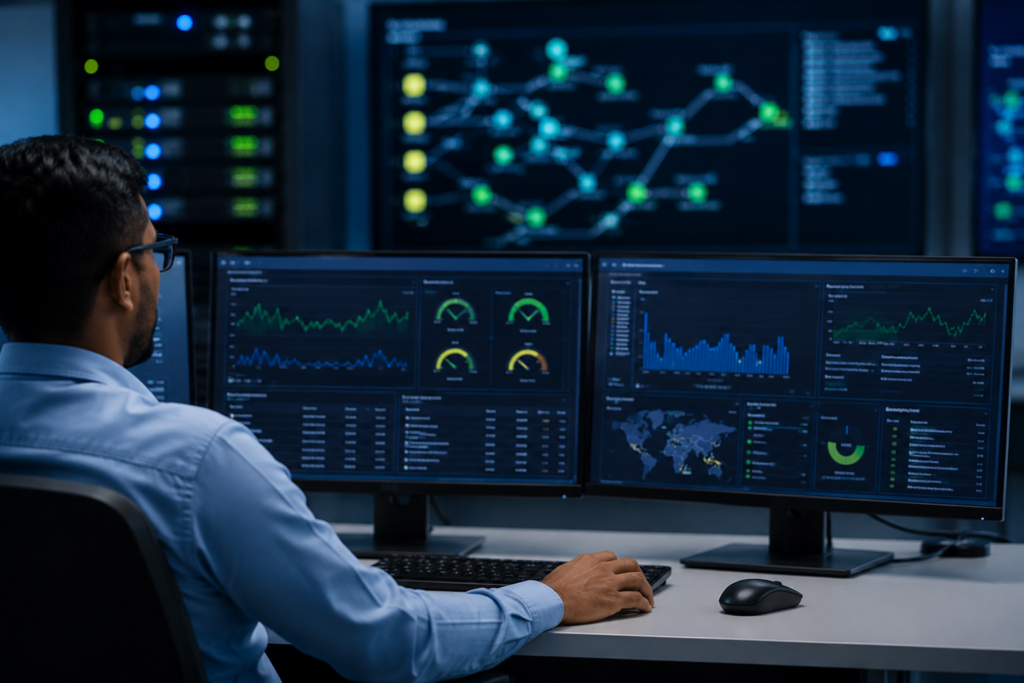
USSD services can look simple from the subscriber’s side, but the infrastructure behind them is anything but simple. A single session may depend on signaling systems, application servers, databases, charging platforms, wallets, and third-party services. When one component slows down, the impact can spread quickly. Predictive AIOps can help operators identify those warning signs earlier, before subscribers begin experiencing failed sessions or slow responses.
For a USSD Service Provider, this creates an opportunity to move from reactive troubleshooting toward proactive service assurance.
Why USSD Bottlenecks Are Difficult to Spot
Not every performance problem begins with a complete outage.
A database may gradually consume more memory. A backend API may start responding more slowly. An application could experience unusual traffic growth. Session durations may increase before failures become visible.
Traditional monitoring can detect many of these issues once predefined thresholds are crossed, but that may happen after customer experience has already started to decline.
hSenid’s USSD roadmap includes AIOps capabilities such as root cause analysis, abnormal behavior alerts, revenue risk identification, and automated analysis across application and infrastructure layers.
Predictive AIOps can build on these signals to help operations teams recognize developing bottlenecks earlier.
Learning What Normal USSD Performance Looks Like
One of the advantages of AI-driven monitoring is its ability to analyze patterns over time.
Instead of looking only at a single traffic threshold, AI can examine application traffic, session behavior, infrastructure performance, and historical usage patterns.
A sudden traffic increase may be normal during a promotion. The same increase at an unusual time may deserve investigation.
The hSenid roadmap includes tracking application traffic and peak usage patterns, particularly around wallet and payment integrations.
For a Best USSD solution, understanding context can be just as important as identifying high traffic.
Detecting Bottlenecks Across the Service Chain
A USSD bottleneck can appear almost anywhere.
The gateway may be processing more sessions than usual. A connected database could become slow. A wallet service may respond inconsistently. An application server may have insufficient memory.
The hSenid roadmap specifically identifies AI-assisted root cause analysis for problems such as database failures and insufficient memory at infrastructure and application levels.
This matters because the visible symptom is not always the real cause.
Subscribers may experience delayed menus, but the USSD gateway itself may be healthy. The actual problem could sit in a downstream application.
Predictive analysis can help operators connect those signals faster.
Protecting High-Volume USSD Services
Traffic capacity becomes especially important for services used at scale.
hSenid’s USSD platform documentation states that the platform can handle more than 45 million transactions per day and up to 15,000 transactions per second.
Capacity alone, however, does not remove the need for monitoring.
A USSD gateway for mobile money may experience sharp demand during salary periods, bill-payment deadlines, or promotions. Predictive monitoring can help distinguish expected peaks from abnormal patterns that could create resource pressure.
For a USSD service provider in Africa, this is particularly relevant where mobile money and essential digital services can generate substantial transaction volumes.
Session Patterns Can Reveal Problems Early
USSD session management provides another useful source of operational signals.
hSenid’s gateway handles session initiation, management, termination, and session resumption after certain unexpected timeouts.
Changes in session behavior can sometimes indicate developing performance problems.
If average session times begin increasing or more sessions require recovery, operations teams may have an early sign that a connected system is becoming slower.
For organizations evaluating the Best USSD provider for fintech, this visibility can be especially valuable because payment journeys depend on consistent and timely session handling.
Predictive AIOps Can Help Protect Revenue
A technical bottleneck is not only an operational issue. It can become a revenue issue.
If transactions begin failing on a high-value service, operators may lose revenue before the underlying technical problem becomes severe enough to trigger a traditional outage alarm.
The hSenid roadmap includes ML-based revenue risk identification designed to flag applications that may be losing revenue or showing unusual risk patterns.
This becomes even more important when USSD billing integration is involved.
hSenid’s USSD Gateway supports request-based and session-based charging and can integrate with an operator’s existing charging systems.
Combining technical performance data with commercial signals can give operators a clearer picture of which issues require immediate attention.
AI Can Support Safer Operational Decisions
Finding a bottleneck is one thing. Fixing it safely is another.
The hSenid roadmap includes an Autopilot capability for automated analysis that can perform checks before commands or changes are executed. It also mentions impact simulation and AI-based testing for bottlenecks and system changes.
This could help operations teams evaluate potential actions before making changes to a live environment.
Instead of reacting immediately to an alert, teams can gain more context about possible causes and likely impact.
From Reactive Monitoring to Predictive Operations
A modern USSD Service Provider needs more than dashboards showing what has already gone wrong.
Predictive AIOps can help operators identify abnormal traffic, emerging infrastructure constraints, session issues, and revenue risks earlier. It can also assist teams in understanding root causes before those problems become subscriber-visible failures.
The subscriber may only see a simple text menu. Behind that menu, however, multiple systems must perform reliably at the same time.
Predictive AIOps helps operators keep those systems healthy before customers notice anything is wrong.